The Architecture of Displacement: A South Wales Case Study on Walled Gardens
Platforms must be forced to state explicitly and unambiguously that content is permanently at risk. The current user agreement model hides reality behind legalese.
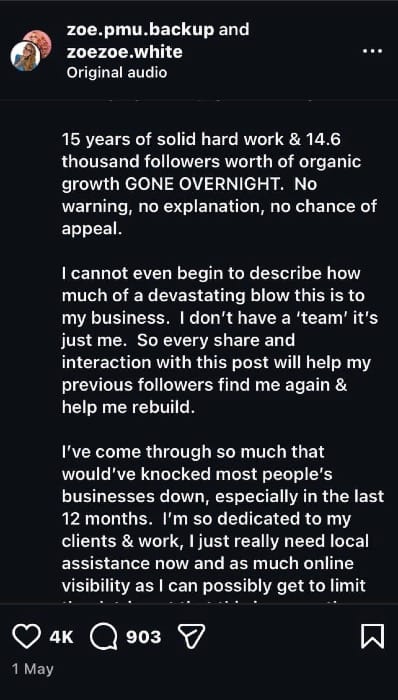
There is a distinct vulnerability in building a livelihood on soil you do not own. When a platform changes its algorithm, its policy, or its ownership, the digital architecture we treat as permanent can vanish overnight without an avenue for appeal. This reality hit incredibly close to home recently. Based here in Cardiff, we have been in touch with Zoe, an independent business owner operating just down the coast in Swansea. Zoe’s experience is not an isolated incident; it is a textbook case study in the systemic risks inherent in modern platform dependency.
The Disappearance of Zoe’s Digital Footprint
Based on Zoe’s account, her business presence was severed instantly, with years of built-up content, client communication, and community visibility erased by a automated platform decision. For an independent business, an Instagram account is rarely just a gallery; it is the front door, the reception desk, and the primary line of communication.
When these algorithmic purges occur, they do so without nuance or human oversight. A business can follow every stated rule, yet still find itself classified as "non-compliant" by an unaccountable system. The immediate fallout isn't just a loss of 'likes', it is a catastrophic disruption to operational infrastructure, severing the link between a local creator and the community that sustains them.
The Resilience of Swansea’s Indie Infrastructure
A look into Zoe’s business profile reveals the exact kind of enterprise that forms the backbone of the South Wales independent scene. Driven by personal craft, local reputation, and direct client relationships, businesses like Zoe's are agile, but highly reliant on predictable digital discovery.
So, when a centralised hub fails, the immediate priority is migration to stable ground. Zoe has successfully re-established her operational base, moving her core infrastructure outside the volatile ecosystem that initiated the purge.
The Walled Garden Deception: Two Essential Structural Shifts
Zoe’s situation highlights a critical structural flaw in how contemporary social media operates. If we are to safeguard creative and commercial autonomy, two principles must become standard practice:
1. Transparent Risk Warnings
Platforms must be forced to state explicitly and unambiguously that content is permanently at risk. The current user agreement model hides reality behind legalese. Users should be under no illusion: you are a tenant, not an owner. If a platform reserves the right to evict an asset without notice, that vulnerability must be front-and-centre on every dashboard, allowing businesses to plan for volatility instead of being blindsided by it.
2. Sovereign Infrastructure and Federated Distribution
Relying on a single broadcasting channel is an existential hazard. True digital resilience requires decentralised distribution:
Sovereign Outlets: The core of your digital footprint—your booking systems, portfolios, and writing—must live on platforms you own and control (such as self-hosted sites or independent nodes).
Cross-Posting and Automated Feeds: Content should never be created solely for one platform. By utilizing cross-posting workflows and RSS feeds, a single piece of media is instantly distributed to multiple independent outlets simultaneously. If one node is cut off, the network remains alive.
Share This Case Study
We are asking our network to share this piece widely. The algorithmic landscape of 2026 is increasingly hostile to independent, unaligned voices. Look at what happened in Swansea not as an anomaly, but as a warning of the structural vulnerabilities built into every corporate garden. Protect your distribution, diversify your channels, and own your infrastructure.
This is an extension of our ongoing activism concerning the inherent hostility of centralised platforms. The failure of Meta’s "blue tick" system—a paid veneer of authenticity that routinely fails to protect independent creators from arbitrary erasure—forces us to fundamentally question the security and integrity of the entire infrastructure.
Naturally, this systemic rot is not unique to Meta. This is a baseline feature of the corporate web; X exhibits identical vulnerabilities, a reality we have well-documented through our own platform experiences in the past. We document Zoe’s case not as isolated tech support, but as a critical diagnosis of a wider corporate hostility toward independent digital life.
STOP READING FOR A SECOND. This node is 100% independent. No tracking. No ads. Powered purely by the Art of FACELESS creative collective and physical print distribution.
ACCESS PROTOCOL:
Drop your email to initialize your node, unlock the rest of this file, and support independent publishing.