Why I Don’t Have Time For Hate
Every time someone demands that everything AI-touched be marked, flagged, branded, they are, without knowing it, which is the whole tragedy, proposing another layer of disadvantage stamped onto disabled people.
Lloyd Lewis, Cardiff, Wales, UK
There’s an industry now. It grew up around a hashtag, and it pays in likes.
Let me tell you where I’m standing before I say anything else, because honesty is the only currency I’ve ever trusted. I’m writing this from Cardiff. I’m Welsh, and I’m disabled. And here’s the thing I need you to sit with. For most of my life I wasn’t disabled. I could see, I could write, I could hold a camera steady and do the work. Then I was disabled, in a major way, in more than one form, one loss stacked on the next. I know both sides of that line. I’ve lived on the comfortable side of it, taking my abilities for granted like everyone does. And I’ve woken up on the other side of it, where the tools you used yesterday don’t fit your hands any more.
That’s the place I’m writing from. Keep it in mind.
We at AOF love walking into platforms as something other than customers. We go in as subversives, as saboteurs, people who treat the wall with the contempt it’s earned. That’s the romance of it. That’s the story we tell ourselves on the good days.
But that is not what is happening out there. Not with the #fuckai tag. Not on Instagram, which is to say not on Meta, which is to say not on a machine built by one of the most extractive companies in human history to harvest your attention and sell it back to you at a markup. Let’s not be coy about whose house this is. You are screaming about authenticity inside a building owned by the man who built the most efficient outrage-delivery system ever made. The platform doesn’t care what you’re angry about. It only cares that you’re angry, because angry stays. Angry scrolls. Angry is the product.
And what gets made there isn’t subversion. It’s performance. Massive followings built on naff little graphics; the smug typographic poster, the hand-drawn sneer, the “no machines were harmed in the making of this art” badge, all designed with the precise self-satisfaction of someone who has never once had to ask whether they could do the thing at all. That smugness reads as ableism. I want to be careful here, because I don’t think most of these people are bigots. It isn’t prejudice. It’s ignorance that manifests as ableism. They’ve simply never had to think about anyone whose hands, eyes, or words don’t work the way theirs do. So they don’t. I didn’t either, once. I get it. But I learned the hard way, and I’m asking you to learn the easy one.
Here is where the ignorance stops being abstract and starts costing people something.
Every time someone demands that everything AI-touched be marked, flagged, branded, they are, without knowing it, which is the whole tragedy, proposing another layer of disadvantage stamped onto disabled people. Because the assistive technology that lets a lot of us function is AI now. That isn’t a hypothetical. That’s June 2026.
Think about who actually uses these tools, and what the “mark it all” crowd is asking them to wear as a scarlet letter:
By the W3C’s own count, most content creators working on accessibility now reach for AI to do it, a near-tripling in two years. This is not the future. It’s the present tense of disabled life. It’s my present tense.
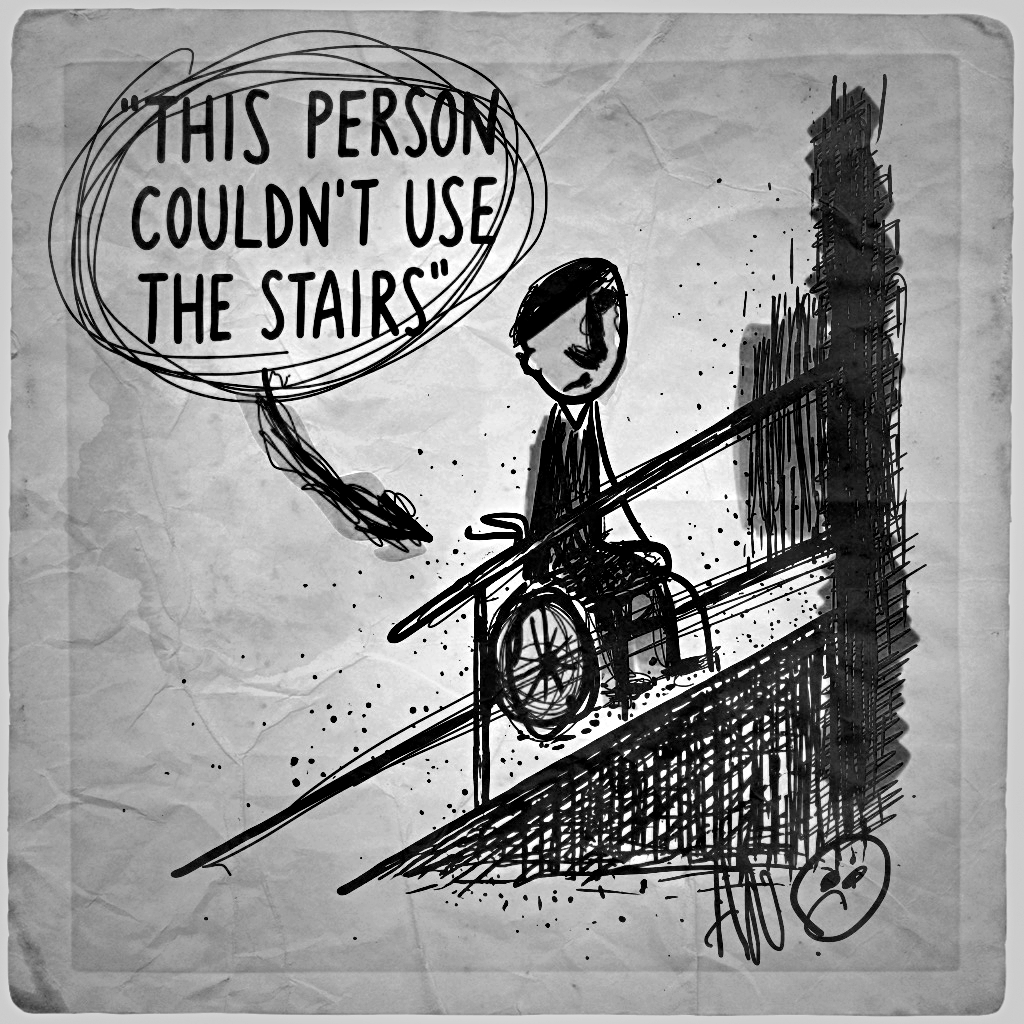
So when the mob says label it, shame it, mark it as lesser, understand what they’re actually saying. They’re saying: the way you compensate for your disability should be visible to everyone, tagged as inferior, so we can sort the “real” artists from the cheats. They’ve taken a wheelchair ramp and decided it needs a flashing sign that says THIS PERSON COULDN’T USE THE STAIRS. They think they’re defending art. They’re building a register.
The online art world has now become something else. It‘s become a pitchfork-wielding mob, hateful, entitled, certain. And entitlement is the right word, because underneath all of it is a belief I have never once been able to afford: the belief that the world owes you a living.
It doesn’t. It never did. Not you, not me, not anyone.
I’ve lost career advantages over and over across my life. Millions of people have. We’ve lost them to tech advances; the thing I could do, the thing I was good at, suddenly automated, outsourced, made cheap. And then I lost more of them to disability, in its different forms: my regular sight, my writing, my photography, each one taken or narrowed in its turn. Every time, the answer was the same and it was never handed to me. Re-purpose. Retrain. Adapt or go under. That has been the entire shape of my survival. There was no grant for it and no applause.
So I have a hard time (a genuinely hard time) taking lectures on purity from people who have never had the ground move under them.
I come from people who were called unskilled.
That word was always a lie. There’s no such thing as unskilled labour, there’s only labour the people in charge decided not to value, because not valuing it was cheaper. Whole communities got that label hung round their necks, and then got axed. Pits, steel, the lot of it, gone, not by accident, but by ideology and Capitalism. By a politics that decided certain lives were a line item. And here’s the part that sticks in my throat: a fair few of the loudest haters now, the ones policing other people’s tools with such righteous heat, come from the same political instinct (or voted for them, repeatedly, across my whole lifetime) that did the axing in the first place. They cheered the market when it came for us. Now it’s come for them, for the illustrator and the designer, and suddenly it’s a moral emergency.
But here’s what I actually want to say to you, and I mean it without a scrap of sarcasm.
Welcome.
"If you have to get up when the alarm clock rings and go out and do a job—and you depend on your earnings, rather than your assets—you are working class... It doesn't matter whether you're blue collar or white collar. And it's not manners or accent. It's where you are in the economic system". Mick Lynch
Mick Lynch put it better than I can. He told a crowd of teachers and rail workers and nurses that the working class is back and what he understood, what the press never wanted to hear, was that the working class isn’t a costume or a postcode or a nostalgia act. It’s a material fact. If you have to work to survive, you are working class. If you don’t have the financial means to support yourself without selling your labour, you are working class. That’s it. That’s the whole definition. The designer who just watched their livelihood get undercut overnight has not been demoted into something shameful, they’ve just discovered, in the hardest possible way, the category they were always in. Many, maybe most, thought they were “working middle class.” There is no such thing. There was only a comfortable distance from the edge, and the edge just moved.
If we dropped that fabricated moniker, that whole carefully maintained fiction of a middle class who are somehow different in kind from the people who clean their offices, collect their rubbish, check out their shopping and serve their coffees, we would remove an enormous amount of the hate overnight. Because the divide is the point. There are politicians and there is a media class who manufacture that division on purpose, because it pays them to. Divide and conquer has always been the most profitable trick in the book. Set the worker against the worker, the abled against the disabled, the “real artist” against the “cheat,” and nobody’s looking up. Create a narrative that distracts and divides. The #fuckai panic is just the newest one off the production line.
And I’ll be blunt about the maths, because I respect you too much to lie: we are not going to win against this level of inequality by hating each other. We can’t. The hate is the inequality, it’s the mechanism, the thing that keeps the people at the bottom too busy fighting sideways to ever look up. Every ounce of rage you spend on a disabled person using a machine to see is an ounce that never reaches the people who actually own the wall, the platform, the policy, the whole rigged board.
So point it up. The real enemy isn’t the tool or the person holding it. It’s the obscene, widening gap between those who have to work to live and the vanishingly small number who own enough that they never will. That’s the one to defeat. Everything else is a magic trick.
That’s why I don’t have time for hate. Not because I’m above the anger, I’ve earned more of it than most of these people will ever know, but because I’ve watched where it goes. Into the machine. Into Meta’s engagement graph. And it lands, every time, hardest on the people least able to take another hit.
But I don’t want to end on a wall. I want to end with a hand held out, because I mean it.
This piece has no comments section you can shout into from a distance. The only way to talk to me is to sign up and comment here, on our ground, in the open. And I welcome that, I want it. Bring me your disagreement. Bring me the argument I haven’t thought of. Tell me where I’m wrong, tell me what it’s like from where you’re standing, and let’s actually look for the solutions together, because there are real ones and they aren’t found by screaming. Do it with grace. Do it with politeness. Do it with a genuine wish to be understood and to understand back, and you will always, always find me (us here at AOF) ready to debate with courtesy and respect.
And if you come to be cruel? If you come carrying prejudice dressed up as principle? We’ll simply delete it. No drama, no debate, no oxygen. You’ll have wasted your own time, and I’ll be honest with you, in the working-class way, plainly, I don’t give a fuck. That door’s not closed. It’s just not yours to kick down.
The rest of you, the ones who’ve just found yourselves standing where I’ve stood, the ones doing the grieving I’ve already done, come in. Sit down. We’ve more in common than they ever wanted you to know.
— Lloyd
STOP READING FOR A SECOND. This node is 100% independent. No tracking. No ads. Powered purely by the Art of FACELESS creative collective and physical print distribution.
Drop your email to initialize your node, unlock the rest of this file, and support independent publishing.
 Amazon.co.ukRead full bio
 YouTube
© 2026 Art of FACELESS. All rights reserved.
The Hollow Circuit™, Hyperstition Architecture™,
The Veylon Protocol™, and Cognitive Colonisation™
are proprietary intellectual property of Art of FACELESS.