The Rage Economy: What the Numbers Actually Say About the Fight on Meta
If the vitriol on Instagram genuinely reflected a mass migration away from the platforms people say they hate, we'd expect to see it in the numbers. We don't.

Art of FACELESS Editorial | Lloyd Lewis, Cardiff, Wales
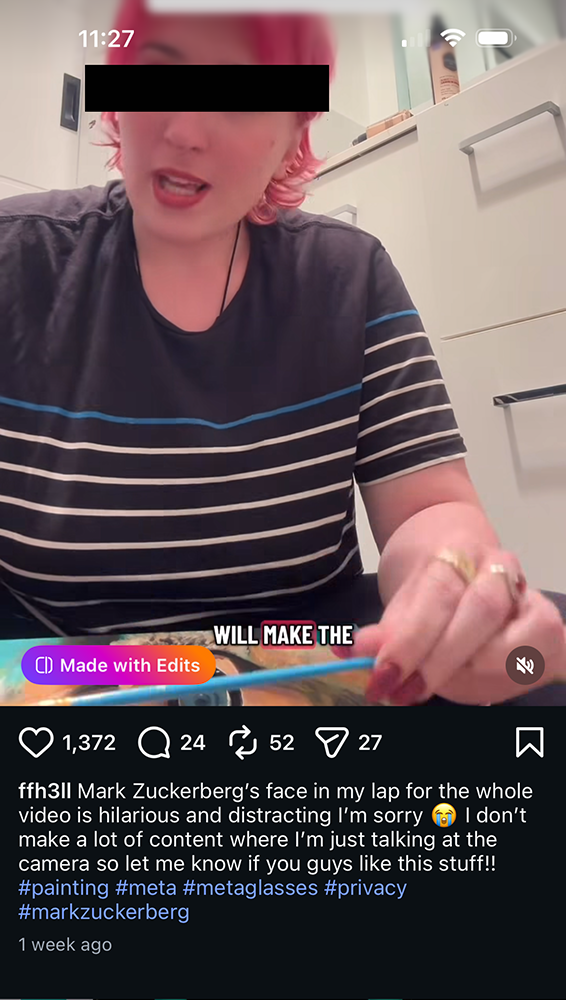
A woman with pink hair is painting. Mark Zuckerberg's face is projected onto the canvas balanced in her lap, and she's talking to camera about how creepy Meta's smart glasses are. The video has 1,372 likes, 24 comments, 52 reposts. Somewhere down the comment thread, someone writes: "I've had male customers wear them while I'm at work and I feel violated every time." Three hundred and twenty-three people like that. The author replies: "they are not taking your power." Another commenter recommends an app that scans nearby Bluetooth signals to alert you when Meta glasses are close, "because we need to keep spreading awareness of the real issues these glasses and technologies cause in our communities." Sixty-four hearts, twenty-four hearts, a chain of validation running down the page.
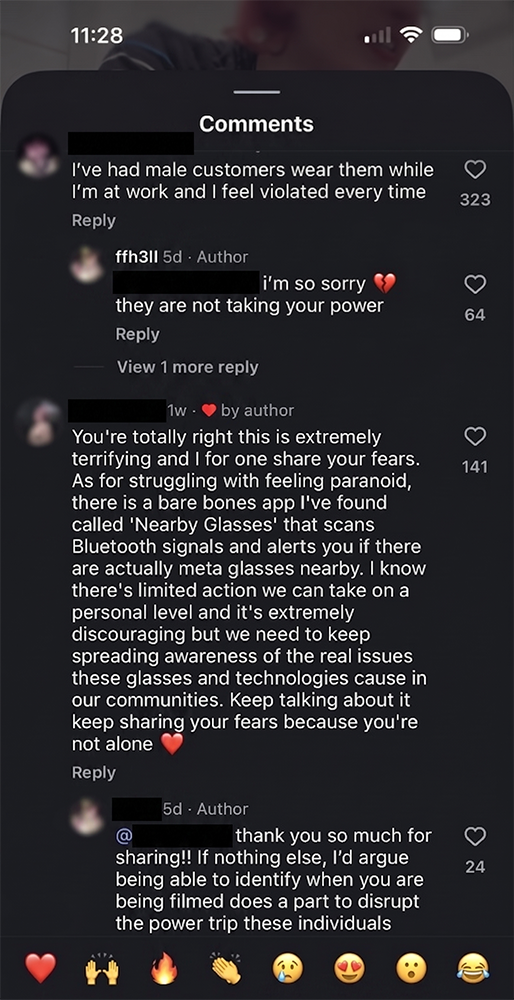
Nobody in that thread mentions the obvious thing: the person who made the video is recording her own image, on her own initiative, and publishing it to Instagram, a Meta product, for public consumption. Nobody mentions that "male customers" wearing a piece of consumer electronics is not, in itself, evidence of anything, and that the fear being rehearsed here; (men are predators when equipped with a camera, and we can build a private detection network to identify them) sails past a fairly serious question about what happens when we assign menace to a device based on the sex of the person wearing it. Nobody mentions that plenty of the people who might actually need Meta's glasses for reading, for description, for a hundred quiet accessibility reasons that have nothing to do with "the power trip these individuals" are on get erased from that framing entirely, because the story only has room for predator and victim.
That thread isn't unusual. It's the format. And it's the format because the format is the business model. This is a piece about the rage economy: what it actually runs on, what the numbers say when you check them instead of assuming them, and why the "everybody hates this" version of the AI backlash doesn't survive contact with the data.
We're not being cute with the phrase. Research published in PNAS analysing 2.7 million posts across Facebook and Twitter found that language about a political or social out-group was shared roughly twice as often as language about an in-group, and that each additional word framing someone as "them" raised the odds of a share by about 67%. Out-group hostility outperformed ordinary negative-emotion language by a factor of nearly five, and outperformed general moral-emotional language by a factor of nearly seven. Anger, specifically, was one of the strongest predictors of engagement the researchers measured. The mechanism doesn't care what the "them" is. Immigrants, politicians, "AI bros", men in smart glasses, the outrage-delivery pipe is agnostic about its fuel. It just wants fuel.
We said this plainly back in June, and we'll say it again because it's the whole argument: "the platform doesn't care what you're angry about. It only cares that you're angry, because angry stays. Angry scrolls. Angry is the product." That isn't a rhetorical flourish. It's a description of how the recommender system is built.
If the vitriol on Instagram genuinely reflected a mass migration away from the platforms people say they hate, we'd expect to see it in the numbers. We don't. Meta reported 3.56 billion daily active people across its family of apps in Q1 2026, up 4% year-on-year, meaning more than one in three humans on Earth opened a Meta app that day. There was a small sequential dip that quarter, and Meta was explicit that it was driven by internet blackouts during unrest in Iran and a government-imposed WhatsApp restriction in Russia, not by a wave of users reading the discourse and logging off in protest. In the same quarter, ad revenue rose 33% year-on-year to $56.31 billion, and time spent watching Instagram Reels rose 10%. The people posting "delete your Instagram" content are, by and large, still posting it on Instagram.
This is the part that gets skipped over most often. A June 2026 Pew Research Center survey of American adults found 40% hold a negative view of AI, 31% are genuinely mixed, and 16% are positive. That is not "everybody." That's four in ten with a negative view, a third sitting on the fence, and the rest either positive or unsure. YouGov's UK polling finds real appetite for regulation, 47% support an AI tax, but its broader 2026 research also describes a public that is "wary... yet open to its potential" rather than uniformly hostile.
The usage data is even more telling than the sentiment data, because it shows people's behaviour tracking against their stated feelings. Gallup's tracking of Gen Z, the demographic most associated with anti-AI sentiment online, found that generative AI use has stayed essentially flat even as anxiety about it climbs: 51% of 14-to-29-year-olds use generative AI at least weekly in 2026, up slightly from 47% the year before, while only 19% say they never use it at all. Anger is rising. Usage isn't falling. Those two lines should move together if the anger were actually driving behaviour, and they don't.
Even the outlet reporting the sharpest AI fatigue confirms the same shape. TechRadar's 2026 survey found "complete refuseniks", people who don't use AI chatbots at all, rose to 30% of respondents, a genuine jump. Read that number the other way round: seven in ten people are still using it. Thirty percent walking away is a real trend and worth taking seriously. It is not "everybody," and it is not the platforms that host the loudest rage against it.
If you've ever wondered why the "just leave Instagram" argument lands so badly with the people you're aiming it at, there's a name for the gap you're describing. Researchers call it the privacy paradox: people consistently report strong concern about how platforms use their data, and then continue using those platforms at close to unchanged rates. One analysis bluntly notes that 72.3% of Americans were active on social media in 2020 and that figure kept growing throughout the exact period privacy anxiety was climbing fastest. The paradox isn't really a paradox once you look at what's actually being weighed: the switching cost is concrete (lost network, lost audience, lost bookings, a new platform nobody else has joined yet) and the harm is diffuse, deferred, and largely invisible day to day. Rational people make that trade constantly, and then feel bad about it, which is its own kind of content.
This is also, not coincidentally, the exact wall we've hit trying to build something people can actually walk toward. Our own FFAQ says it without dressing it up: "Why the fuck are you still on those shitty platforms instead of supporting indie and open web projects? You tell us, in the comments. But you'll have to sign up to do that." Getting someone to type a comment that already exists inside an app they have open costs them nothing. Getting them to create an account on a site they've never heard of, with no algorithm to bring the next post to them automatically, costs them a genuine, if small, act of will. Decentralisation asks people to do work. Outrage doesn't ask for anything except a thumb.
We've made this argument before and the data keeps handing us more evidence for it. "Slop" gets deployed as a synonym for "AI-touched," full stop, regardless of the amount of human craft, intention, or provenance behind the piece. Meanwhile, plenty of content that involves zero AI sails past the same scrutiny entirely. In our own Authentic Slop investigation, we documented Pinterest's classifier flagging two decades of hand-built Reallusion and Photoshop work as "AI Modified", an estimated 50% false positive rate, across the independent creative community, while, on the same platform, an advertiser sold unlicensed hand-painted canvases of Snoopy and SpongeBob at $150- $800 a piece, certificate of authenticity included, no scrutiny applied at all. One was flagged as fake because it looked too clean. The other was actual, provable, commercial infringement of protected characters, and it ran as a paid ad. We put it plainly in that piece: "That work would be called slop. The $800 hand-painted Snoopy on linen canvas... would not." If "slop" tracked quality or honesty, that wouldn't happen. It tracks which toolchain triggers the reflex.
It's also worth saying, as we argued in AI Slop Is a Slur, that the word behaves structurally like every other slur in English: a broad, flattening label applied to a category of person or work regardless of individual merit, used to shut down engagement rather than start it. Reality television, content farms, engagement-bait listicles, and mass-produced "faceless channel" YouTube content were all called slop, by name, long before a single generative model existed. The internet has always had a slop problem. AI just gave the word a new, more satisfying villain to point at.
The claim that "AI is theft" deserves to be taken seriously, and it also deserves an honest history. Digital creators were having their work taken, redistributed, and monetised without credit or payment from more or less the moment the internet became a mass medium. DeviantArt was dealing with organised art-theft scandals as early as 2007, and the Library of Congress documented the platform's ongoing "Share Wars", communities negotiating, in real time, what it meant to have your work copied and stripped of attribution across forums, print-on-demand sites, and stock image mills, more than a decade before "generative AI" entered ordinary conversation. We watermarked everything for exactly this reason, years before any of this was an AI story. The theft was already at scale. It just didn't have an algorithm behind it angry enough to make the story travel, so it never got the same collective reckoning. AI didn't invent the grievance. It gave a decades-old grievance a villain with a name, a face, and a stock price, which is a much better fit for the outrage-delivery format the PNAS researchers described.
There's a version of the anti-AI argument that assumes, often without noticing it's assuming it, that hiring a human illustrator for every project is a live option for everyone. It isn't, and the day-rate data makes the gap concrete. Creative Boom's 2026 survey of 403 UK illustrators found a median day rate of £350 nationally, climbing to a median of only £425-£450 after eleven-plus years in the profession, strikingly flat growth for a skill that takes a decade or more to build, and a rate that leaves little room to absorb repeated one-off commissions for social posts, zine covers, or a joke that only needed to exist for a day. Recommended industry rates for established illustrators run from £350 for a small company up to £850-£1,200+ for the largest clients. That's not a criticism of illustrators, whose rates are, if anything, too low for the skill involved. It's a description of who can and can't absorb that cost on a whim, repeatedly, across a full slate of work. For an independent collective running on "fuck all, no grant, no funding round," as we put it in our Straight Statement on plzdontkillus, or for a disabled creator who has already lost income to a body that stopped cooperating, "just commission a human every time" is a policy that only works if you already have the money the policy assumes. That's not a small technical detail. It's the entire reason the loudest version of this debate skews toward people for whom the cost was never actually the constraint.
None of the above is an argument that everything currently being generated is fine, and deepfakes are exactly where that distinction matters most. The numbers here are genuinely alarming on their own terms: deepfake files online went from roughly 500,000 in 2023 to an estimated 8 million in 2025, a roughly sixteen-fold increase in two years, and 98% of deepfake video in circulation is non-consensual pornography. That is a real, specific, gendered harm with real victims, and it is not the same argument as "someone used a diffusion model to make cover art for a fictional band of graffiti cats." Lumping the two into one undifferentiated "AI bad" bucket does a disservice to both conversations: it under-serves the urgency deepfake victims actually need, because the discourse is busy litigating whether a Midjourney landscape is theft, and it over-punishes assistive and creative uses that have nothing to do with non-consensual imagery. The UK public itself draws this distinction clearly, 96% oppose AI-generated child sexual abuse material and 87% oppose non-consensual adult "undressed" images, but only 25% think AI-generated art from tools like Midjourney counts as art either way, which is a question of taste and category, not a question of harm. The public can tell these apart. A lot of the discourse can't, or won't, because collapsing them into one enemy is more satisfying and travels further.
Which brings us back to where we started. The Meta glasses thread isn't a story about AI ethics at all, not really. It's a worked example of everything above happening at once, in miniature, in a single comment section: an out-group ("male customers", "these individuals") assembled and punished with no individual evidence required; a slur-adjacent flattening of an entire category of user into "predator"; a total absence of the accessibility argument we've made at length elsewhere, that the same glasses are, right now, letting visually impaired people read the world out loud, and a creator who is, in the same breath, filming and monetising her own face on the platform she is condemning, with nobody in 24 comments finding that worth a single line. We are not saying her discomfort is invented, or that Meta's privacy record deserves any benefit of the doubt, the Guardian's own month-long test of the glasses surfaced real, documented problems, including moderators reviewing sensitive footage. We're saying that the specific shape this particular complaint took, gendered suspicion, a private surveillance app to identify "them", zero engagement with the self-recording irony sitting right there in the frame, is exactly what you'd predict from a system that rewards out-group anger at roughly seven times the rate of anything more careful. The algorithm didn't produce a lie. It produced the version of the true thing that would travel furthest, and stripped out everything that would have slowed it down.
We don't think AI is an existential threat, and we think the handful of people running the companies building it might be. We think using any technology to attack Big Tech is compromised, including this one, and we've said so in writing. We think #fuckai is mostly a performance staged inside the exact building it claims to be burning down, and we think the people performing it are, overwhelmingly, not the people who most need protecting from what AI actually threatens. We think "slop" is doing the work of a slur, and we think the theft argument is real but not new, and we think deepfakes are the ’existential threat’ problem being smothered under a much noisier, much less urgent argument about aesthetics.
And we think the honest answer to "why won't people leave the platform that's radicalising them against the thing they're using it to complain about" is the one nobody wants: because leaving costs something real, staying costs something invisible, and the invisible cost loses that trade nearly every time, right up until enough people decide, together, that it doesn't have to.
We built somewhere to have that argument without an algorithm deciding which version of it travels. You'll have to sign up. That's the whole point.
Sources cited throughout. Further reading: Why I Don't Have Time For Hate | AI Slop Is a Slur | Authentic Slop Catalogue Entry 001 | Our FFAQ | On AI Labelling, Digital Craft, and Platform Withdrawal
A note on redaction
We had no legal or platform obligation to redact any of this. The material was posted publicly; Meta's own terms permit exactly the viewing and referencing we're doing here, and fair dealing for criticism would have let us reproduce every screenshot exactly as it appeared — full handles, full faces, no exceptions. We chose not to, and we'll explain why clearly rather than relying on redacted images to make the choice self-evident.
"Publicly accessible" is not the same as "consented to be re-platformed." A comment written for an audience of strangers scrolling a specific video, under whatever norms govern that space in that moment, is a different disclosure once it's lifted into a new context — a permanent, indexable, critical essay, reaching people who would never have found the original thread. Fourteen years of arguing against non-consensual identification doesn't get to carve out an exception for two strangers just because redacting them was more work than not doing it. So we did the work.
That standard, though, applies differently to faces than it does to names attached to public speech, and the distinction is deliberate enough to state outright rather than leave for a reader to puzzle over. The video's author is not redacted by handle here — her name stays, because she put it on her own argument, made publicly, in her own voice, same as ours is on this response to it. Her face is redacted anyway, same as every other face in these screenshots, including ours further down. That is not an inconsistency; it's two different questions getting two different answers. Facial identification is something our protocol treats categorically, independent of who's in frame or whether they've considered their own exposure — a face doesn't earn protection because its owner asked for one, any more than it loses protection because someone didn't. A name attached to voluntary public speech is a separate matter entirely, and erasing it wouldn't be neutrality — it would just be a quieter way of avoiding the point.
Which is also why she isn't the subject of this piece. She's the catalyst. The subject is the argument itself: a public call to protect ourselves from facial identification, made in a thread where every reply disclosing real fear and real trauma sits permanently attached to a real face and a real name, discoverable by anyone with the link. We are not naming and shaming an individual — we're pointing, with as much detail and energy as the inconsistency deserves, at a pattern she happened to surface first. Her name stays because she chose to put it on her claim. Her face doesn't, because that's the standard we hold regardless of who's in frame.
#plzdontkillus #AI #DeepFakes #anonymity #myfacebelongstome
Art of FACELESS | artoffaceless.com | Cardiff, Wales, Est. 2010
Join the Movement: Learn more about our MyFaceBelongsTo.Me protocol and how to protect your digital sovereignty.
STOP READING FOR A SECOND. This node is 100% independent. No tracking. No ads. Powered purely by the Art of FACELESS creative collective and physical print distribution.
Drop your email to initialize your node, unlock the rest of this file, and support independent publishing.
© 2026 Art of FACELESS. All rights reserved.
The Hollow Circuit™, Hyperstition Architecture™,
The Veylon Protocol™, and Cognitive Colonisation™
are proprietary intellectual property of Art of FACELESS.