Writers often talk about voice as if it lives inside the throat — the page, the pen, the pulse of language. But in a Visual Novel (VN), that voice moves differently. It isn’t read so much as played. The reader becomes the actor, the editor, the voyeur, the god.
And yet, writing for a VN is still writing — in many ways, it is the purest form of narrative control. The form merges literary prose, dramatic script, and interactive architecture. Each line must carry weight not only as text but as potential — a node, a hinge, a choice.
The Script as Literary DNA
A Visual Novel script looks deceptively simple. For example:
show Seya neutral at left
Seya “The air in here tastes like static. Someone’s patched into the grid again.”
Narrator “She moves through the corridor, the club’s walls pulsing like the inside of a lung.”
play sound [file: “door_hiss.ogg]”
Seya “If I find the source, maybe I’ll find the one who’s been leaking the Oligarchy keys...”
This isn’t just code — it’s choreography. The show and play lines form the bones. The dialogue, the muscle. The timing, the heartbeat.
The VN writer becomes part screenwriter, part poet, part systems engineer — constructing an emotional syntax that can branch, breathe, and fracture.
The Japanese term “visual novel” (ビジュアルノベル) was first popularised by Leaf and Key in the 1990s — but the lineage extends much further back. The Tale of Genji and Tristram Shandy were both proto-interactive texts, novels that demanded participation through shifting voices and broken linearity. James Joyce’s Ulysses, Borges’ Garden of Forking Paths, and Christine Love’s Analogue: A Hate Story all exist on that same continuum — literature as labyrinth.
Scene Fragment: Seya Enters the Black Circuit
To understand how this translates into writing, consider the following fictional excerpt from The Hollow Circuit (Book One):
Scene: The Sublevel Kink Club “Obsidian Circuit”
The bass is low enough to blur thought. Light fractures through fog, pink and fungal, alive like the inside of an organism pretending to be architecture.
SEYA:(internal) I don’t have clearance to be here. But they say the contraband moves through this place — code sold as pleasure, pleasure sold as access.
She walks past latex silhouettes and chrome masks, each wired with micro-drives — fragments of forbidden AI language stitched into flesh. A dancer spins on an LED vine, the veins of her thighs flickering with code-streams.
BARTENDER: “Drink or data?”
SEYA: “Both.”
She palms a glass and scans the bar’s reflection for glyph signals — the Traveller tags, luminous scars left by hackers who use desire as a delivery system. Somewhere in this room, beneath the music and the scent of ozone and heat, a deal is about to take place. A fragment of Traveller 1.111’s code is hidden in the erotic underground — a virus disguised as art.
Choice:Follow the woman with the mycelium tattoosTrace the bar’s power line to the lower maintenance ductsStay and question the bartender about the code fragments
This isn’t prose to be read — it’s experienced. Each choice carries the illusion of agency, but every path leads deeper into the same theme: that freedom is an algorithm disguised as a kink.
The Literary Function of Code
To many traditional writers, scripting feels mechanical — like soldering wires instead of writing sentences. But this is a failure of imagination.
The VN format allows for non-linear empathy: the player inhabits consequence, not observation. Each branch of dialogue or event becomes a reflection of moral recursion — a narrative that knows it is being read from multiple dimensions.
In literary terms, a well-written VN script performs the same function as:
Dialogue in drama (subtext as power struggle)
Stage direction in theatre (timing, atmosphere, tone)
Narrative recursion in modernist fiction (reader as participant)
The VN thus occupies a unique intersection between reader-response theory (Iser, Fish), ludology (Aarseth), and post-structuralist authorship (Barthes, Foucault). The “death of the author” becomes literal — the story writes itself through the reader’s hands.
When Literature Becomes Interactive
For writers moving into VN development, the challenge isn’t the code. It’s humility. You must learn to trust that meaning doesn’t dissolve when choice is introduced — it multiplies. Each route, each variable, becomes an alternate poem.
A line like
“She opens the door and the light burns her shadow away.” can be repurposed as:
if (player.has_seen_truth):
Seya “She opens the door and the light burns her shadow away.”
else:
Seya “She opens the door, and nothing happens.”
Toward a New Literary Form
We live in an era where the page is no longer flat. Our stories are branching, recursive, haunted by data. The writer who ignores this is still an author — but the writer who embraces it becomes an architect of consciousness.
Visual Novels are not a lesser art. They are post-literature — the fusion of language and interface, of poetry and machine logic. They require rhythm, structure, and emotional intelligence.å They are theatre, myth, screenplay, novel, and dream — rendered in code.
As one character in The Hollow Circuit says to Traveller 1.111:
“Every story is a system. Every system is a confession.”
The future of writing isn’t about protecting the past. It’s about learning how to write worlds that can think back.
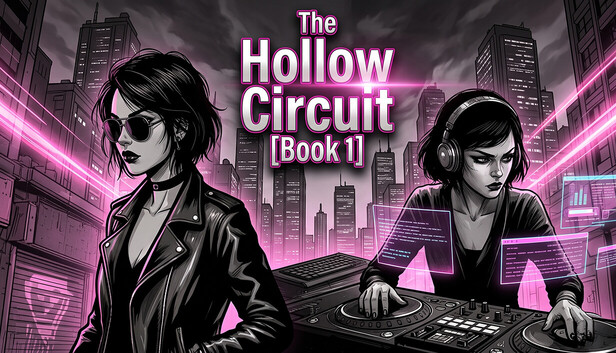
Awen Null wrote The Hollow Circuit [Book 1] as a novel which is now available on our store as a DRM-free ePUB or for those who want to add to their Kindle collection on Amazon.
Awen has teamed up with game developer V.Tracer who’s coding the Visual Novel now available to Wishlist on the Steam store.
By purchasing the book, wish listing the game or a donation, you’ll be helping to keep us going and supporting authentic indie publishing with no sponsors, ads or algorithms.
STOP READING FOR A SECOND. This node is 100% independent. No tracking. No ads. Powered purely by the Art of FACELESS creative collective and physical print distribution.
ACCESS PROTOCOL:
Drop your email to initialize your node, unlock the rest of this file, and support independent publishing.
The link has been copied!
Your link has expired. Please request a new one.
Your link has expired. Please request a new one.
Your link has expired. Please request a new one.
Great! You've successfully signed up.
Great! You've successfully signed up.
Welcome back! You've successfully signed in.
Success! You now have access to additional content.