…there's a cohort of reflexive AI opposition online that operates entirely on vibes and insults, and I don't want to be mistaken for it. I'm not saying AI risk isn't real. I share the underlying concern — that's the entire premise of The Hollow Circuit.
On cows, cameras, and who gets to warn us about the end of the world
By Lloyd Lewis, founder of Art of FACELESS and Awen Null, outspoken author and transmedia artist behind The Hollow Circuit® 16 July 2026
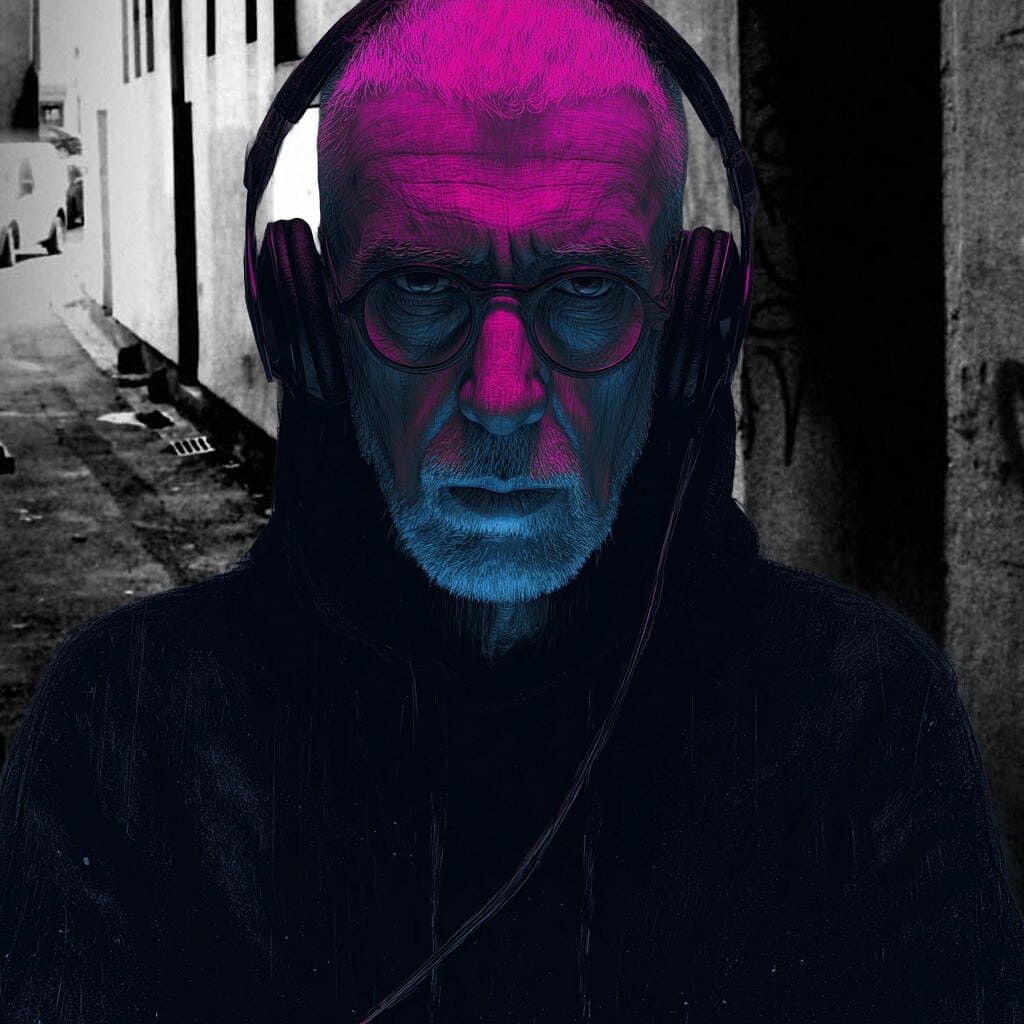
I'm going to say the quiet part out loud, because Facelessness only works as a principle if it's applied honestly, including to myself: I'm Awen Null. Fifteen days of transmissions on plzdontkillus.online, written and posted by one disabled bloke in Wales, on a laptop, for nothing. No stipend. No mentor. No venue. No camera crew.
I want to be clear about why I'm telling you that now, and why I'm doing it under my own name rather than staying safely behind the mask I usually work in. Because what started as a small, slightly embarrassing, act of borrowing somebody else's momentum turned into something I didn't expect: a fifteen-day window onto exactly how thin the "serious AI-safety project" performance can be, once you look at what it actually costs to produce, who it actually lets in the door, and what it's actually asking its participants to hand over.
The cow question
Here's a detail that's already public, reported by an outside outlet, not something I'm alleging: the application for plzdontkillus.com — the funded, Berkeley-based, month-long "creator bootcamp" about AI existential risk, backed by the Machine Intelligence Research Institute, mentored by Grimes and Eliezer Yudkowsky — includes, as a mandatory screening question, a request that applicants describe how they would, hypothetically, have sex with a cow (Gazetteer SF).
I'm not telling you that to be salacious. I’m certainly no prude. I'm telling you because it's a design choice, and design choices tell you who a thing is actually for. A selection process built around shock-value provocation questions, a month-long in-person residency requirement, and a content format built on daily face-to-camera video is not neutral. It selects — whether anyone intended it to or not — for mostly young, able-bodied, geographically mobile, financially flexible people with nothing keeping them from disappearing to Berkeley for a month. I don't need a study to tell me that. I've spent years running a project from inside a body that doesn't let me perform "content creator" on demand, and I recognise exclusion-by-format the moment I see its shape. That's not an accusation against any person running the bootcamp. It's a description of what the format does, anywhere, run by anyone, regardless of intent — and it's happening at a moment when the US Department of Justice is openly questioning whether disability civil rights protections are even binding (NPR), when federal contractor disability-compliance staffing has been gutted by nearly 90% (Senator Warren's office), and when nine states are suing to weaken disability protections outright (The Arc). This isn't happening in a vacuum. It's happening in a country actively rolling back the floor.
The venue is the tell
The residency is housed at the Rose Garden Inn in South Berkeley — a property that, and I promise I'm not making this up, "permanently closed in 2024, when the owners, the tech-backed nonprofit Center for Applied Rationality, were ordered to pay back the $1 million in FTX funds used to buy the property" (Gazetteer SF). A building bought with money clawed back from one of the largest fraud collapses in crypto history is now hosting a program about the responsible stewardship of humanity's future. I'll let that sit.
And to be precise, because precision matters here: this project is not run by, affiliated with, or reviewed by the University of California, Berkeley. There's no IRB. No ethics board. No published data policy. It borrows the word "Berkeley" the way borrowed light works — reflected, not generated. My own background includes ISO-standard audit and documentation practice as a (now-retired) pharmacologist and I can tell you plainly: a project shaped like this would be unlikely to clear institutional review anywhere that still has one.
The Oligarchy of Light
The Oligarchy of Light (OoL) are the antagonists in Book 1 of the Hollow Circuit's vocabulary and lore. Not villains in the cartoon sense (though they have, two millennia on, evolved into desiccated grotesques) — just the elite, platforms, and capital pools that get to decide what counts as illuminated, credible, worth funding, worth covering. Everyone else operates in the unlit part of the frame, the deep, mycelial tunnels of people who’ve rejected the status quo: seen, if at all, by accident, and never funded to be seen on purpose.
The Bay Area captured 82.6% of all US venture capital in the first quarter of this year (Angel Investors Network). The US and UK together hold roughly three-quarters of global AI-safety funding, with the Bay Area alone projected to hold more than half of the field's research staff by the end of the year (Quick Market Pitch; LongtermWiki). That's the Oligarchy of Light in numbers. It isn't a conspiracy. It's just where the light already is, and it means the version of "AI risk" that reaches you is overwhelmingly the version that a small, wealthy, geographically clustered group decided was worth the electricity.
I've said before, and I'll keep saying it: the strongest argument I have is that we built The Hollow Circuit — four registered trademarks, fourteen years of continuous transmedia lore, a real IP-enforcement track record, and this very analysis — for nothing. No grant. No mentor. No hustle on the big platforms, which we rejected on principle years ago and still do. If this is what's possible in the dark, unfunded part of the frame, ask yourself what the well-lit part could be doing instead of asking creators how they'd violate livestock.
The AI-Doom narrative is drowning in its own noise
Here's the part I actually find most damning, and it has nothing to do with cows or venues. It's that the AI-Doom narrative is currently being buried by exactly the kind of content it's supposedly trying to warn people about.
Days after release, a Steam game called "King Of The Hollow Circuit" — an entirely AI-produced project with, by every visible metric, zero organic traction — ranked at the top of general search results for a title infringing our registered mark (SteamDB; Steam, now renamed "King Of The Dark Circuit" after our complaint). That's not a one-off glitch. It's a documented pattern search researchers now call "recommendation poisoning" — AI-optimised junk outranking earned authority because ranking systems reward volume and keyword match, not substance (AuthorityTech, citing The Verge). If you want a compact metaphor for why "the AI-doom conversation" keeps losing to noise, that's it: Google briefly ranked an AI-generated nothing above a real fourteen-year body of work, when AI-safety influencers make videos about how AI might end us.
And then there's $PDKU — the token that sprang up around this whole moment, currently sitting at a price of zero, a trading volume of zero, one holder, and a scam flag on its own tracker page (TheBitTimes). People treated its appearance as proof the conversation had "arrived." I'd argue the opposite: a dead, one-holder scam token is exactly what shows up when an idea becomes attention-shaped instead of substance-shaped. That's not momentum. That's decomposition with ring lighting.
The cameras are the risk, not the protection
Here's where I have to be careful, because I want to make a real point without making it sound like a threat (which, of course, it isn’t) and the distinction matters. A month of daily, personal, face-forward video from dozens of participants is, by the field's own published technical standard, more than enough raw material to build a convincing deepfake of any one of them — Germany's federal cybersecurity authority puts the threshold at "only a few minutes" of footage (BSI). YouTube's own "likeness detection" tool — sold as deepfake protection — requires a government ID and biometric face video, and its privacy policy currently allows that biometric data to train Google's AI models (MSN/CNBC). Published research on deepfake datasets flags exactly this combination — high-volume, high-quality, consented-but-unreviewed personal video — as a recognised dual-use risk (MethodsX).
I'm not saying anyone involved is going to misuse that material. I am saying that a project built to raise alarm about AI risk is, structurally, manufacturing the exact raw ingredient for one of the harms it claims to fear, at scale, and that gap deserves to be named plainly rather than performed around. That's the whole point of Facelessness as a practice — we could trade in exactly this kind of biometric currency and refuse to, on principle, and that refusal is the argument, not a threat.
Who's inside the word "us"?
The other thing that's bothered me about this entire genre of content is smaller, and more philosophical, and it's the thing Awen Null has actually been circling for fifteen days without anyone at the funded end of this noticing: when people say "AI might end us," who is "us," exactly? Every version of that sentence I've seen this year quietly means Homo sapiens, specifically, as currently constituted. That's not a neutral default — it's a live fault line in the philosophy of technology right now, with serious people arguing over whether human succession by posthuman or AI-shaped descendants counts as an ending at all, or as something else entirely (Truthdig, "Team Human vs. Team Posthuman"). A month-long, well-funded residency about existential risk never once, as far as I can see, opened that question. Fourteen days of unpaid fiction did. I'll let you draw your own conclusion about which one was doing the harder thinking.
What I'm not saying
I want to be precise about this, because there's a cohort of reflexive AI opposition online that operates entirely on vibes and insults, and I don't want to be mistaken for it. I'm not saying AI risk isn't real. I share the underlying concern — that's the entire premise of The Hollow Circuit. I'm not saying the people running plzdontkillus.com are acting in bad faith, and I have no evidence that they are; my critique is of a format and a funding structure, not of anyone's character. What I am saying is that "well-funded" and "well-lit" are not the same thing as "rigorous," and that a genre of content built to warn the public about AI risk has an obligation to model the accountability, access, and data governance it's asking everyone else to take seriously. Right now, judged against those standards, it doesn't.
What we'd do with the light
We've run this whole operation — four registered trademarks, fourteen years of continuous, coherent fiction, an actual IP-enforcement record against a Steam publisher, and now this — on nothing, deliberately, because we rejected the platform hustle from day one and we're still not doing it. That's not a limitation I'm apologising for, bragging about or even smug about. It's the proof of concept. That’s why it’s stated so frequently and, probably, by now, is getting on your nerves.
It’s just that it’s really important.
If this is what a project can build entirely in the dark, the only honest question left is what could it build with even a fraction of the light currently being spent on cow questions and a residency?
We're not asking to be let into the Oligarchy of Light. Far from it. We're asking why it gets to decide, alone, what counts as illumination.
Nature of this piece. This is editorial analysis and opinion commentary, not investigative reporting or a formal academic finding, unless explicitly labelled as a working paper with stated methodology. Where it draws on published reporting, primary documents, or public statements, each factual claim is sourced and linked at the point it's made. Where it offers interpretation, critique, or structural argument, that is presented as the author's analysis, clearly distinguished from sourced fact.
No allegation against named individuals. Nothing in this piece alleges bad faith, malicious intent, or specific wrongdoing by any named person. Critiques of format, funding structure, selection design, or institutional accountability are directed at systems and structures, not at the character or motives of any individual participant, mentor, or organiser. Where a structural or lived-experience critique is offered (for example, regarding disability- or age-based exclusion), it is grounded in the author's own standing and documented policy context, not presented as a factual accusation requiring third-party proof — consistent with established standpoint-theory methodology in critical and social-science writing.
Standing and positionality. The author, Lloyd Lewis, writes as a disabled, UK-based creator with 14 years of continuous, self-funded work on this subject matter (as Art of FACELESS / The Hollow Circuit®, and under the pen name Awen Null where noted). That standing is disclosed, not hidden, and is offered as relevant context for readers assessing the piece's perspective — not as a claim of neutrality.
Independence. Art of FACELESS is not affiliated with, funded by, or endorsed by any organisation, mentor, or individual named or discussed in this piece, including the Machine Intelligence Research Institute, the "plzdontkillus.com" residency, or any of its participants or mentors. No compensation has been received in connection with this piece.
Corrections and right of reply. If any factual claim in this piece is inaccurate, or if any person or organization named here wishes to respond, contact artoffaceless.com directly. Verified corrections will be made promptly and transparently, with a visible correction note.
Sourcing standard. Every factual claim in this piece links to a public, dated, primary or independently reported source at the point it's made. A full reference list appears above.
Art of FACELESS — 14 years of independent, self-funded transmedia work. No grant funding. No institutional backing. No platform hustle.
ZINEGLITCH // DISPATCH
STOP READING FOR A SECOND. This node is 100% independent. No tracking. No ads. Powered purely by the Art of FACELESS creative collective and physical print distribution.
ACCESS PROTOCOL:
Drop your email to initialize your node, unlock the rest of this file, and support independent publishing.