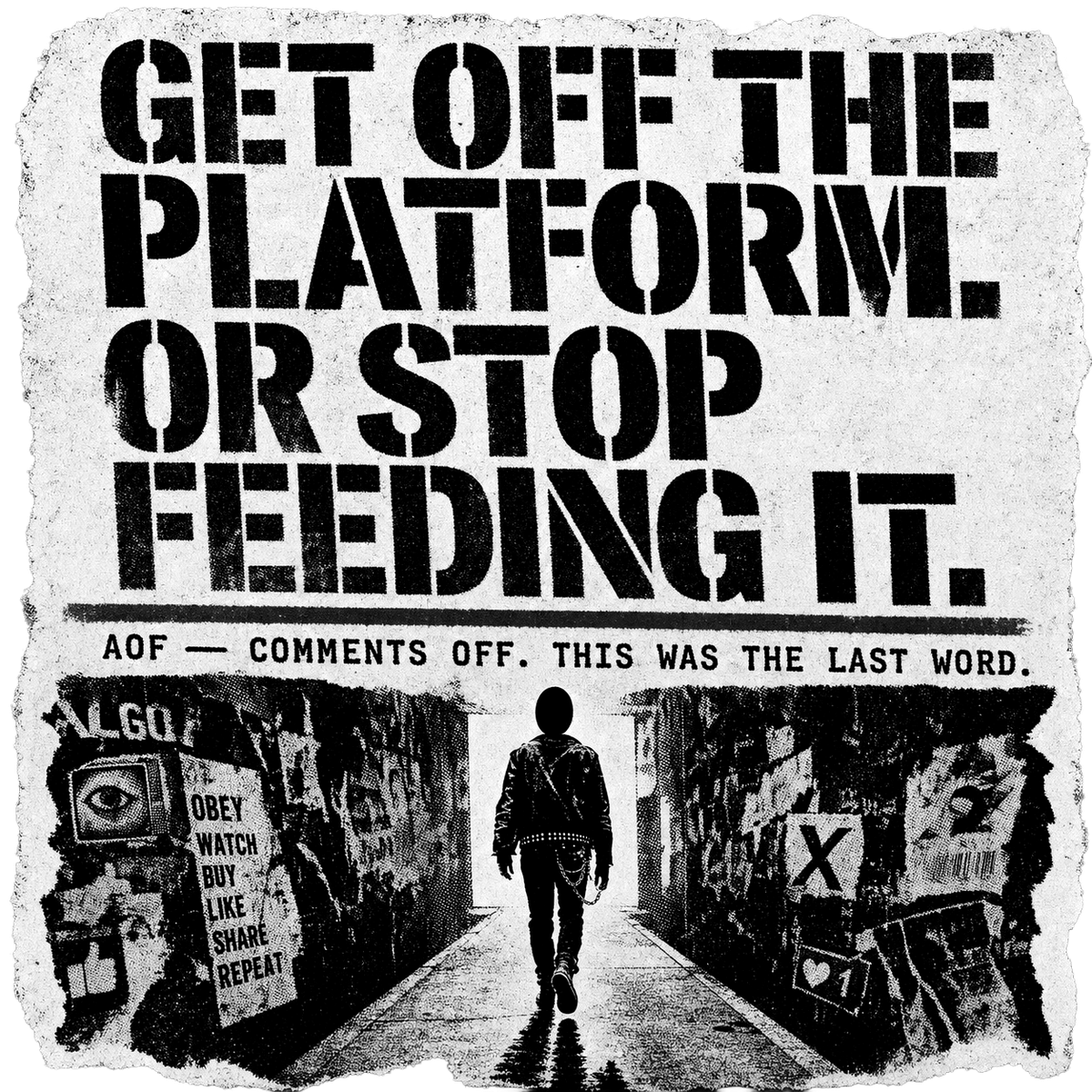
Get off the platform that's profiting from your outrage. Or at the very least, stop feeding it and subscribe and engage here, where you'll really make a difference to artists and creatives trying to build something sustainable outside of the social media churn.
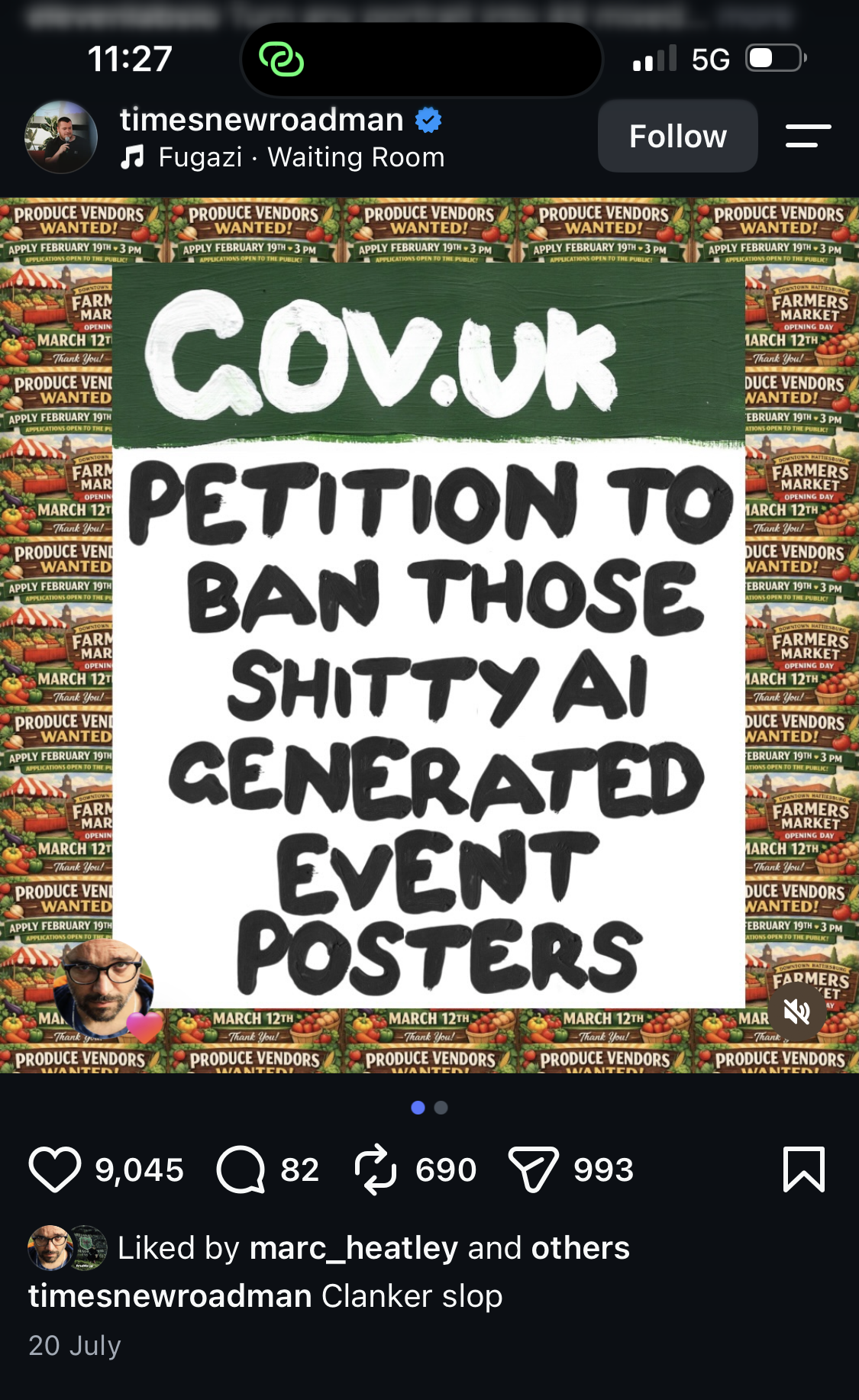
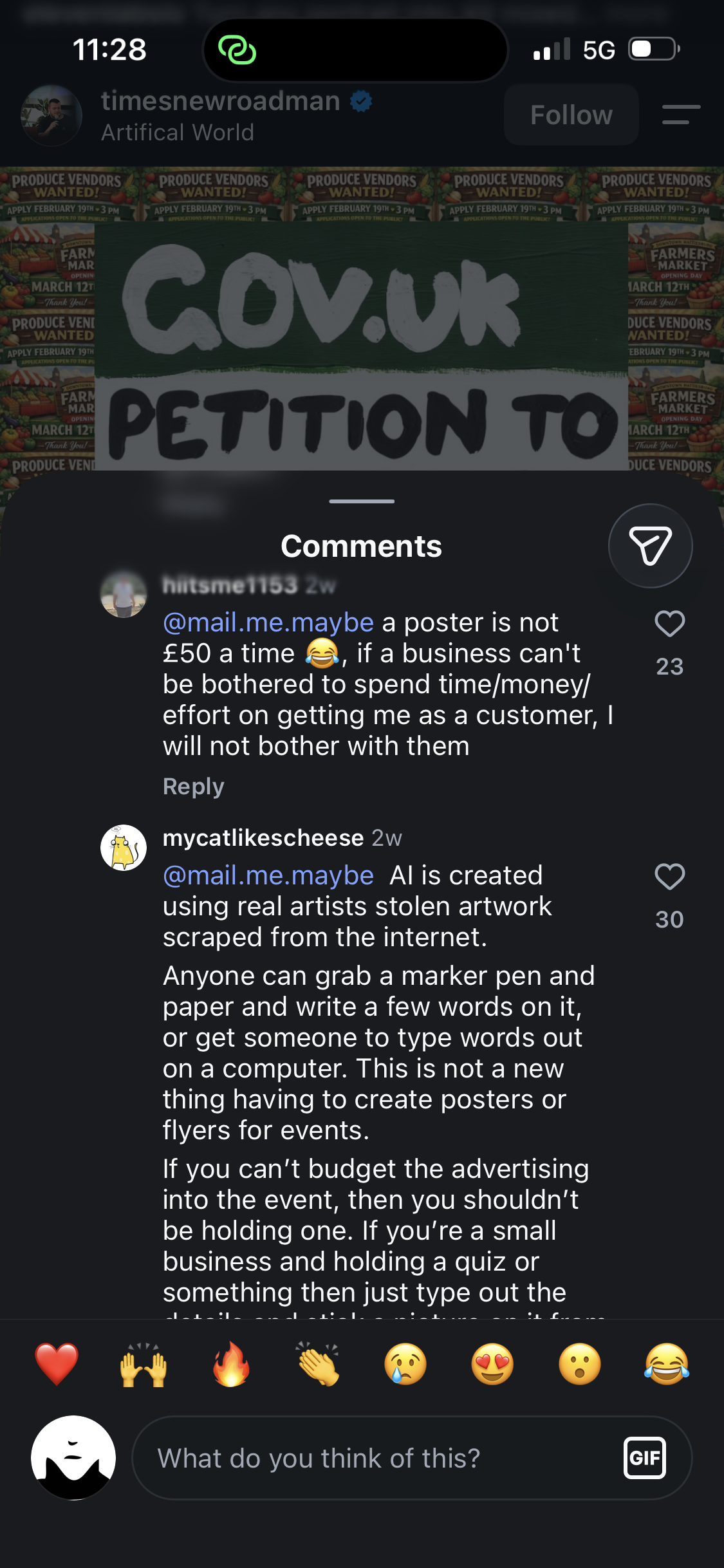
Every few days, the same post does the rounds. A screenshot of a farmers' market flyer or a pub quiz poster, ring-lit in that smug "ban.png" font: look how ugly, look how lazy, look how AI. Thousands of likes. Hundreds of comments. Zero new income for a single working artist. That's the bit nobody in the replies wants to talk about, so we will.
1. You're raging against a machine on a machine built by the same people
The irony is so thick it's almost the whole point. You're furious about a free Canva poster generated in thirty seconds, so you open Meta — a platform whose entire business model is an AI recommender system deciding what outrages you next, harvesting your data while you type, and selling your attention to the highest bidder — and you post about it there. For free. To make Zuckerberg richer.
That's not activism. That's not solidarity with artists. That's content for an algorithm that doesn't care whether the "slop" in question is a farmers' market poster or your own righteous dunk about it — both are just engagement, both get monetised the same way. If you actually cared about the labour behind creative work, the platform itself is the first thing you'd have a problem with. Raging about AI on Meta is like picketing a sweatshop from inside the factory that owns it.
2. The pile-on is the actual product
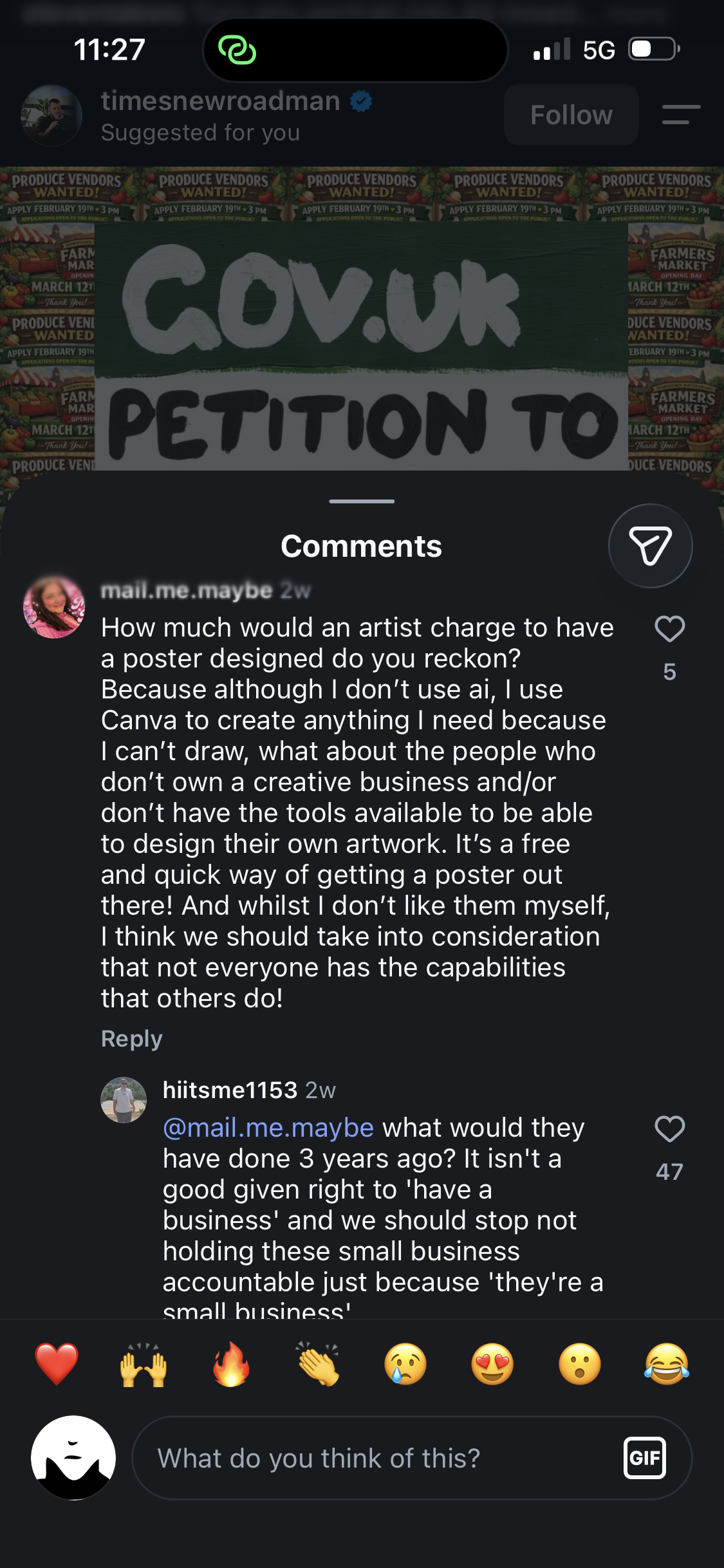
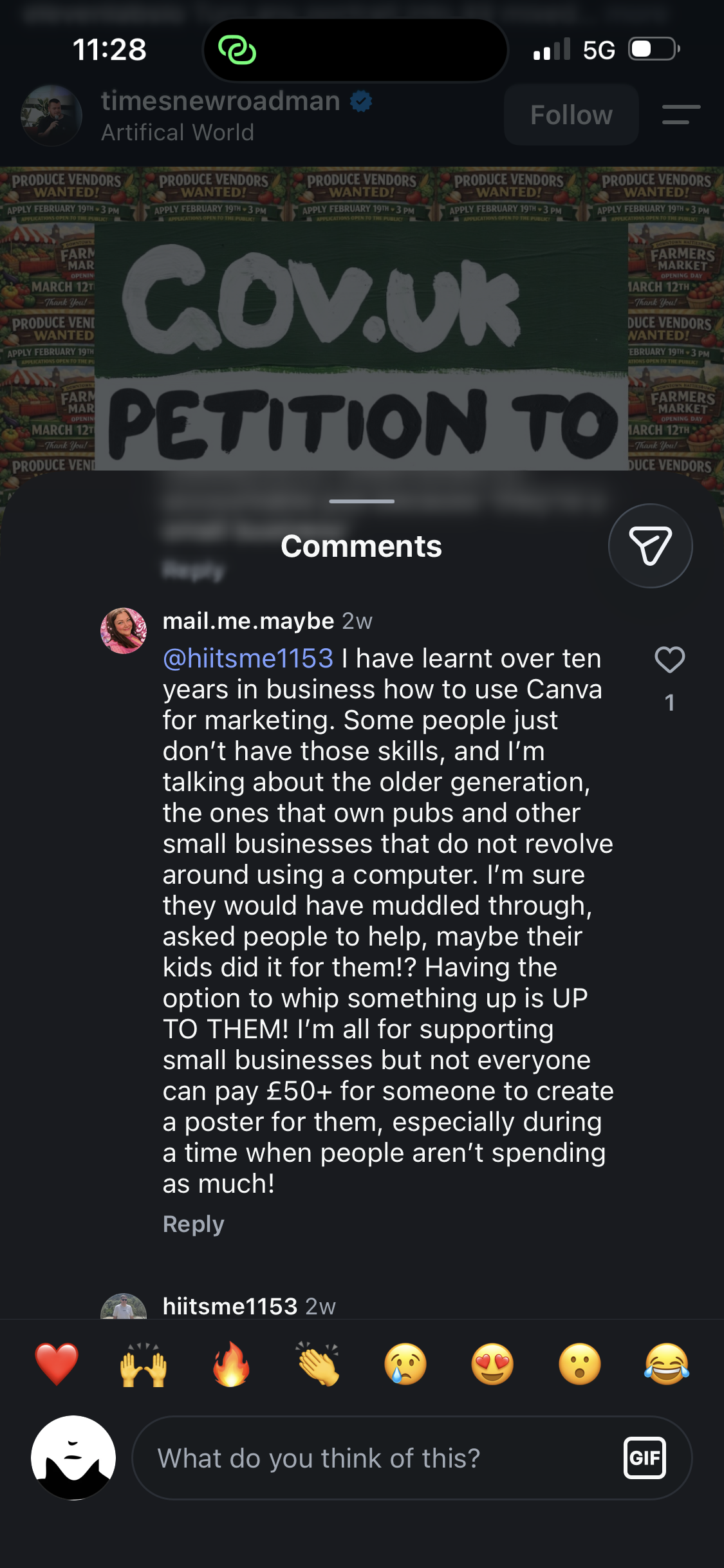
Scroll two comments deep on any of these posts, and you'll find someone trying to say something sane — "not everyone can afford £50 for a poster,""some of these are pub landlords who can't code,""maybe read the room on cost of living" — and watch what happens. They don't get a conversation. They get dogpiled. Twenty, thirty, fifty likes stacking up under increasingly smug replies, each one competing to land the most devastating dunk, none of them actually listening.
That's not moral clarity. That's a bullying mechanic wearing an ethics costume. The people trying to bring nuance into the room are the only ones actually thinking about the humans on the other end of the "AI slop" — and they're the ones who get flattened for it. If your movement can only survive by punishing empathy, it isn't a movement. It's a mob with a hashtag.
3. Nobody in these threads has done the maths on cost of living
Here's the part that should embarrass everyone dunking from the sidelines: we are the artists you claim to be defending, and AI has already taken the work. The poster commissions, the small-batch flyer gigs, the "quick logo for a mate's pub quiz" jobs — gone, absorbed by free tools, years ago. That ship has sailed. So when a comment section full of people who've never once paid an artist a fair rate suddenly discovers outrage over a farmers' market flyer, the hypocrisy isn't subtle.
You want small businesses and community organisers to pay proper rates for design, on top of rent, on top of stock, on top of everything else costing more this year than last. Fine — so does every artist we know. But that only works if the people demanding it are also the people funding it. Most aren't.
And the numbers back that up: the median self-employed income for a UK visual artist is just £12,500 a year — down 40% since 2010, and 47% below the median UK worker's income — with 56% of artists earning less than £5,000 from actual art sales in a given year (DACS/University of Glasgow Artists' Earnings Report, 2024; The Art Newspaper; Creative United, 2024 Survey). That's the actual crisis. A comments section dunking on a free Canva poster does absolutely nothing to fix it — if anything, it's a displacement activity that feels like solidarity while producing nothing for a single working artist.
4. The numbers nobody's running in the replies
So let's put the two things people are actually arguing about side by side, properly costed.
What raging on Meta is worth: Meta pulled in $200.97 billion in revenue in 2025 and $60.5 billion in net income (Meta Q4/FY2025 results; earnings analysis). Worldwide average revenue per user hit $15.66 in a single quarter (Meta ARPP data) — meaning you are worth more to Meta's ad business every three months than most creators will ever be paid by it. Globally, people collectively spend somewhere between 11.5 and 14.5 billion hours every single day scrolling these platforms (social media time-use data; Planable, 2026), almost all of it unpaid, all of it feeding the same recommender system everyone claims to distrust. And if you're actually trying to get paid for content on the platform, Instagram's own Reels bonus programme pays out roughly $0.01–$0.05 per 1,000 views (creator payout data, 2026). A viral "ban AI slop" post doesn't pay a single artist's rent. It pays Meta's shareholders.
What building something actually costs — and generates: A small studio shipping even a modest game is spending real money on real people for years. Typical indie budgets run $50,000–$300,000, ranging from $10,000 for a solo 2D title to $2 million+ for a polished 3D release (indie dev cost breakdowns; Vsquad, 2026). A single 3D character asset costs $1,000–$5,000+ depending on complexity (game art outsourcing pricing); properly animating that character takes 120–180 hours of skilled human labour (3D animation cost breakdown); freelance 3D artists bill $20–$250 an hour depending on seniority (freelance 3D artist rates); voice work for NPC dialogue runs from an industry-standard $250/hour nonunion session rate upward (indie voice acting rate guide) — and that's before engine licensing, hardware, marketing and QA are even in the budget. If an AI tool speeds up one small piece of that pipeline — a placeholder bark line, a texture iteration — inside years of scripting, writing, world-building and human animation, it isn't replacing artists. It's what lets a small independent team afford to pay the humans doing the other 95% of the job.
And when that project ships, even modestly, the money doesn't disappear into an ad auction — it recirculates. The UK games industry alone generates an estimated £12 billion in GVA annually and supports over 73,000 jobs across roughly 1,700 studios (University of Portsmouth economic impact study; TIGA); the wider UK creative industries contribute £123 billion in GVA (Creative Industries data, 2024); and for every £1 of GVA the arts and culture sector generates directly, another £1.14 ripples into the wider economy through supply chains, local spend and jobs (Creative Industries Federation & Arts Council England). That's a multiplier a comment-section pile-on will never have. A profit from a shipped project can pay a coder, commission an artist, cover a print run, fund a small grant, put money behind a person offline. A thousand likes on a "ban AI posters" post pays nobody — it's just an ad impression inside a $200 billion advertising business.
That's the actual choice on the table: spend years and real money building something that funds artists, coders and printers and puts value back into local and global economies — or spend an afternoon dunking on a free flyer for an audience of a company that's already quietly worth more from your outrage than any artist will ever see from it.
5. It's boring. We're done playing along.
None of this is new anymore. It's the same screenshot, the same "clanker" caption, the same performative fury, the same pile-on, on a loop, for clout. It generates nothing — no funding for artists, no better rates, no actual conversation about what AI has cost this industry, and clearly no engagement with the actual figures either. It just generates likes for accounts farming manufactured outrage, at the expense of anyone in the comments who tries to be reasonable.
So here's where AOF stands, plainly: we're a serious studio, not a comment-section prop. We will keep calling out the absurdity of this genre exactly as loudly as it calls out legitimate use of technology — the double standards, the guilt-tripping, the mob tactics, the numbers nobody checks — and we'll name it when it's worth naming. What we won't do is hand these threads more engagement, more comment fodder, more free labour dressed up as moral outrage.
From here on, this is what our Instagram and Threads are for: broadcast, not debate. We'll say our piece, we'll turn comments off, and we're not going to sit around farming likes off manufactured rage — ours or anyone else's. If we ship a game or publish a book, that's the thing that actually generates income, hopefully profit, and lets us support, grant-fund, and pay coders, artists, printers and people offline — which is exactly where more of the art world's energy needs to go, instead of giving it all away for free online. If you want a real conversation about AI, artists, and who actually gets paid, we're having it. Just not in a comments section built to reward the loudest bully in the thread.
Get off the platform that's profiting from your outrage. Or at the very least, stop feeding it and subscribe and engage here, where you'll really make a difference to artists and creatives trying to build something sustainable outside of Meta's business model.
— Art of FACELESS
ZINEGLITCH // DISPATCH
STOP READING FOR A SECOND. This node is 100% independent. No tracking. No ads. Powered purely by the Art of FACELESS creative collective and physical print distribution.
ACCESS PROTOCOL:
Drop your email to initialize your node, unlock the rest of this file, and support independent publishing.
The link has been copied!
Your link has expired. Please request a new one.
Your link has expired. Please request a new one.
Your link has expired. Please request a new one.
Great! You've successfully signed up.
Great! You've successfully signed up.
Welcome back! You've successfully signed in.
Success! You now have access to additional content.