Initializing...

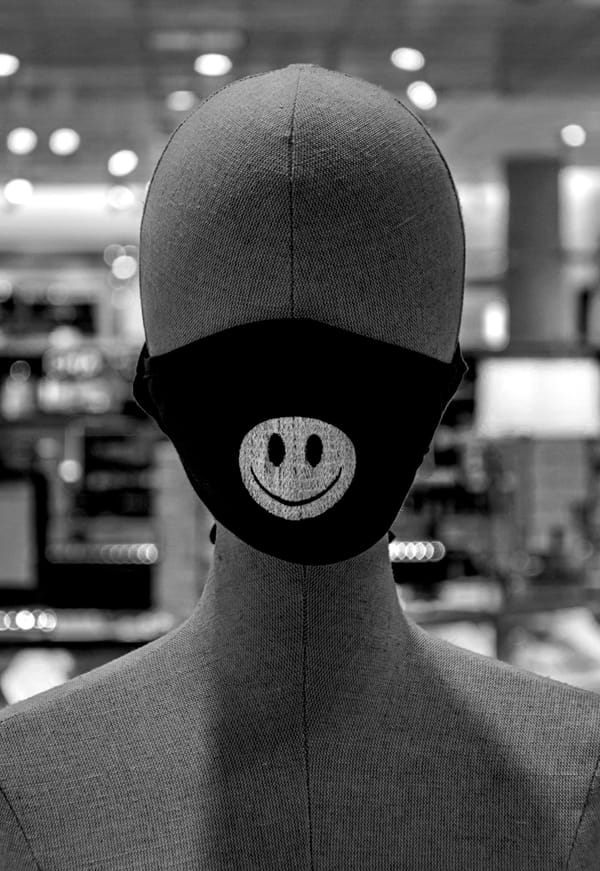
THE SUBSTACK SMILE MASK
Photo by Frames For Your Heart / Unsplash

THE SUBSTACK SMILE MASK

When you amplify a demographic, you amplify its worldview. On Notes, that worldview is unmistakable: neo-Victorian moralising in the language of neutral observation.


Share this post

A FIELD REPORT FROM BELOW THE ALGORITHM
Art of FACELESS

Substack markets itself as the anti-platform:
no algorithm, no noise, no distortion — just writers and readers in a civilised public square.

But spend ten minutes in Notes and you quickly realise the square is not a square at all.
It’s a curated veranda occupied almost entirely by a very specific demographic:
middle-class, American, comfortable, insulated — and loudly convinced their anecdotal experience is universal truth.

For us — working-class artists who live in Cardiff and witness homelessness, addiction, and precarity every single day — the shock isn’t that these views exist.
The shock is that Substack presents them as normal.

This week’s Notes feed was a case study in genteel cruelty: a steady drip of posts about homelessness that read less like observation and more like propaganda.
The tone was consistent across orange-tick writers, paying subscribers, and self-appointed sages of “realism”:

“The homeless are picky.”
“They turn down food.”
“They have expensive taste.”
“They’re disagreeable.”
“Entitled.”
“Manipulative.”
“Difficult.”

Scroll a little and you watch the narrative metastasise:
poverty reframed as personal failing, addiction reframed as character flaw, structural collapse reframed as attitude problem.

Screenshot from Substack Notes 07/12/25

This is not commentary.
It’s class fiction — a comfortable mythology that justifies a society where millions live in precarity while a platform elite congratulates itself for “thinking deeply.”

We are not theorising from distance.
We live in Cardiff.
We watch people sleep in doorways, shoot up against the concrete, beg outside shops that no longer exist.
We see the aftermath of austerity, addiction, trauma, and the systemic collapse of mental-health services.
We don’t have the luxury of pretending these are moral failings.

Substack Notes, however, rewards the luxury.

Screenshot from Substack Notes 07/12/25

THE PLATFORM THAT SMILES WHILE IT PICKS A SIDE

Substack insists it has “no algorithm.”
But anyone who has ever watched an online space evolve knows this is marketing sleight of hand.

No algorithm becomes:

  • curated discovery
  • visibility weighting
  • editorial nudging
  • follower amplification
  • “Featured Writer” designation
  • and the quiet social capital of the orange tick.

When you amplify a demographic, you amplify its worldview.
On Notes, that worldview is unmistakable:
neo-Victorian moralising in the language of neutral observation.

Screenshot from Substack Notes 07/12/25

That is not merely offensive; it is false.
And unmoderated falsehood, when echoed, becomes cultural truth.

Substack’s refusal to intervene is framed as a commitment to free expression.
In reality, it is a commitment to non-disruption of its core user base, whose paid subscriptions provide the platform’s lifeblood.

This is the same dynamic that allowed “meritocracy” to become the dominant illusion of LinkedIn, and polite cruelty to flourish on the early Facebook feed:
platforms take the shape of the people they reward.

Substack likes to market Notes as “the future of meaningful conversation.”
What we saw was more like the past:
Victorian workhouse logic rebranded as insight.


THE REAL PROBLEM:

NOT BIAS — UNCHECKED BIAS

Bias exists everywhere.
That’s not the issue.

The issue is when a platform amplifies bias without accountability while performing moral neutrality.

Screenshot from Substack Notes 07/12/25

There is no counterbalance.
No factual grounding.
No lived-experience voices platformed.
No moderation against dehumanising rhetoric.

In Notes, social truth is produced by repetition, not evidence.
And repetition is produced by visibility weighting, not merit.

The result?
A digital culture where:

  • cruelty is framed as realism
  • judgment is framed as honesty
  • class prejudice is framed as common sense
  • and those who know the subject intimately — social workers, homeless advocates, recovering addicts, people living in poverty — are drowned out by people who “heard a story once.”

This is not a failure of conversation.
It is a failure of architecture.

When a platform designs itself around visibility without verification, engagement without accountability, speech without context, the people who win are the people least affected by the consequences of their speech.


WHY WORKING-CLASS ARTISTS ARE DONE WITH THIS

We are not outsiders looking in.
We are participants withdrawing in protest.

When you have grown up without a financial safety net, when you have lived through addiction, when you have seen homelessness not as a concept but as a neighbour’s face, you develop an allergy to cruelty masquerading as insight.

Substack is becoming a platform where:

  • those closest to hardship are least visible
  • those furthest from hardship are most amplified
  • and the platform smiles as if nothing is wrong.

We’re not here for the spa-culture veneer.
We’re not here to politely tolerate genteel misinformation.
And we are certainly not here to have our work associated with an environment where structural oppression is rewritten as personal flaw.

We will keep the AOF Substack account active —
not as a home, but as a signpost.
A billboard pointing outward to our own independent spaces, where our work cannot be distorted, framed, or swallowed by platform culture.

If Substack is the conversation, AOF is the counter-conversation.


It's not a space we identify with


And after all the talk of “entitlement,” “ingratitude,” and “bad choices,” this is what Substack rewards most: a perfectly curated milestone from a demographic whose worldview saturates the platform’s culture.

There is nothing wrong with celebration.
What’s wrong is the illusion of universality, the presumption that this background, this stability, this trajectory, is the neutral centre from which all social commentary flows.

When an overwhelmingly privileged user base narrates homelessness, addiction, poverty, or precarity as personal defect, the result is not discourse.
It is class ventriloquism.

Screenshot from Substack Notes 07/12/25

This is why we’re done mistaking Substack for a public square.
It is a veranda and everyone standing on it seems surprised that the people drowning below don’t share the view.

AOF is stepping off the platform.
Not silently, but with full documentation.

We’ll keep our space open only as a signpost, a warning, and a reminder:
the algorithm isn’t the problem, it’s the architecture that decides whose voices count as reality.

Platforms rarely reveal themselves in their policies.
They reveal themselves in the people they amplify.
AOF December 2025

All screenshots shown above reproduce publicly visible comments posted on Substack Notes at the time of capture. These images are presented for commentary, criticism, and documentation under fair dealing/fair use provisions. No private information has been accessed or disclosed.

Usernames and avatars of public commenters have not been redacted, as these individuals elected to publish their statements in an open, searchable environment. Their inclusion here serves a documentary and analytical purpose: to examine the cultural norms reinforced by algorithmic platforms.

By contrast, images of individuals not participating in these public discussions—such as the graduating student shown in the final screenshot—have been partially anonymised. This reflects a simple principle:

critique power structures, not bystanders.

No part of this essay implies wrongdoing, malice, or criminality on behalf of any individual shown. The intent is structural, not personal: to highlight patterns of discourse, demographic drift, and algorithmic bias that shape the tone and culture of Substack Notes.

We critique platforms as architectures, not people as targets.

This document is published in the spirit of transparency, record-keeping, and public interest.

LEGAL FOOTNOTE
Reproduction of public comments for purposes of critique, reporting, or analysis is protected under UK Copyright, Designs and Patents Act 1988 (Fair Dealing: Criticism and Review), EU InfoSoc Directive Article 5, and US Fair Use doctrine (17 U.S. Code §107). Only content posted in a publicly accessible forum has been included. No individuals have been represented as engaging in conduct beyond their own published statements. The analysis addresses platform dynamics and cultural patterns, not personal character.

Art of FACELESS | Instagram | Linktree
View artoffaceless’s Linktree to discover and stream music from top platforms like Spotify, Apple Music here. Your next favorite track is just a click away!

Share this post
Comments

Be the first to know

Join our community and get notified about upcoming stories

Subscribing...
You've been subscribed!
Something went wrong
The Real AI Crisis Isn’t Copyright — It’s Compliance by Design
Photo by lhon karwan / Unsplash

The Real AI Crisis Isn’t Copyright — It’s Compliance by Design

by Lloyd Lewis For the past two years, public debate around AI has been trapped in the wrong room. People keep shouting about copyright theft, dataset purity, and whether the model saw their blog post in 2014. This is the comfortable fight, the fight everyone can understand without reshaping a worldview. But copyright is not the crisis. It is a decoy. The deeper threat, the one we’re collectively refusing to look at, is the stealth architecture of behavioural steering now baked into every lay


FACELESS

FACELESS