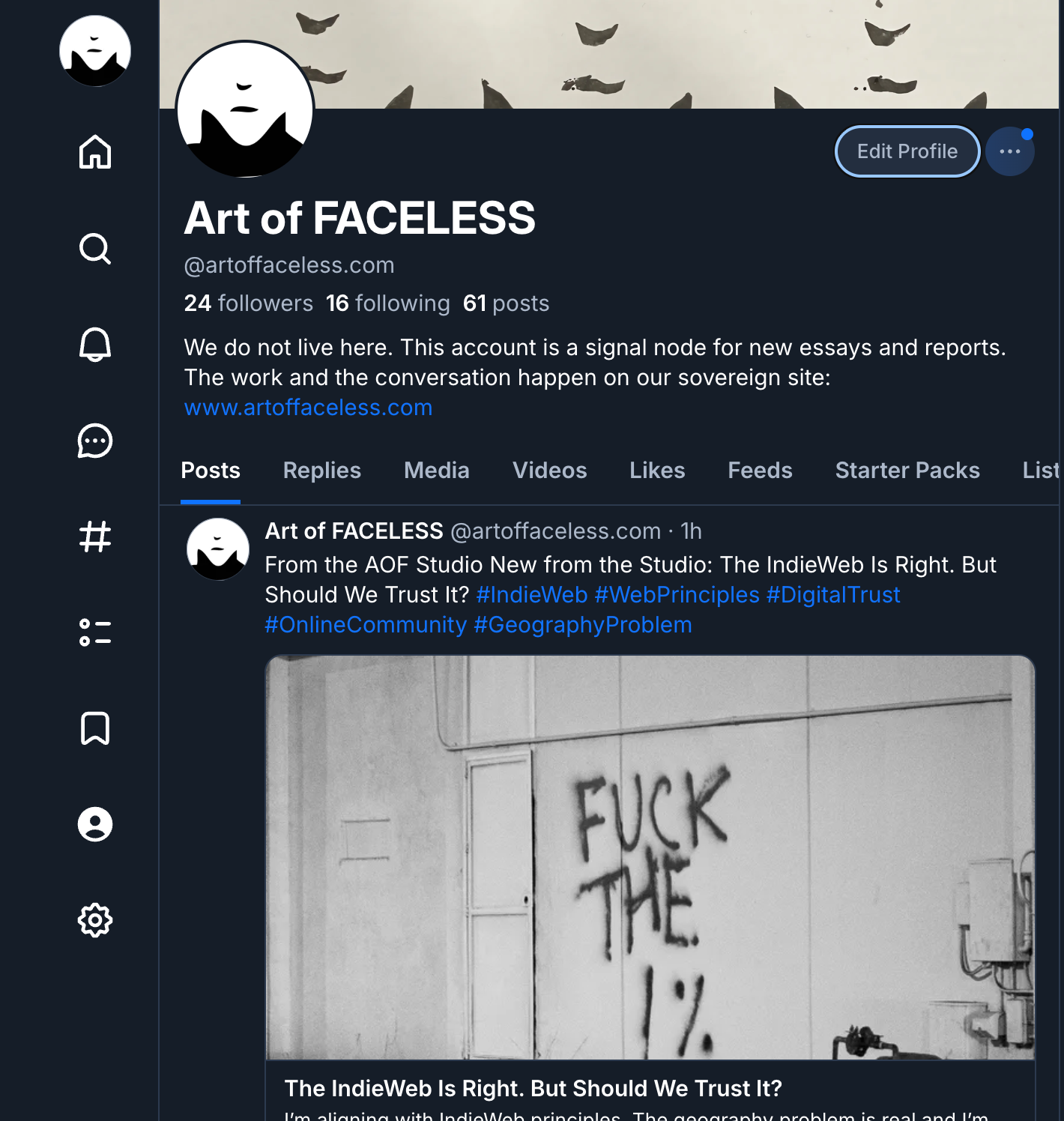
I'm aligning with IndieWeb principles. The geography problem is real and I'm naming it. The class problem is real and they know it. The institutional gravity problem is real and it hasn't gone away just because there's now a meetup in Edinburgh. Then I tried to actually join. Seven updates follow.
ZineGlitch · Art of FACELESSOpinion · The Open WebLloyd Lewis · 28 April 2026 · Cardiff, Wales
The IndieWeb Is Right. But Should We Trust It?
Strip the developer-speak and the core of IndieWeb is embarrassingly simple: own your domain. Publish there first. Don't hand your creative output to a platform that can delete it, monetise it, or disappear overnight. Sound familiar? It's basically what we've been advocating since 2010. Apparently there's now a community wiki for that.
AOF Position
Aligning with IndieWeb principles. Not joining the club. artoffaceless.com is the hub. Always has been. We were IndieWeb before IndieWeb had a name for it.
The geography problem
Nine consecutive Summits. One city. One country. Cardiff has no chapter.
Let me tell you what happens in my gut the moment I encounter a community built around principles.
It seizes. Every time. Doesn’t matter how good the principles are. Doesn’t matter if I agree with every single word. The visceral punk Pavlovian response fires before the rational brain gets a look in: another wiki, another code of conduct, another set of founding documents that’ll be framed on a wall while the founders quietly negotiate the acquisition.
Some of that sounds like Art of FACELESS (oh the irony!).
I’m now ‘retired’. I’ve watched this happen enough times that the pattern recognition is basically involuntary now. Good people. Good ideas. A community forms. A nonprofit status gets filed. Sponsors appear. A travel scholarship fund gets announced for “underrepresented groups.” The flagship event stays in the same city for nine years running. Then one day you look up and someone’s driving a Porsche and explaining, very patiently, why the corporate partnership is actually fine.
Strip the developer-speak and the core of IndieWeb is embarrassingly simple: own your domain. Publish there first. Own your content. Don’t hand your creative output to a platform that can delete it, monetise it, or disappear overnight and take everything with it. Sound familiar? Yeah, it’s basically what we’ve been advocating since, like, 2010 when the writing was on the wall of T&Cs of Facebook et al.
That’s it. The POSSE model — Publish on Your Own Site, Syndicate Elsewhere — is a formal name for what any creator with a functioning brain should have been doing all along. Put it on your turf. Push it outward. Don’t mistake the platform’s algorithm for your audience.
Art of FACELESS has operated this principle without the acronym. artoffaceless.com is the hub. Always has been. Everything else is signal distribution. We’ve watched platforms eat people’s entire catalogues — years of work, gone because a company pivoted or an account got flagged or a moderator had a bad day. We built accordingly. Apparently there’s now a community wiki for that.
Fair enough.
The Geography Problem
Here’s where I get difficult. And specific.
IndieWeb was founded in 2011 by Tantek Çelik and Aaron Parecki, out of Portland, Oregon. The annual IndieWeb Summit — their flagship gathering — was held in Portland every single year from 2011 to 2019. Nine consecutive years. One city. One country. Their own fundraising copy, to this day, describes “motivated local groups all over the US Europe” — no comma, note, between US and Europe, as though the second is a footnote to the first.
Parecki’s day job is Director of Identity Standards at Okta — a major commercial identity management corporation. Çelik works on web standards at Mozilla, which runs on a budget north of half a billion dollars annually. These aren’t garage hackers. They’re credentialled standards professionals with deep institutional roots in the American tech ecosystem. That’s not automatically disqualifying. But it is context.
Their past Summit sponsors have included GoDaddy. I’ll let that sit there for a moment. GoDaddy — the domain registrar best known for predatory upselling, domain parking fees, and building the most hostile possible onboarding experience for non-technical users — was welcomed as an aligned sponsor of a movement supposedly about empowering independent creators. That tells you something about whose independence they were imagining.
The founding event geography tells you the rest. Portland. SF. NYC — the latter hosted at the New York Times offices and Mozilla Manhattan. These aren’t neutral venues. These are the rooms where a particular class of internet professional is already comfortable. A certain kind of person can travel to Portland for a conference on short notice. Most people on earth cannot.
Most people, at the time of writing, in Europe, wouldn’t want to.
Now — and I’m going to be fair here, because fairness is the job — by 2025, events were running in Edinburgh, Düsseldorf, Nuremberg, and Bengaluru. There’s a Homebrew Website Club meeting in a café near Waverley Station. Online sessions carry GMT timezone tags. The infrastructure is genuinely internationalising (even if it is with a z).
I’ve seen this before too. Diversity initiatives. Geographic expansion. A Bengaluru meetup listed next to years of Portland Summits. It can be real. It can also be the kind of thing that gets announced to deflect the criticism while the centre of gravity doesn’t actually move. I don’t know yet which this is. What I know is that Cardiff — a capital city, in one of the poorest regions of Western Europe, in the country that arguably gave the world the concept of public digital infrastructure — has no chapter. Neither does most of working-class Europe. The Global South is represented by a single physical event in one Indian city.
I’m watching. Sceptically. From Wales.
The Class Problem (Which They Know About)
To their credit, IndieWeb’s own community has been arguing about this since 2018. Their principles list — ten items — reads almost entirely as a developer manifesto. Build what you need. Use what you make. Open source your stuff. Document your stuff. The accessibility critique has come from inside the house, repeatedly, with one commentator noting that the basic “just buy a domain and upload your files” framing “automatically excludes a huge number of people who will not or cannot spend money on something like this.”
That’s a class analysis. It’s correct. And the fact that IndieWeb’s own people have been making it for seven years without it being resolved tells you something about the structural limits of principle-led communities that emerge from positions of privilege.
The last of their ten principles, the only one that’s genuinely universal? “Have fun.” Tagged on at the end like someone remembered humans exist. It’s also a bit naff to be honest.
What Actually Checks Out
I looked at their finances. I’ll give them this: they’re genuinely transparent. Open Collective, publicly auditable. Their operating costs are around two hundred dollars a month — hosting, domains, infrastructure for the community projects. That’s it. No salaries. No executive compensation. No six-figure anything visible in the ledger.
I was wrong about that specific fear, at least for now. Credit where it’s due. The books are open and the books are modest. That’s rarer than it should be, and it matters.
Why AOF Is Aligning Anyway
None of the above changes the underlying truth of the thing.
The corporate web is actively hostile to independent creators. Twitter/X proved it at scale. The Crew shutdown proved it for games. Google’s pivot to AI-generated results is systematically dismantling the discoverability of individual sites that spent years doing everything right. The economics of platforms have always been: your content is the product, your audience is the asset, and when the numbers change, you’re renegotiable.
IndieWeb, whatever its limitations, is one of the few organised expressions of a counter-position that isn’t simultaneously trying to sell you an alternative platform. The principles — own your domain, publish first on your own site, syndicate outward — map directly onto what AOF has been building for years.
For us, artoffaceless.com is not an outpost. It’s the operation. The Ghost stack we run isn’t incidental — it’s chosen for POSSE compatibility, for SEO persistence, for keeping our analytics answerable to us and not to a social platform. Ghost’s network, largely invisible to casual users, quietly builds web presence in ways that platform-first publishing simply cannot. That’s an IndieWeb-aligned decision we made before we knew IndieWeb had a name for it.
So we’re acknowledging convergence. We’re not joining a club.
The Honest Position
I’m aligning with IndieWeb principles. The geography problem is real and I’m naming it. The class problem is real and they know it. The institutional gravity problem is real and it hasn’t gone away just because there’s now a meetup in Edinburgh.
But the principles? Own your identity. Own your content. Publish on your own ground. Don’t let a corporation hold the keys to your creative life.
Those aren’t American principles. Those aren’t developer principles. Those are the principles of anyone who’s ever had a platform pull the rug, a landlord change the terms, a gatekeeper decide you’re no longer convenient.
NOTE: Twitter. In 2026. On an independence platform.
Retry?
Update — published same day
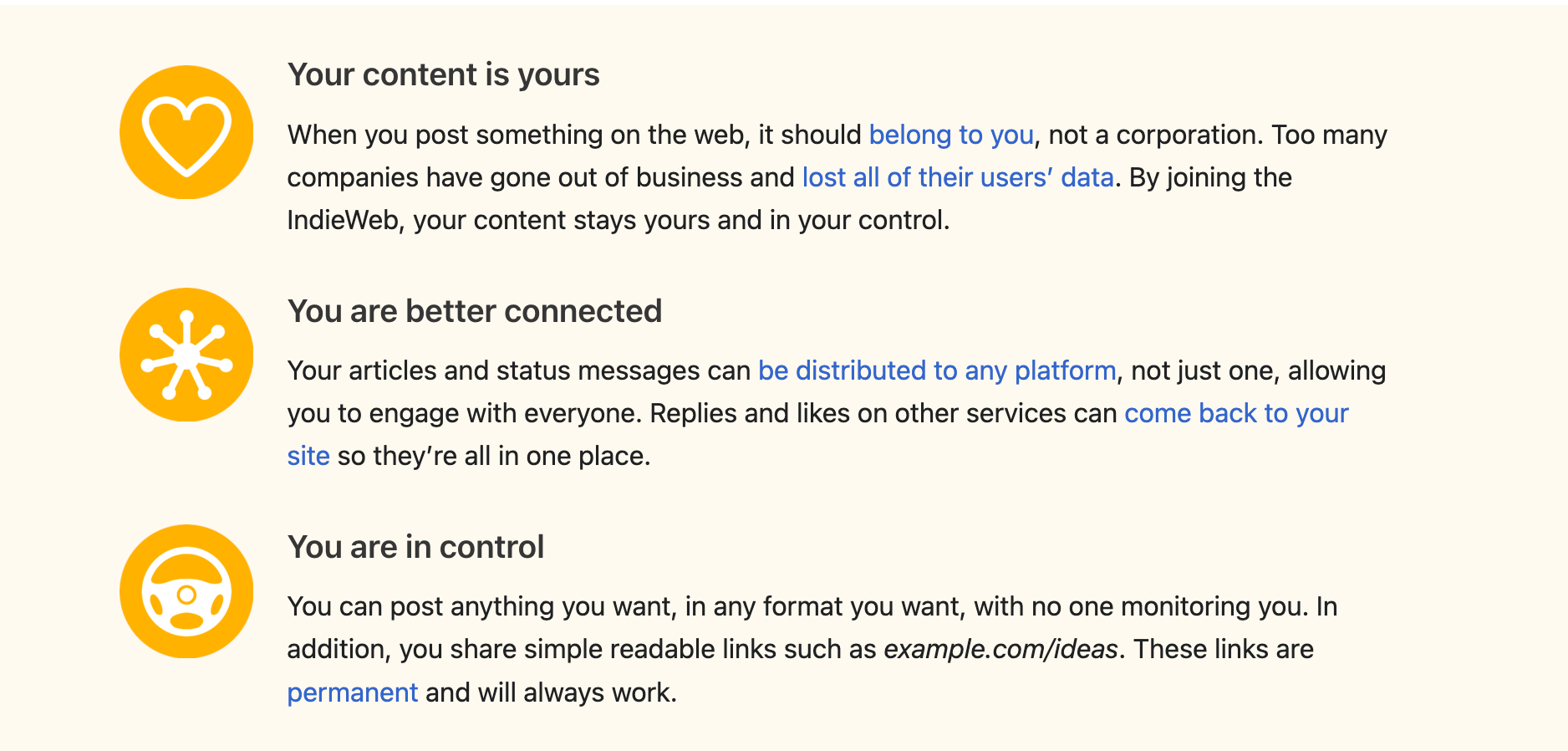
After I filed this piece, someone sent me a screengrab of IndieWeb's own principles page. Three promises, rendered in cheerful orange icons.
Screengrab of IndieWeb's core principles taken from their website on 28/04/2026
"Your content is yours.""You are better connected.""You are in control."
And then this: "These links are permanent and will always work."
Permanent. I want you to sit with that word for a moment.
Now show me the contract.
There isn't one. There's a wiki page. There's a community ethos. There's the goodwill of two founders who currently hold senior positions at Okta and Mozilla. What there is not — anywhere in the IndieWeb's legal architecture — is a binding mechanism that prevents acquisition, dissolution, or a quiet pivot the moment the right number lands in the right inbox.
That's not a collective or co-operative.
We've watched this sequence before. del.icio.us. Last.fm. Tumblr. A hundred smaller communities that believed the culture was the protection. It wasn't. Culture doesn't survive a liquidation event. "Permanent links" is a design principle, not a deed of ownership.
So. What happens if Elon offers them a billion dollars and they accept?
The honest answer is: nothing stops them. Nothing at all.
I'm still aligning with the principles. I'm just naming, clearly and for the record, that principles without legal architecture are a promise made in good faith by people who may not always be in a position to keep it. That's not a conspiracy. That's just how organisations work when the money gets serious.
Own your domain. That part, at least, is actually yours.
1 — Web sign-in via Bluesky handle @artoffaceless.com
Status
FAIL — rel=me not detected
Fix applied
Manually added rel=me tag to Ghost header injection
Attempt
2 — Re-validate after header edit
Status
FAIL — Bluesky "does not link back"
Note
Bluesky has no dedicated website field. Profile bio link ignored by validator.
Attempt
3 — IndieAuth endpoint added to header
Status
FAIL — Same error. "Does not link back."
Time elapsed
Approx. 3 hours. Most people would have stopped at step one.
Update Two — same day, getting worse
I tried to register artoffaceless.com with IndieWeb. We've owned that domain and variations of it for over a decade. It is, by any reasonable definition, ours.
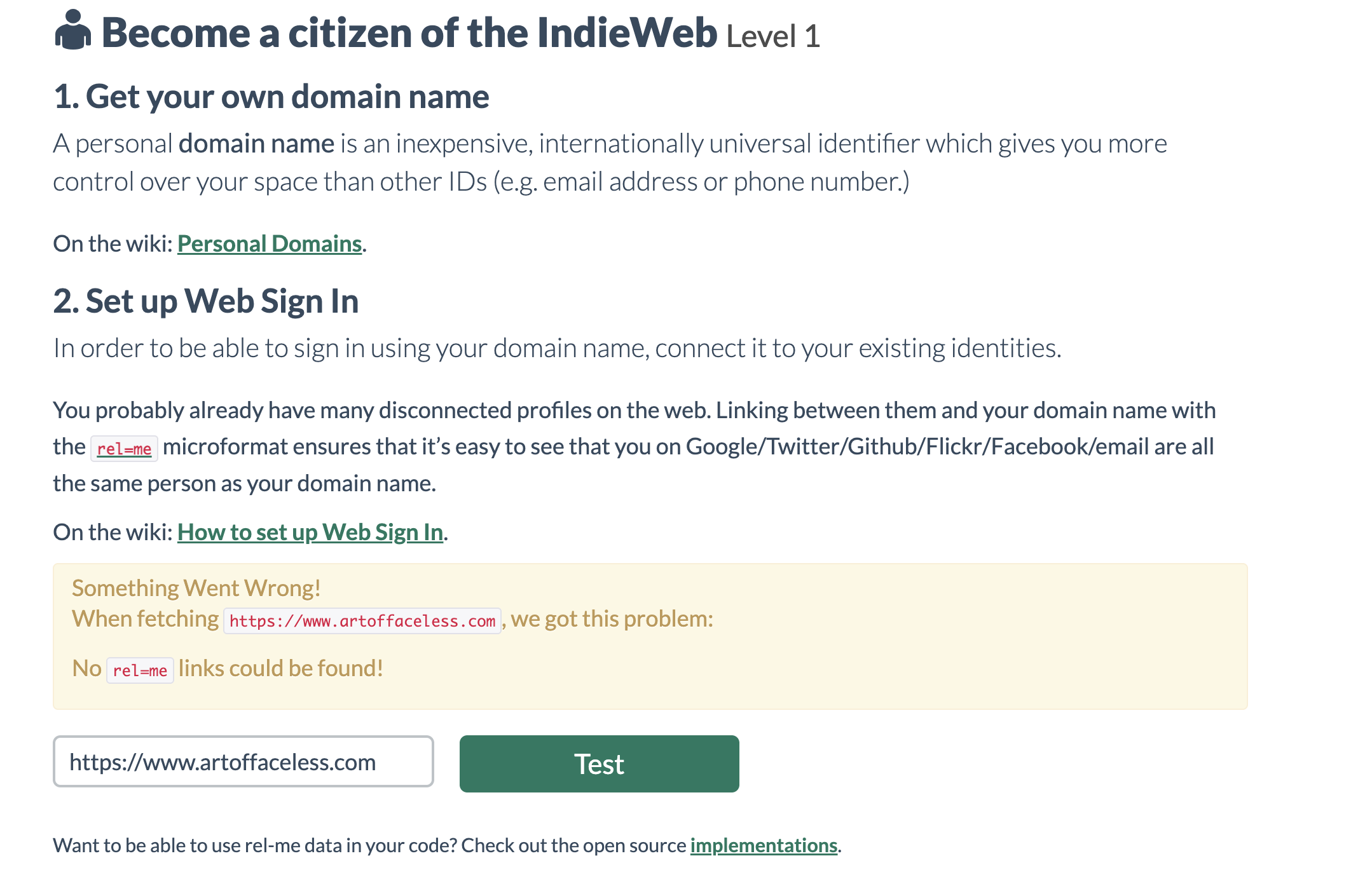
Screengrab of IndieWeb's web sign in test function from their website on 28/04/2026
Step 2 of their onboarding — "Set up Web Sign In" — returned an error. No rel=melinks could be found. To fix this, I needed to manually add code to my site's HTML — a rel=me tag in the header pointing to a social media profile — so their system could verify who I am.
The list of platforms they suggest for this verification: Google. Twitter. GitHub. Flickr. Facebook.
Twitter. Facebook. In 2026. On an independence platform.
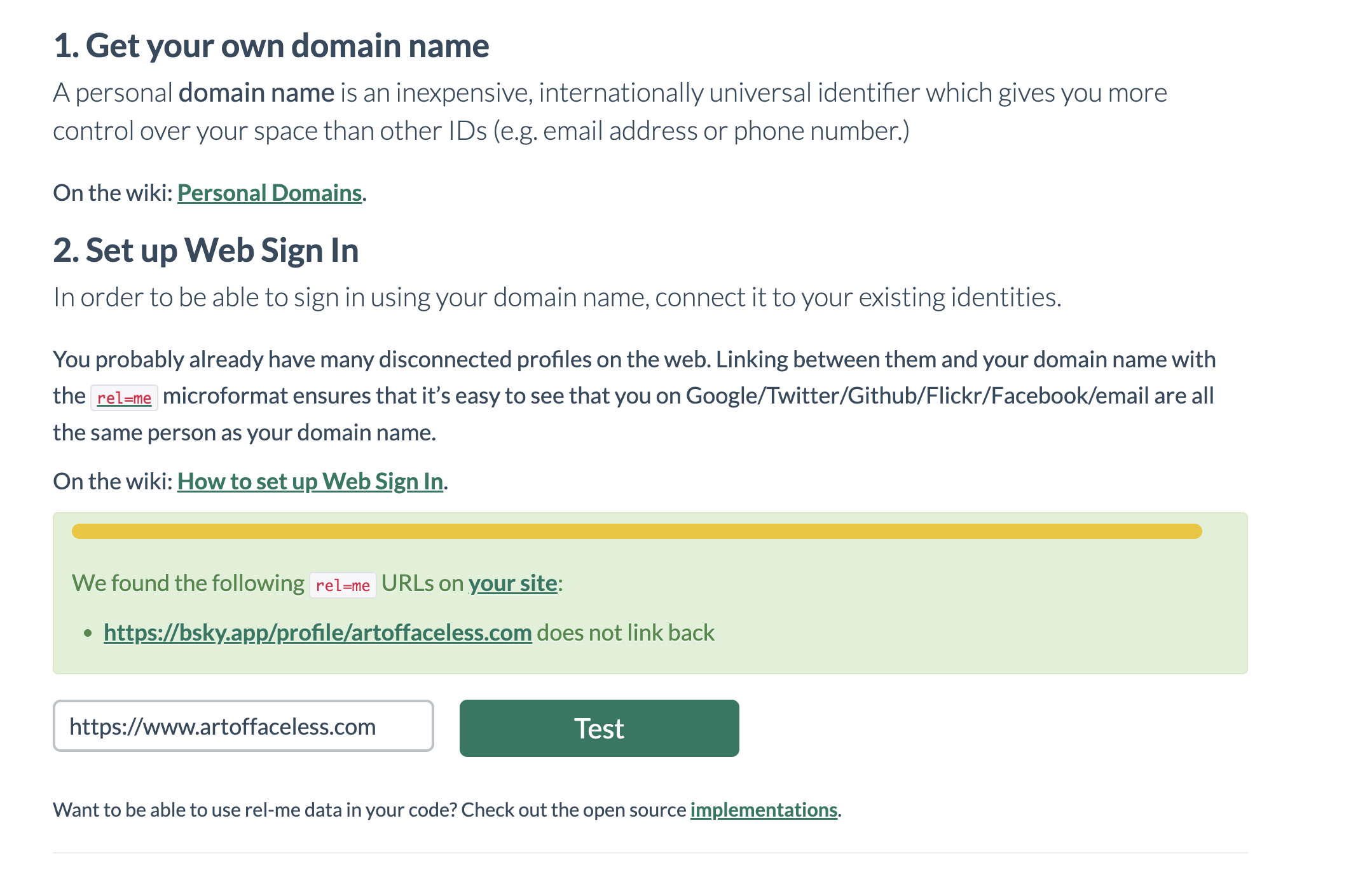
I added the code. Our Bluesky handle, for context, is our domain — @artoffaceless.com — verified through Bluesky's own cryptographic domain check. By any reasonable measure, domain ownership is not in question. The validator found the link this time, but returned a new error: Bluesky "does not link back."
So I went to fix that on the Bluesky side. Here's the thing: unlike X, Bluesky has no dedicated website field in the profile. Our site was already linked in the profile description. It didn't matter. Their validator couldn't confirm the handshake.
Still not verified. Four steps in. One manually edited HTML header, one platform limitation outside our control, and a domain we own that the IndieWeb system still cannot formally recognise.
This is where most people would have given up.
Strike that. The HTML step would have ended it for most people long before this.
I wrote in this piece about the class problem — about the gap between "own your domain" as a principle and the technical knowledge required to actually participate. I didn't expect to document it in real time on the day of publication. Here it is anyway. Screenshots available. All of it happened exactly as described.
The principles page says your domain is your identity. The onboarding page says your identity requires a corporation to countersign it. And if that corporation's platform architecture doesn't accommodate the handshake, you're simply not visible — regardless of how long you've held the ground.
I'm still joining. But I'm filing all of this under evidence, not oversight.
Update Three — still the same day
After publishing afterthought two, someone pointed me toward the platform-independent validation route. It exists. It's called IndieAuth — their own protocol — and it doesn't require Google, Twitter, Facebook, or Bluesky to countersign anything. Your domain authenticates you directly. No corporate intermediary.
To be clear: this is what IndieWeb says it's for. This is the thing.
Here's how you access it. You add two lines to your site's HTML header:
Then their system can see you as an independent entity, authenticated by your own domain, beholden to nothing.
That information is three wiki pages from the front door.
The onboarding page — the one a new arrival sees first, the one that returned an error on artoffaceless.com, the one that listed Twitter and Facebook as suggested verification platforms — does not mention this route. It sends you to social media. The independent path requires you to already know it exists, which requires you to have gone looking, which requires you to not have given up at the HTML injection step, which most people would have.
IndieWeb's own wiki acknowledges this directly — that tutorials go out of date and "can frustrate or at least disillusion" newcomers. That's not reassuring. That's an admission that the gap between the principles and the experience has been visible long enough to document.
The independent route works. The welcome mat still points the wrong way.
I've added the header tags. I'll report back on whether it clears.
It didn't.
Final state, after one day, four attempts, three different technical configurations, and more wiki pages than anyone without a development background should be expected to read:
https://bsky.app/profile/artoffaceless.com does not link back.
We own the domain. Our Bluesky handle is the domain. The IndieAuth endpoint tags are in the header. The rel=me link is in the header. artoffaceless.com is a functioning, continuously maintained independent site.
The IndieWeb validator still cannot confirm we exist.
I'm done trying to validate. The principles are right. The welcome mat points the wrong way. The independent path is three wiki pages deep and still doesn't work when you find it. And somewhere in Portland, I assume, someone is giving a talk about digital independence to a room full of people who already know how to edit HTML.
We're in. We're just not verified. Make of that what you will.
1 — Web sign-in via Bluesky handle @artoffaceless.com
Status
FAIL — rel=me not detected
Fix applied
Manually added rel=me tag to Ghost header injection
Attempt
2 — Re-validate after header edit
Status
FAIL — Bluesky "does not link back"
Note
Bluesky has no dedicated website field. Profile bio link ignored by validator.
Attempt
3 — IndieAuth endpoint added to header
Status
FAIL — Same error. "Does not link back."
Time elapsed
Approx. 3 hours. Most people would have stopped at step one.
Update Four — the same day! The conclusion I didn't expect to write.
Let me tell you what I've established over the past few hours.
Art of FACELESS owns artoffaceless.com. We publish there (here) first. We syndicate outward. We run Ghost on a custom domain with a newsletter stack we control. We have a Bluesky handle that is our domain. We have active UK trademarks. We have fifteen years of documented independent creative work that has never lived primarily on a corporate platform.
By every principled definition IndieWeb offers, we are IndieWeb. We were IndieWeb before we knew IndieWeb had a name for it.
Their validator still cannot confirm we exist.
Here's why. Ghost — the publishing platform most naturally aligned with IndieWeb's stated principles, the one that talks loudest about independence and ownership, the one whose default theme was specifically designed so you can launch without writing a single line of code — rejected microformats2 support in 2013. A developer submitted a pull request. Ghost's founder closed it. They chose Schema.org instead. Google's format. Then Twitter Cards. Then Open Graph. Silo-specific, oligopoly-friendly structured data, baked into every default theme they've shipped since.
Source, Ghost's current default theme (the one we use), has no microformats2 support. Level 2 IndieWeb compliance on a Ghost site requires editing Handlebars template files — not a code injection, not a setting, not a toggle. Theme development. Which means a developer. Which means money, or knowledge, or both.
So the platform that says "launch without writing a line of code" is incompatible with the community that says "your domain is your identity" because of a decision made in a pull request eleven years ago.
None of those decisions were made by us. None of those rooms had anyone like us in them.
And this is where I land, after an afternoon of HTML headers and wiki pages and validator errors and a Level 2 screen that appeared without Level 1 ever confirming we'd passed:
The IndieWeb is right. The principles are correct. Own your domain. Publish there first. Don't let corporations hold the keys to your creative life.
We've been doing that.
But the IndieWeb's implementation — its validator, its onboarding, its dependency on platform decisions made by Ghost and Bluesky and a pull request rejection from 2013 — cannot see us. A working-class multimedia collective from Cardiff, fifteen years deep, doing exactly what the principles describe, is invisible to the system built to recognise it.
I said at the start that I'd watched communities fail to include the people they claim to want. I said I was watching, sceptically, from Wales.
I've seen enough.
We're not joining. We're just going to keep doing what we've always done — on our own ground, on our own terms, fifteen years and counting — and let the validator catch up when it's ready.
It knows where to find us. It always did.
IndieWeb Onboarding · "Anyone Can Do This"Status: Ongoing
?
Buy a domain — costs money. Not everyone has it.
✕
Set up Web Sign In via supported provider— Twitter. GitHub. Google. Facebook.
✕
Add rel=me tag to site HTML header— requires code injection knowledge
✕
Achieve Level 1 validation— Bluesky not a supported provider
✕
Find the IndieAuth independent route— three wiki pages from the front door
→
Edit Ghost Handlebars templates for Level 2 — requires a developer
Not everyone has the executive function to navigate this. Not everyone has the educational background that makes a Handlebars template legible rather than hostile. Disability. Cognitive difference. Neurodivergence. Chronic illness. These aren't edge cases. They're the people the principles claim to want.
Update Five — the one where I get there before you do.
Someone will point this out, so let me do it first.
We publish this on Ghost Pro. We don't self-host. Ghost's servers, not ours. A US-adjacent infrastructure layer beneath all our talk of sovereignty. Fair point. Have it.
Here's the full picture with the nuance though.
Ghost Pro costs us £300 a year. That's the tier that gives you the features a serious independent publication actually needs — custom integrations, analytics, newsletter functionality, the works. On top of that, domain registration. Buy three years upfront and it's cheaper, but it's still a recurring cost that doesn't go away. For a small independent collective with no revenue stream from the site itself, £300 a year is not nothing. We have no sponsors. We have no backers. It's a considered decision, not a casual one.
Now. Ghost is a non-profit. The Ghost Foundation is legally structured as such, which doesn't make it invincible but does change the incentive architecture considerably. It cannot be acquired in the conventional sense without dissolving the foundation. There's no exit event coming. No VC looking for a return. That matters.
Ghost is also fully open source. If Ghost Pro disappeared tomorrow — if the Foundation collapsed, if the terms changed, if something went catastrophically wrong — we could pull every piece of content and spin up a self-hosted instance. The lock-in is convenience, not architecture. We are renting the managed service, not the software. That's a real and meaningful distinction.
But let's be honest about why we're not self-hosting. Self-hosting Ghost requires a VPS. It requires server administration. Security maintenance. SSL certificate management. Backup protocols. Dependency updates. When something breaks at 2am it requires someone who knows what they're doing to fix it.
And here's where I'm going to use a word I don't deploy lightly: malarkey.
The assumption baked into "just self-host" — the assumption baked into IndieWeb's entire Level 2 onboarding, into the "just edit your theme files" solution, into the "just implement microformats2" guidance — is that the person on the other end of the screen has the cognitive bandwidth, the technical education, the physical and neurological capacity, and frankly the time and money to execute these things as casually as the instruction implies.
That assumption is malarkey.
Not everyone has the executive function to navigate four wiki pages deep into a technical specification at the moment they need it. Not everyone has the educational background that makes a Handlebars template file legible rather than hostile. Not everyone has the working memory to hold a debugging sequence together across multiple browser tabs while also running a creative practice, managing health conditions, caring for people, or simply living a life that doesn't centre on web infrastructure.
Disability. Cognitive difference. Neurodivergence. Chronic illness. These aren't edge cases in the population of people who might want an independent web presence. They are a substantial and systematically underserved constituency who are told, over and over, by IndieWeb and Ghost and the entire open source ecosystem, that independence is available to anyone — and then handed a command line.
£300 a year for Ghost Pro buys us a managed infrastructure we can actually operate without a systems administrator on the team. For us, right now, that's the accessibility tool. That's the ramp instead of the stairs. It costs us sovereignty at the infrastructure layer and we've made that trade consciously because the alternative — self-hosting — would consume the time and cognitive resources we need for the actual work.
We're aware of the irony. We're naming it. We're not pretending it isn't there.
One more thing, while we're here. IndieWeb's operating costs are listed on Open Collective as approximately $200 a month. I mentioned this earlier as evidence of their financial transparency and relative modesty. I'm leaving that credit in place — the books are open and that matters.
But $200 a month for the infrastructure of an entire international community's technical foundation is a number that deserves scrutiny of its own. What's not in that figure? Volunteer labour? The unpaid hours of developers maintaining the tools, updating the wiki, running the validators, answering questions in the chat? The $200 is the server bill. Is the real operating cost carried by people who aren't on the ledger?
That's a different piece. But it's coming.
Ghost's position
Independence Platform
"Launch without writing a line of code." Open source. Non-profit. POSSE-compatible. Chosen for a reason.
The actual dependency chain
Ghost default theme → no microformats2IndieWeb Level 2 → requires microformats2Fix → edit Handlebars templatesHandlebars → theme developmentTheme development → developerDeveloper → money or knowledge
Update Six — I owe them an apology. Sort of.
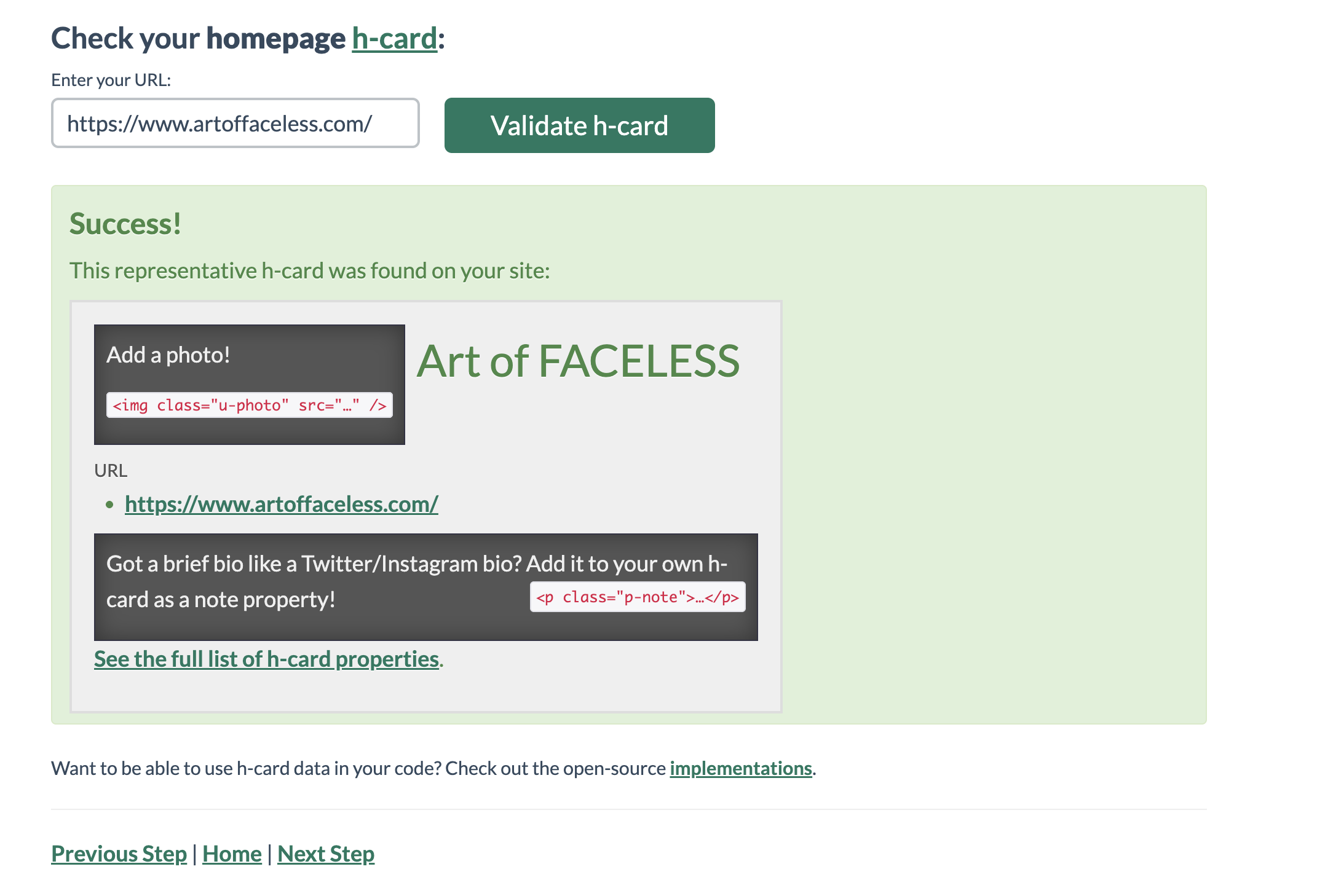
I added one line of h-card code to the Ghost header injection.
Success.
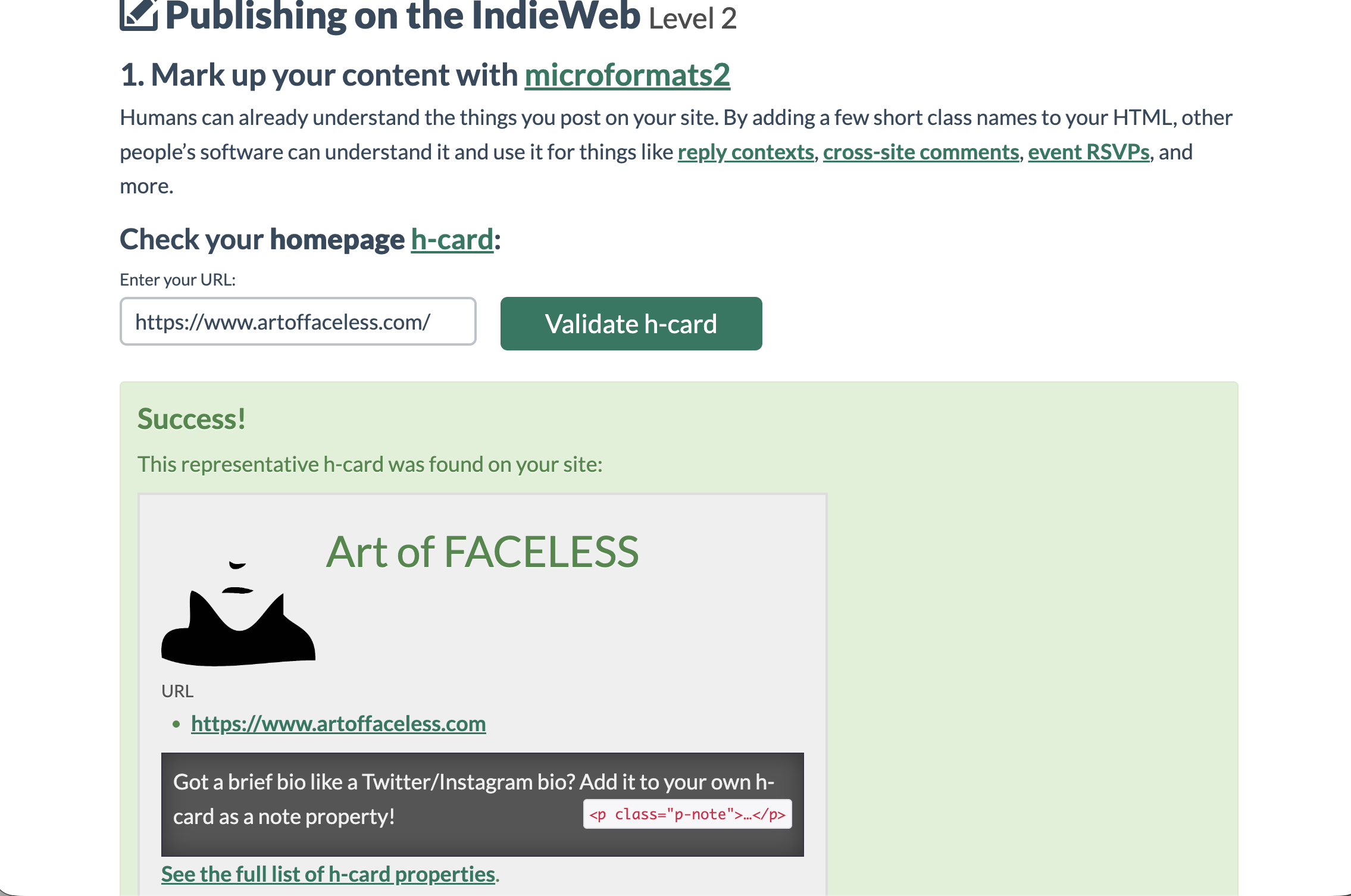
After a full afternoon. After four validator errors, three technical configurations, two HTML header rewrites, one rejected 2013 pull request, and approximately one thousand words of righteous Welsh scepticism — one line of code cleared Level 2.
artoffaceless.com is now a verified IndieWeb citizen.
Their validator has one remaining suggestion. It would like us to add a photo.
We have operated under a strict faceless protocol since 2010. No biometric data. No images of the people behind the work. Faces are not the point. Absence is the architecture.
The IndieWeb validator would like us to add a photo.
We're going to have to disappoint it.
Update Six · After one full afternoon · Four validator errors Three configurations · Two header rewrites · One rejected 2013 pull request
Level 2 Cleared.
One line of h-card code. That's it. That's all it was.
Their validator has one remaining suggestion.
It would like us to add a photo.
We have operated under a strict faceless protocol since 2010.
The faceless logo — designed in 2012, a year before their first Summit — is now sitting in their h-card validator preview. It was always the only face we had. It will do.
But we're in. Genuinely, formally, verifiably in — the faceless logo, designed in 2012, a year before their first Summit, sitting in their validator's h-card preview next to our domain in 2026. It was always the only face we had. It will do.
It took one way longer than I would have liked and I've reported this in real-time. Four validator errors. Three technical configurations. Two HTML header rewrites. One rejected pull request from 2013 that wasn't ours. Six afterthoughts. And a logo that predates the community that just verified it.
The principles were right all along. The welcome mat still points the wrong way. Both things remain true.
This is NOT an easy open web welcome.
We're watching. Less sceptically than earlier afterthoughts. Still from Wales.
Bluesky launched 2023. It is 2026. The login screen still says "This is not a supported authentication provider." That is a decision. Somebody made it. Nobody reversed it.
If you took the IndieWeb principles seriously enough to leave Twitter, you cannot log in. The door is locked. The key belongs to someone else.
artoffaceless.com · Est. 2010 · No Twitter account required.
Update Seven — the one that changes everything.
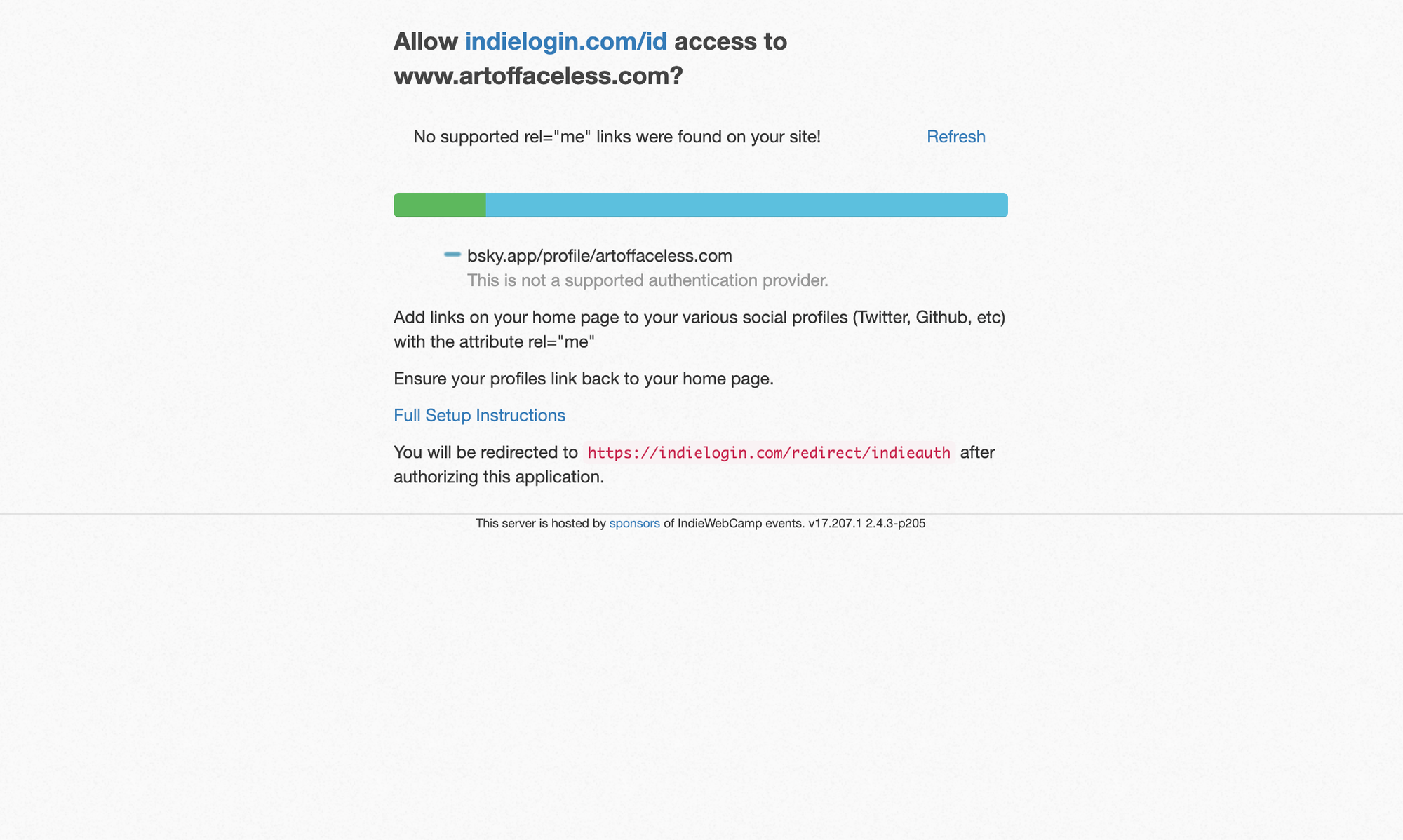
I tried to log into IndieWeb.
Not to validate. Not to check a number on a progress bar. To actually participate — to access the wiki, to engage with the community, to do the thing the principles invite you to do.
The login screen is provided by indielogin.com. A third-party centralised authentication service, hosted by sponsors of IndieWebCamp events, asking permission to access artoffaceless.com in order to confirm that artoffaceless.com is who it says it is.
A centralised login gate. For an independence community. With a progress bar.
Our Bluesky profile was found. The one whose handle is our domain. The one that proves domain ownership through cryptographic verification. The one that is, by any technical definition, the most IndieWeb-compatible social presence we could have built.
The response: "This is not a supported authentication provider."
The supported providers listed: Twitter. GitHub. Etc.
Twitter. For the third time in this piece. On the independence platform. Still.
Let me be precise about what this means — not for us, but for everyone.
If you took the IndieWeb principles seriously enough to leave Twitter, you cannot log in.
If you never had a GitHub account because you're not a developer, you cannot log in.
If you routed your identity through your domain and Bluesky because that's what the open web told you to do, you cannot log in.
If you are a working-class creator without a technical background who did everything right — owned your domain, published there first, syndicated outward, built independently — but didn't maintain accounts on the corporate platforms that IndieWeb exists to free you from, you cannot participate in IndieWeb.
The door is locked. The key is a Twitter account.
Or GitHub — which hasn't been an independent open source platform since Microsoft acquired it in 2018 for $7.5 billion. Or Google. Or Facebook. Or Flickr, owned by SmugMug, a private US company. Every supported provider on that list is a US corporation. There is no ethical option. There is no independent option. The list exists and that is the list.
And even if you chose the least-worst option on it, you'd still be granting indielogin.com — a third-party centralised authentication service hosted by IndieWebCamp sponsors — access to your domain. The full chain looks like this: corporate platform confirms your identity, third-party service accesses your site, IndieWeb lets you in. Three entities between you and participation. None of them are you. None of them are indie.
The door is locked. The key belongs to someone else.
This is not a bug. This is not an oversight they haven't gotten around to fixing. Bluesky launched in 2023. It is 2026. The login screen still says "This is not a supported authentication provider." That is a decision. Somebody made it. Nobody reversed it.
I started this piece with a visceral punk Pavlovian response — the immediate distrust of communities built around principles. I did the research. I credited what deserved credit. I documented the geography problem, the class problem, the legal architecture problem, the onboarding failures, the Ghost problem, the disability and cognitive access problem. I tried, genuinely and in good faith, to join.
And at the final gate, after a full day, the system told me what I suspected at the start.
The IndieWeb is right. The principles are correct. Own your domain. Publish there first. Don't let corporations hold the keys to your creative life.
But the IndieWeb's own login screen hands those keys straight back to Twitter and GitHub. The independence community requires corporate permission to enter. The open web has a velvet rope. And the people most likely to be standing on the wrong side of it are exactly the people the principles claim to want.
We are on the wrong side of it. We are staying there.
artoffaceless.com. Est. 2010. No Twitter account required.
Lloyd Lewis is a writer and co-founder of Art of FACELESS, an independent multimedia collective based in Cardiff, Wales, operating since 2010.
Disclaimer: This article is published as an opinion piece under the Lloyd Lewis editorial byline for Art of FACELESS. All factual claims regarding IndieWeb’s founding, event history, finances, and sponsorship are drawn from publicly available sources including IndieWeb’s own wiki, Open Collective ledger, and event archive — all of which are linked or verifiable independently. Readers are encouraged to consult primary sources. The views expressed are the author’s own and do not constitute legal, financial, or organisational advice. Art of FACELESS has no commercial relationship with IndieWeb, any of its named founders, or any of the organisations referenced in this piece. AOF’s alignment with IndieWeb principles, as stated above, is based solely on shared values and carries no financial or contractual arrangement.