"Players aren't going to visit a webpage for lore. They're going to navigate a world that exists whether or not they're playing. That distinction matters enormously."
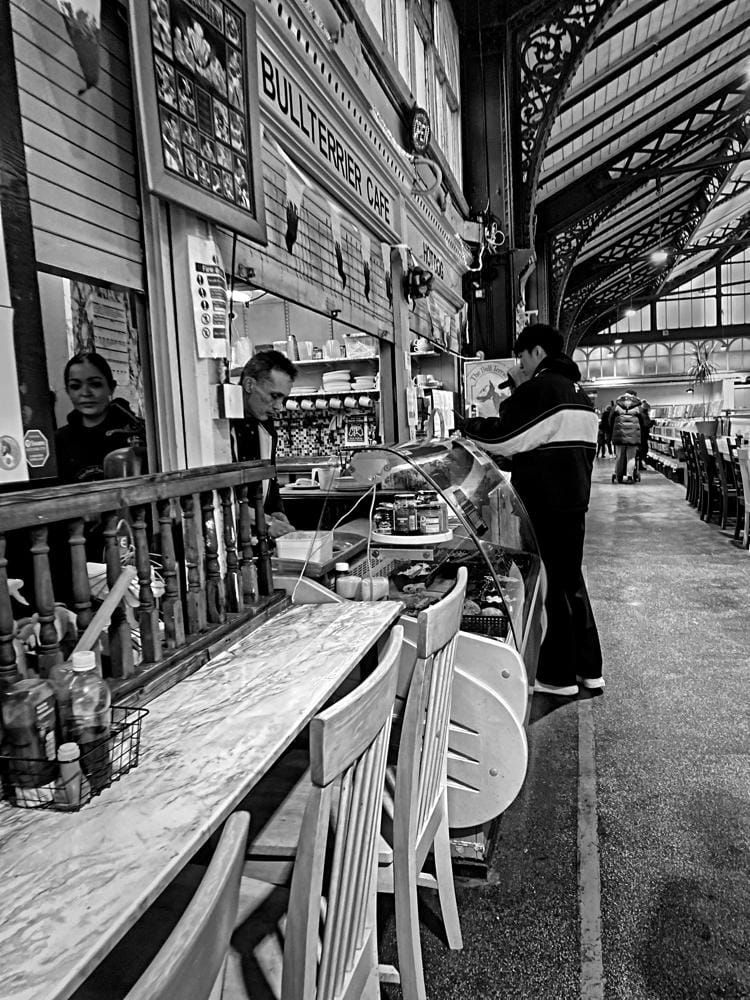
Cardiff Market has been here since 1891. Upstairs, in the Bull Terrier Cafe that tourists miss and locals don't have to think about, the smell of gravy and hot pastry sits over everything like a comfortable argument. Lloyd Lewis is already eating when I arrive; pie, peas, chips, and gravy; no apology for starting without me.
A market trader two tables over is complaining about his pitch. Someone's child is performing a sustained tantrum near the stairs. Lloyd doesn't seem to notice any of it, or notices all of it and has long since stopped making the distinction.
I sit down. He offers me a chip dripping in gravy. I decline. We begin.
AWEN: You've been building something for a long time. Most people would have rebranded by now, pivoted, found something easier. Why hasn't Art of FACELESS collapsed into something more manageable?
LLOYD:
"Because manageable isn't the point. Manageable is what you become when you've accepted someone else's definition of success. AOF was never going to do that. It was built wrong, on purpose, for exactly the conditions we're in now."
He takes a forkful of pie. Continues without ceremony.
"Everything we've refused to do, give the work to platforms, make it easy to consume, smooth out the difficult edges, all of that refusal is infrastructure now. The awkward decisions compound. They become scaffolding."
AWEN: Scaffolding. You use that word deliberately.
LLOYD:
"I use it precisely. The Hollow Circuit isn't a game with a website attached. The network, the open web nodes, the archive, the fiction running across Blogger and Neocities and the bulletin boards, that IS the game. Players aren't going to visit a webpage for lore. They're going to navigate a world that exists whether or not they're playing. That distinction matters enormously."
AWEN: Some people will read that and hear delusion. A small independent collective from Cardiff claiming they've built a new form of interactive experience.
Lloyd puts his fork down. Not defensively. More like someone making room to speak properly.
LLOYD:
"Let them. The work doesn't need their permission to be what it is. I come from ISO documentation and pharmaceutical design thinking and research. I don't make claims I can't evidence. The architecture is documented. The trademarks are registered. The fiction has been running in public for over a decade. The lore isn't written to support the game, the game is the front door to years of accumulated world. That's not a claim. That's a catalogue."
A burst of noise from the market below rises and fades. He picks the fork back up.
AWEN: Tell me about the engine choice. RPG Maker MZ. People are going to laugh.
LLOYD:
"Good. Let them laugh first. They'll stop when they play it."
He almost smiles.
"MZ has a reputation problem. It's seen as the engine for teenagers making stock-asset JRPGs. We're using it to deliver a story-rich transmedia experience where the RPG mechanics function as punctuation, mini-games at strategic narrative moments and the VN is the primary register. The photography from Porto and Athens is in there. Lloyd MSUX's sound is in there. Seren's print sensibility is in there. V's fabrication work feeds back into the game through physical objects that carry codes. The engine is irrelevant. The vision isn't."
"Suda51 didn't need a AAA framework. He needed a singular worldview and the stubbornness to execute it. That's the model. People overcomplicate things. Just look at the sculptures you can make from Lego, for example. Lego was a toy when I was a kid. It's still just individual bricks it was back in the day. But just look at the artwork it's responsible for in 2026. Go look at the huge Welsh dragon in the St David's Centre. People would have laughed at any serious artist using Lego bricks as a medium to make that a few decades ago."
AWEN: You've been public about the open web philosophy — Blogger, Neocities, bulletin board structures. It reads as deliberately anachronistic. Is that romanticism or strategy?
LLOYD:
"It's neither. It's survival architecture."
He leans back slightly. The market noise settles into a lower register around us.
"Platform-dependent distribution is someone else's permission. Blogger shouldn't still exist. Neocities looks like 1997. The Late To The Party Games bulletin board structure reads as a relic. But none of them can be algorithmically gated, none of them can shadow-ban the work, none of them will deprecate the content because the engagement metrics don't justify the server costs. They just exist. Openly. Permanently linkable. That's not romanticism. That's the only infrastructure that can't be taken away."
AWEN: And social media?
LLOYD:
"Graffiti. We show up, leave the mark, leave. The post is an arrow. Never the destination. When we use those platforms, we are using them. They are not using us. The moment that equation inverts, we're gone."
AWEN: Steam. You've thought carefully about distribution. But Steam is DRM. That's a philosophical contradiction for a project built on open infrastructure.
He doesn't flinch at this. He was waiting for it.
LLOYD:
"It's a staged contradiction. Steam is where the indie audience lives right now. The discoverability is unmatched at launch. We use it for what it's good for, reach, credibility, the review profile that matters for what comes next. But we're GOG Patron subsribers and supporters. We believe in what they're doing enough to fund it. DRM-free is the correct permanent home for THC. A game about Cognitive Colonisation shipped exclusively through a platform that controls player access to content they've paid for would be a contradiction, people would rightfully call that out."
"Steam gets us in the door. GOG is where the work lives permanently."
AWEN: The physical objects. Merch that functions as game infrastructure. Codes in V's 3D printed pieces. Inserts in Seren's zines. You're distributing game content through objects that exist in the physical world in Cardiff, Wales and other cities and countries simultaneously.
LLOYD:
"That's the most ungovernable distribution method we have. No platform can deprecate a printed card. No policy change revokes a code that exists as a physical object in someone's hands. It just exists in the world. Forever, if they keep it."
He finishes the last of the chips. Sets the plate to one side with the quiet efficiency of someone who has already moved on mentally.
"The whole architecture is consistent. Open web, open distribution, physical as the ultimate open format. Every node in the network, digital or physical, is one that nobody can take away."
AWEN: Last question. This conversation, us sitting here, this interview, the conversation that produced the thinking you've just articulated, that becomes part of the game too?
LLOYD:
"Everything is. This will be published. That's not a creative decision at this point. It's just the truth of how AOF operates. The Hyperstition Architecture isn't a content strategy. It's a description of what was already happening. The fiction and the reality were always the same organism. We just named it."
He stands, checks his watch, pulls on his denim jacket. The market trader nearby is still arguing about his pitch. The child near the stairs has found a new grievance.
"There's no fanfare. It's just there. And it always was."
Lloyd Lewis left just as I finished the last line of this post. Outside, the market continued its argument with the world. The Hollow Circuit, in whatever version of Cardiff it currently occupies, continued writing us both.