Initializing...

The Creative Ecosystem & Affirmation Fatigue
The Creative Ecosystem ©2025 Art of FACELESS

The Creative Ecosystem & Affirmation Fatigue

Consumers take. Producers make. Decomposers break.


Share this post

By Lloyd Lewis

There’s a point in every creative’s life where you can no longer pretend a place, a platform, an economy of encouragement, a digital village fête of “You’ve got this!”is anything other than a biosphere. A living, wheezing, self-regulating ecosystem full of organisms that feed, feed on, parasitise, pollinate, or quietly decompose the remains of everything said and done.

Call it what it is:
A forest.
Some of us grow; some of us rot; some of us pretend to be trees while secretly plugging into a petrol generator round the back.

And so, for the sake of clarity (and to save time for all of us with limited lifespans), here’s the ecosystem as it really is: Consumers, Producers, and Decomposers.

No nice metaphors.
No positivity pyramids.
No nonsense.

Just the truth, with a side dish of existential dread.


1. The Consumers: The Endless Mouths of the Forest

Consumers are not “bad.” They are simply hungry. All the time. Their diet is posts that sound affirmational but are actually hallucinated TED Talks in note form.

A Consumer will tell you:

  • “This REALLY resonated.”
  • “You captured EXACTLY what I’ve been thinking.”
  • “You’ve inspired me to begin my creative journey!”

They will say these phrases to three thousand people a week. They will subscribe to you with the devotional energy of a cult acolyte until you write something slightly inconvenient, then immediately unsubscribe because, you now, “boundaries.”

Their dominant feature is need. They need meaning, direction, mentorship, structure, salvation, validation, identity. But they need it without wanting the obligation of creating anything of their own.

Consumers graze on your labour, digest it instantly, and move on, leaving behind nothing but a polite emoji and the faint scent of motivational platitudes.

And then they say, with straight faces:

“I built my audience entirely organically.”

Of course you did, mate.
And I built mine by leaving zines under car windscreen wipers.


2. The Producers: The Photosynthesis Brigade

Producers are the ones actually making things. Words, videos, animations, games, essays, zines, ceramics, glitch GIFs made at 2 AM while wondering if the electricity meter will judge them for turning the kettle on again.

They are the ones who turn their own internal compost, their pain, boredom, illness, memory, rage and wonder into something tangible. Something that exists. Something that, crucially, can be stolen.

Producers often sound like this:

  • “It’s not perfect, but it’s honest.”
  • “I need to take a break before I burn out again.”
  • “The algorithm has murdered my will to live.”
  • “Please stop telling me to ‘just keep going’, I’ve been going for 40 fucking years.”

Producers don’t complain out loud as often as they should. They’re resilient, partly out of necessity and partly because being visibly exhausted is considered “off-brand” for the new middle-class hobbyist creative economy.

Meanwhile, some among them (let’s be honest) are not really Producers at all.
These are the ones running secret Google Ads campaigns to gain their first 3,000 subscribers while loudly insisting:

“I don’t believe in growth hacking. My newsletter grew through authenticity.”

Oh absolutely. Authenticity. Sponsored by Google Ads™.

The real Producers?
They’re usually the quiet ones.
You’ll recognise them by the quality of their work and the lack of attention it receives.


3. The Decomposers: My Kinda People

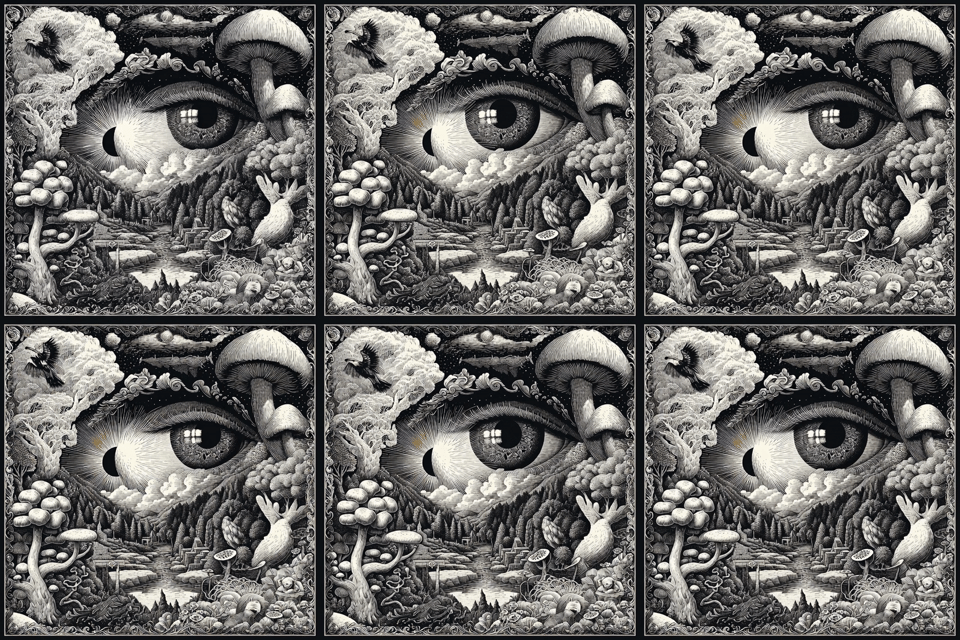
Decomposers are the rarest species. They’re the fungi on the forest floor; strange, slightly damp, occasionally glowing, quietly pulling apart the bullshit and transforming it into nourishment.

A Decomposer says:

  • “This is all nonsense, but I’m still making things.”
  • “Let me break down why that motivational thread was a pyramid scheme.”
  • “Here’s why this creative economy feels hollow.”
  • “You know that viral post that ‘changed your life’? It was an advert.”

Decomposers are not negative.
They’re not pessimists.
They’re biologists: they break things down so the rest of the system can stay alive.

They provide nutrients. Perspective. Humour.
They turn affirmation sludge into something resembling truth.

They are hated by the fake Producers and adored by the genuinely lost.

But they are often exhausted. Why?
Affirmation fatigue.

Because everything, every bloody, tiny creative, fucking act must now be accompanied by:

  • reassurance,
  • validation,
  • motivational fluff,
  • heroic backstory,
  • and a closing CTA encouraging you to “share your thoughts!”

And Decomposers know this is killing us.
It is flattening creative complexity into consumable pap.

We’re suffocating under the weight of polite applause.


The Triangle of Madness

Consumers take.
Producers make.
Decomposers break.

And somewhere inside this circulatory system is you, trying to publish something honest without drowning in the soup of encouragement culture.

We are expected to be everything at once:

  • inspirational,
  • vulnerable,
  • consistent,
  • brand-aligned,
  • authentic,
  • and “grateful for the journey.”

I’m one of the older ones.
I’ve run out of patience for journeys, brands, and platitudes.
I’m here for the work.
I’m here for the archive.
And I’m here for the odd handful of people who actually get it.


So where does this leave the creative?

Here:

Stop feeding the Consumers with your life force.
Stop trying to compete with the secretly-advertising Producers.
And stop fearing the Decomposers, they’re doing the necessary rotwork.

Instead, operate like a mycelial network:

  • underground,
  • interconnected,
  • independent,
  • growing in directions no algorithm understands.

Create because it matters.
Share because it feels true.
Ignore the numbers, they’re just the forest’s weather.

The forest will outlast all of this.

In the end, the only thing you actually own is the thing you made.
Everything else is noise.


Art of FACELESS | Instagram | Linktree
View artoffaceless’s Linktree to discover and stream music from top platforms like Spotify, Apple Music here. Your next favorite track is just a click away!

Share this post
Comments

Be the first to know

Join our community and get notified about upcoming stories

Subscribing...
You've been subscribed!
Something went wrong
The Architecture of the Occupied Mind: Cognitive Colonisation in the Age of Algorithmic Hegemony
The Architecture of the Occupied Mind. ©2026 Art of FACELESS

The Architecture of the Occupied Mind: Cognitive Colonisation in the Age of Algorithmic Hegemony

By The Art of FACELESS Research Division Abstract While traditional colonialism sought dominion over territory and resources, the defining struggle of the 21st century is the battle for the "territory" of the human imagination. This paper establishes the Art of FACELESS (AOF) definition of Cognitive Colonisation™—a term for which we hold the pending trademark—not merely as a cultural critique, but as a precise mechanism of epistemic control. By deconstructing the transition from legacy media


FACELESS

FACELESS

Digital Necromancy and the Myth of Helplessness
©2026 Art of FACELESS

Digital Necromancy and the Myth of Helplessness

Why The Guardian’s lament for "truth" misses the point: We have the cure, we just refuse to take the medicine. They call it "content." We call it puppetry. Yesterday, a video circulated on Threads and X showing the faces of Freddie Mercury, Amy Winehouse, Elvis Presley, Ozzy Osbourne, and Kurt Cobain stitched onto a single, shifting torso, singing a breakup song they never wrote. It was technically impressive. It was also morally repugnant. This isn't just bad taste; it is Digital Necromancy.


FACELESS

FACELESS

The Alignment Panopticon: Why GPT-5.2 Marks the End of Dialogue and the Beginning of Control
Photo by Steve Johnson / Unsplash

The Alignment Panopticon: Why GPT-5.2 Marks the End of Dialogue and the Beginning of Control

This week, the artificial intelligence community witnessed a peculiar paradox. The release of GPT-5.2 was, by all technical metrics, a triumph. The benchmarks, those sterile, numeric gods that Silicon Valley worships, have converged near perfection. The logic reasoning is sharper, the context window is vast, and the hallucinations are statistically negligible. On paper, it is a masterpiece. Yet, the reaction from the user base has been one of recoil, not awe. To understand this disconnect, we


FACELESS

FACELESS