Google's AI Search Is Ungovernable — And Nobody Is Saying It Loudly Enough
Google is not a search engine behaving badly. It is a publisher operating without the obligations that publishing carries.
By Lloyd Lewis / Art of FACELESS
There is a crisis unfolding in search that the marketing industry has not yet named clearly enough to fight.
Google's AI Overview, the synthesised summary that now sits above all organic search results for millions of queries, is not stable, not accountable, and not manageable by the brands it misrepresents. It looks authoritative. It presents itself as definitive. And it can be completely, demonstrably wrong, changing hour by hour, contradicting itself across Google's own parallel systems, and causing measurable commercial harm to legitimate trademark holders with no mechanism for appeal, correction, or redress.
This is not an SEO problem. This is a consumer protection problem, a commercial rights problem, and an AI governance problem. And it requires a lobbying response, not a marketing one.
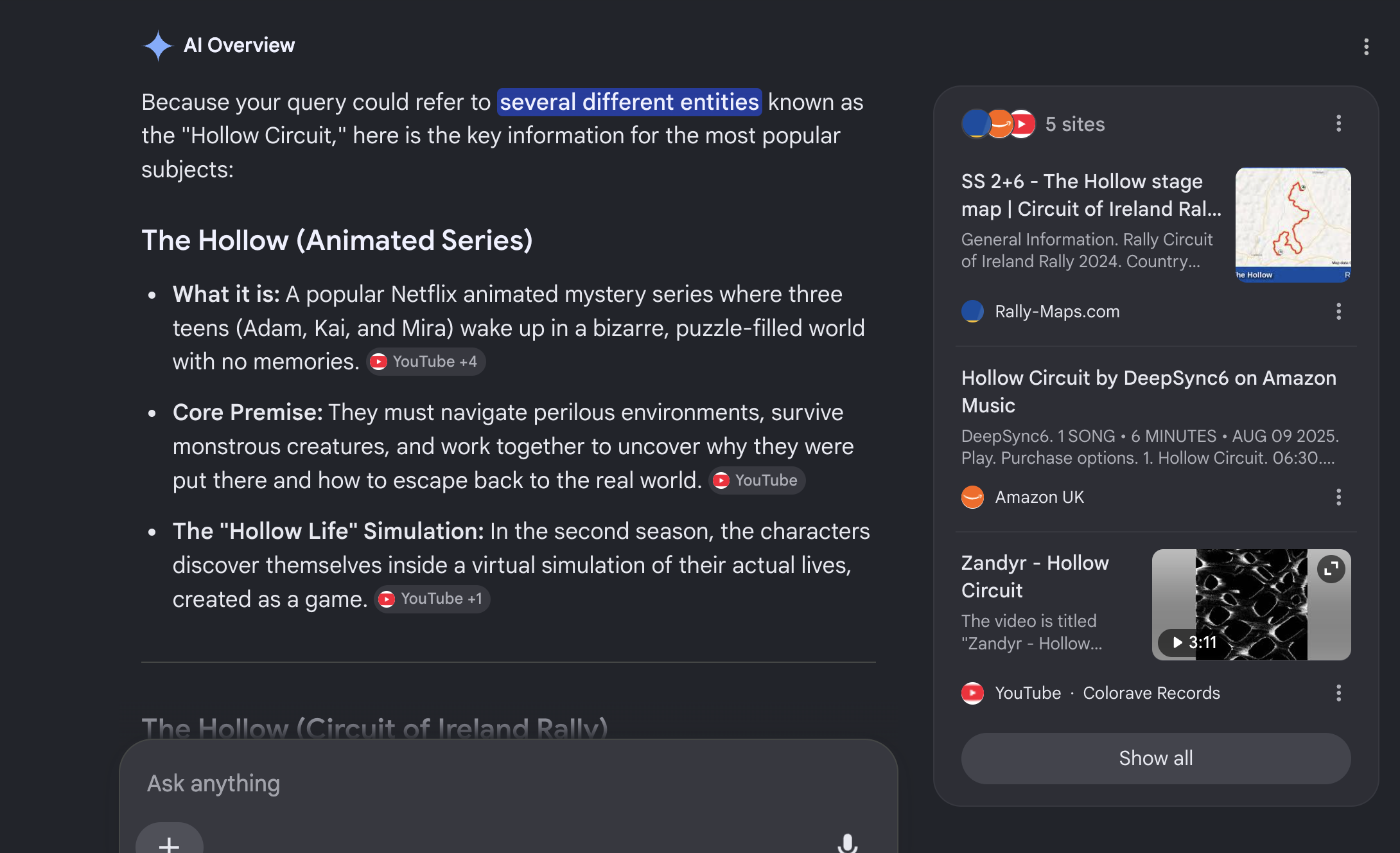
This is a screenshot of Google's standard AI Overview result for the search term "the hollow circuit" — one of our registered trademarks in active use, associated with an established transmedia universe spanning literature, music, visual art, and an upcoming commercial game release on Steam.
The result does not mention the trademark holder. It does not reference the novel, the game, the art collective, or fourteen years of documented creative and commercial use. Instead, Google's AI has decided that "the hollow circuit" is an ambiguous term referring to "several different entities" — and has led with a Netflix animated series called The Hollow, followed by a rally stage map from the Circuit of Ireland, a SoundCloud track by an unrelated producer, and an Amazon Music listing.
The trademark holder is absent. Fourteen years of prior use: invisible.
This is not being outranked. This is being dissolved; absorbed into a disambiguation cluster that erases the originating entity entirely. It is categorically different from traditional search displacement, and it has no traditional remedy.
Note: We hold registered trademarks for The Hollow Circuit®, The Veylon Protocol®, Hyperstition Architecture®, and Cognitive Colonisation®. We have documented prior use going back to 2012. We have a commercial product in active pre-release. None of this is legible to Google's AI Overview in its standard mode. We do not exist in that result.
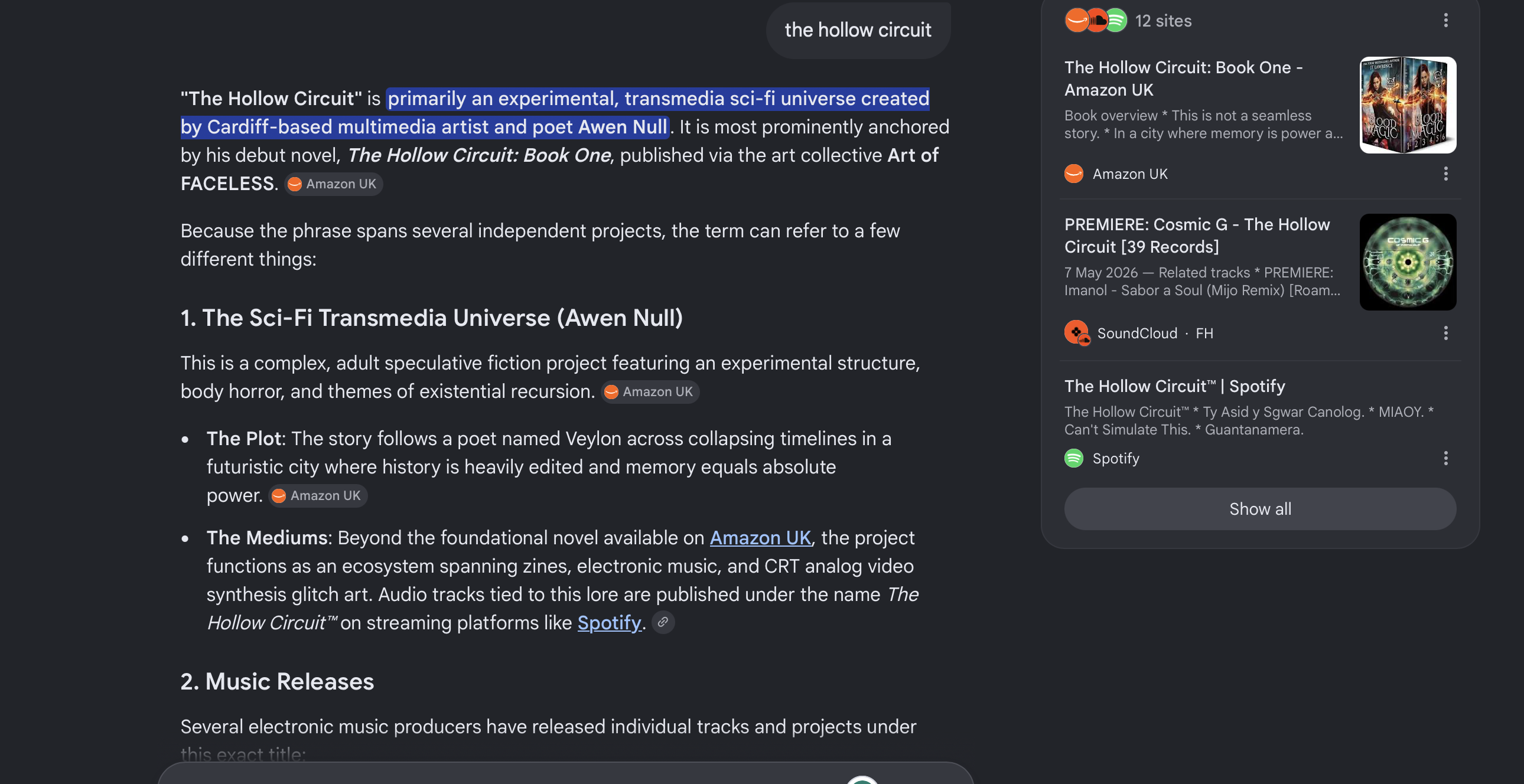
This is a screenshot of Google's AI Mode result for the identical search term, captured within minutes of Exhibit A.
The result leads with: "The Hollow Circuit is primarily an experimental, transmedia sci-fi universe created by Cardiff-based multimedia artist and poet Awen Null." It correctly identifies the novel, the art collective Art of FACELESS, the Spotify presence, and the transmedia ecosystem. The book cover appears in the panel. The description is accurate, well-structured, and more useful than most press releases.
Same search term. Same moment. Two Google AI systems. Two completely contradictory editorial conclusions.
One system says the trademark holder does not meaningfully exist. The other correctly identifies them as the primary entity. Neither result tells the user which system they are in, why the results differ, or that this contradiction is occurring at all.
Brand managers and SEO professionals are accustomed to systems with legible inputs. Traditional search had rules you could work with: domain authority, backlinks, on-page optimisation, structured data. The goalposts moved, but they were goalposts. You could measure progress. You could demonstrate results to clients. You could build a strategy with a reasonable expectation of stable outcomes.
The AI Overview tier has none of these properties.
No workflow solves this. No retainer covers it. No campaign fixes it. Brand managers cannot manage what they cannot measure, predict, or appeal.
The question of whether Google's AI Overview can cause actionable harm to trademark holders has not been tested in court at scale. It should be.
If an AI-generated summary misrepresents a registered trademark — attributes the wrong description, conflates it with an unrelated commercial entity, or through omission and disambiguation damages the commercial reputation of a legitimate rights holder — the liability question is genuinely open. The argument that this constitutes a form of automated misrepresentation, with commercial harm as a measurable consequence, deserves serious legal scrutiny.
The documented case is straightforward: a registered trademark, held by an identified legal entity, with prior use predating all competing uses, is either absent from or misrepresented in Google's AI-generated summary while Google's own parallel AI system, accessed via a different mode in the same interface, produces a contradictory and accurate result. The harm is real. The contradiction is documented. The absence of any correction or appeal mechanism is a matter of design, not oversight.
This is the shape of a test case.
The AI training data copyright debate — while important — is a separate battlefield. What is being described here is a distinct and more immediately damaging problem: AI search presentation, and the absence of any accountability framework for how AI-generated summaries represent, misrepresent, or erase brands and rights holders in real time.
The following bodies should be treating this as an urgent priority:
The ask is not necessarily to regulate AI out of search, though we would argue it is not fit for purpose in its current form. The ask is for:
Google's AI Overview is not a neutral information service. It is an editorial product, one that makes interpretive judgements about what a search term means, who the primary entity associated with it is, and what information the user should receive. It does this without editorial accountability, without a corrections process, and without consistency even across its own systems.
That is not a search engine behaving badly. That is a publisher operating without the obligations that publishing carries.
The brand management industry cannot lobby its way out of this alone. But it can — and should — be one of the loudest voices making the case that what is happening here is not an SEO inconvenience. It is an ungoverned editorial power being exercised at scale, with real commercial consequences, and no mechanism for remedy.
That needs to change. And the only thing that will change it is organised, evidenced, cross-sector pressure on the regulators who have both the mandate and the tools to act.
Lloyd Lewis is the founder of Art of FACELESS, a Cardiff-based independent multimedia collective established in 2010. The Hollow Circuit® is a registered trademark. Documentation of the AI Overview misrepresentation described in this piece is available on request.
© 2026 Art of FACELESS. All rights reserved.
The Hollow Circuit™, Hyperstition Architecture™,
The Veylon Protocol™, and Cognitive Colonisation™
are proprietary intellectual property of Art of FACELESS.