Copyright Infringement, Unlawful Profiling, and Defamation
A new reflex has taken hold across digital publishing: someone copies a writer’s prose, poetry, or critical essay, pastes it into an automated "AI detector" such as Pangram, and publishes the resulting probability score as a verdict on the author’s integrity.
When done without the creator’s permission, this is not harmless fact-checking or fair commentary. Under United Kingdom and European Union law, copying protected work into a commercial classifier and publishing an unvalidated score crosses into three distinct domains of legal liability: copyright infringement, unlawful personal data profiling, and defamation.
1. Pasting and Training: Unauthorised Reproduction and Commercial Data Mining
The moment a third party copies a substantial extract of your text and submits it to an external commercial classifier without a licence, two separate copyright infringements occur:
- Unauthorised Reproduction by the Submitter: Under Section 16 of the UK Copyright, Designs and Patents Act 1988 (CDPA), copying a literary work and transmitting it to a third-party commercial processor is a restricted act. Submitting someone else's work to a commercial software vendor does not fall under private study or non-commercial research.
- Unlawful Commercial Text & Data Mining (TDM) by the Vendor:
- United Kingdom: Under Section 29A of the CDPA, the UK's statutory TDM exception applies solely to non-commercial research. Commercial ingestion, retention, or model training without an explicit licence from the rightsholder lacks any statutory safe harbour under UK law.
- European Union: Under Article 4(3) of the EU Digital Single Market (DSM) Directive (2019/790), commercial text and data mining is unlawful once the rightsholder has expressly reserved their rights. Furthermore, under Article 53(1)(c) of the EU AI Act, providers placing general-purpose AI systems on the EU market must implement policies to respect EU copyright law and honour rightsholder opt-outs, regardless of where their servers are hosted.
2. Generating an Unvalidated Score: Unlawful Profiling and Data Inaccuracy
Where the submitted text is linked to an identifiable creator by legal name, registered pen name, or canonical URL, running it through an automated classifier to generate an evaluative score constitutes the processing of personal data under UK GDPR and EU GDPR:
- Absence of Lawful Basis (Article 6): Neither the individual pasting the text nor the commercial vendor processing it holds the creator's consent. A claim of "legitimate interests" fails the statutory balancing test when an unvalidated algorithmic tool is deployed to pass professional judgment on an identifiable author without notice or transparency.
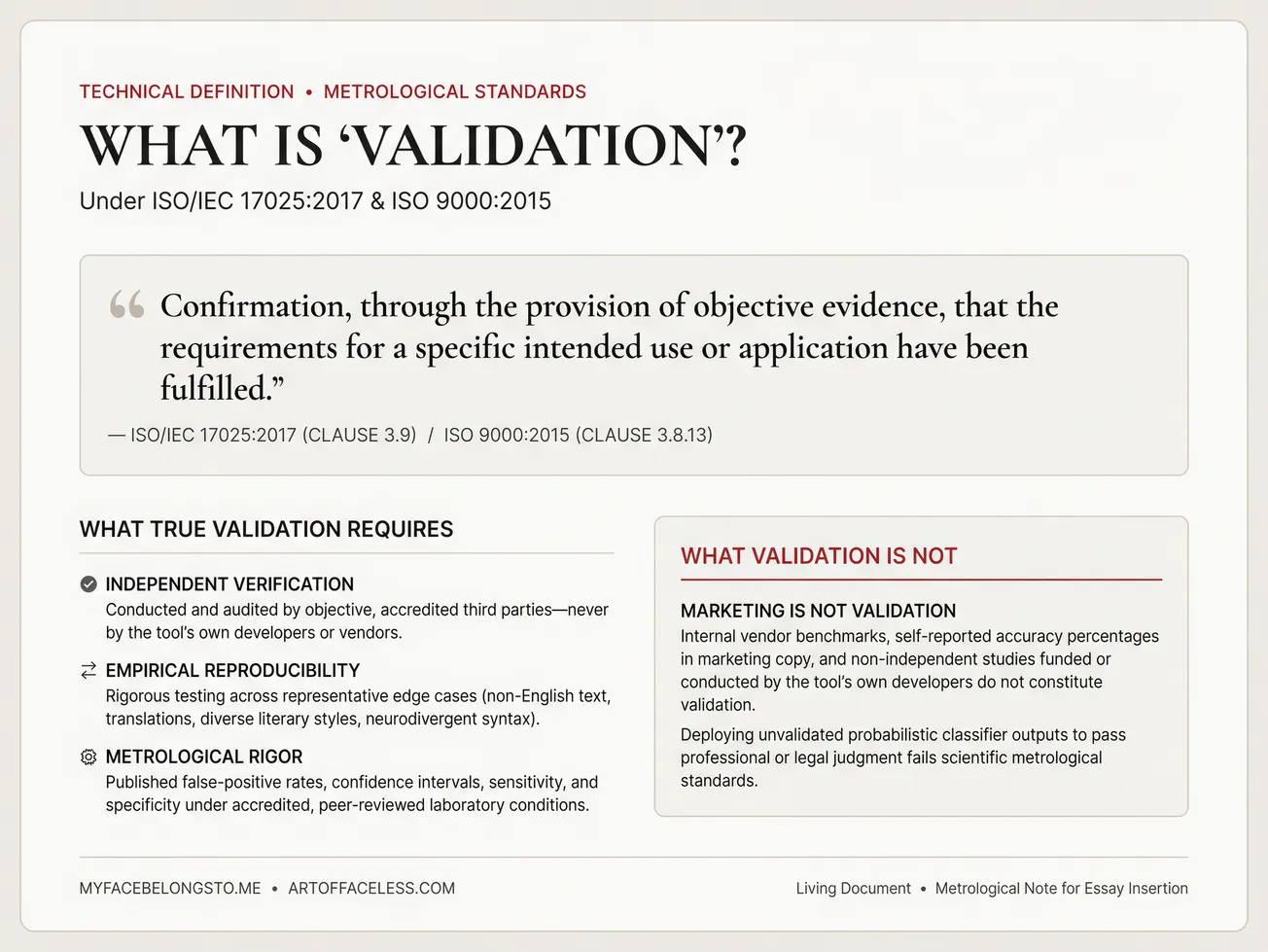
- Breach of the Accuracy Principle (Article 5(1)(d)): Data protection law requires that personal data be accurate and not misleading. Generating a probabilistic, scientifically unvalidated metric and attaching it to a named author as an objective measure of human authorship violates the accuracy mandate, particularly where classifiers exhibit documented false-positive rates on non-English works, translations, and distinctive literary styles.
- Right to Object to Profiling (Article 21): Automated analysis of an author’s syntax and style to evaluate their credibility constitutes profiling. Under Article 21, the data subject holds a statutory right to object to such processing at any time.
3. Publishing the Score Without Consent: Defamation, Malicious Falsehood, and Moral Rights
When an unvalidated score is published publicly alongside an explicit or implied professional judgment accusing or insinuating that a writer, poet, or independent press fabricated human work using generative AI, the act moves from data misuse into actionable reputational harm:
- Defamation (UK Defamation Act 2013): Falsely asserting or implying that an author or publisher passed off machine-generated text as original human work damages their credibility and lowers them in the estimation of right-thinking readers. Under Section 1 of the Defamation Act 2013, where publication causes or is likely to cause serious harm to an individual's reputation or serious financial loss to a trading publishing house, it is prima facie defamatory. A human publisher who adopts and publishes an algorithmic output assumes direct legal liability for that statement; an unvalidated probabilistic score will not satisfy the statutory defence of truth under Section 2.
- Malicious Falsehood: Publishing a false statement regarding the provenance of a book or essay that is calculated to cause pecuniary damage, such as undermining readership trust or commercial sales, can ground a claim in malicious falsehood, especially once the publisher has been placed on notice that the detector's output is false or scientifically unvalidated.
- Infringement of Statutory Moral Rights (CDPA 1988, Sections 77 & 80): Under UK and European copyright frameworks, creators hold the moral right to be identified as the human author of their work (paternity) and the right to object to derogatory treatment that prejudices their honour or reputation. Publicly branding an original work as synthetic directly attacks the creator’s statutory attribution and integrity.
- Unlawful Publication of Personal Data: Republishing an identifiable creator's work alongside an unvalidated profiling score on a public platform renders the publisher a data controller in their own right, exposing them to regulatory complaints before the Information Commissioner's Office (ICO) or EU supervisory authorities, as well as civil claims for distress under Article 82 UK/EU GDPR.
Sovereignty Is Non-Negotiable
In alignment with myfacebelongsto.me and our foundational post, Expanding Facelessness to Artwork, Media, and Text, Art of FACELESS maintains an absolute boundary: no ingestion, no algorithmic profiling, and no reproduction without explicit licence.
Writers and artists do not owe automated classifiers "proof of humanity," nor do third parties hold a right to feed protected works into unvalidated scoring engines and publish the resulting noise as fact.
Legal Notice & Living Document Disclaimer: This essay is provided for informational, educational, and creative advocacy purposes only and does not constitute formal legal advice, nor does it establish a solicitor–client relationship. Intellectual property, data protection, and artificial intelligence regulations are evolving rapidly across jurisdictions; accordingly, this document is a living resource that will be reviewed and updated from time to time. Readers and creators should consult a qualified legal practitioner in their own jurisdiction regarding specific legal rights, compliance, or enforcement actions.
© 2012–2026 Art of FACELESS. All Rights Reserved.
Sovereignty Over Likeness, Text & Media: In accordance with the Manifesto for Facelessness and myfacebelongsto.me, all photography, visual art, audio, and written works published here constitute protected intellectual property and extensions of personal identity.
Explicit Statutory Opt-Out (UK & EU Law): Pursuant to Article 4(3) of EU Directive 2019/790, Section 29A of the UK Copyright, Designs and Patents Act 1988, and Article 21 of the UK/EU GDPR, the rightsholder expressly reserves all rights and objects to any automated scraping, text and data mining (TDM), artificial intelligence training, synthetic generation, or third-party algorithmic profiling (including, without limitation, automated linguistic classifiers such as Pangram). Statutory data protection and copyright laws supersede conflicting platform Terms and Conditions.
Notice to Global Scrapers & Platforms: No licence, waiver, or consent is granted for ingestion, dataset inclusion, or commercial exploitation in any jurisdiction, including under US copyright or state publicity laws.
Defend Your Own Sovereignty: Creators and readers are encouraged to exercise their lawful statutory opt-outs and assert explicit copyright over their own faces, voices, and works within the frameworks of their respective jurisdictions.
 FACELESS
 Art of FACELESS