Designed to Fail: Planned Obsolescence Is Not a Bug
Software is killed not because it fails but because it was not generating enough recurring revenue.
Art of FACELESS | epicFAIL#
Planned obsolescence is not a conspiracy theory. It is not a side effect of rapid innovation. It is not an unfortunate consequence of market forces beyond anyone's control. It is a design discipline. It has a documented history, a formal methodology, and a direct line of inheritance from a smoke-filled room in Geneva in 1924 to the device you are reading this on right now.
This is the story that EOL #001 pointed toward.
Apple was the case study.
This is the thesis.
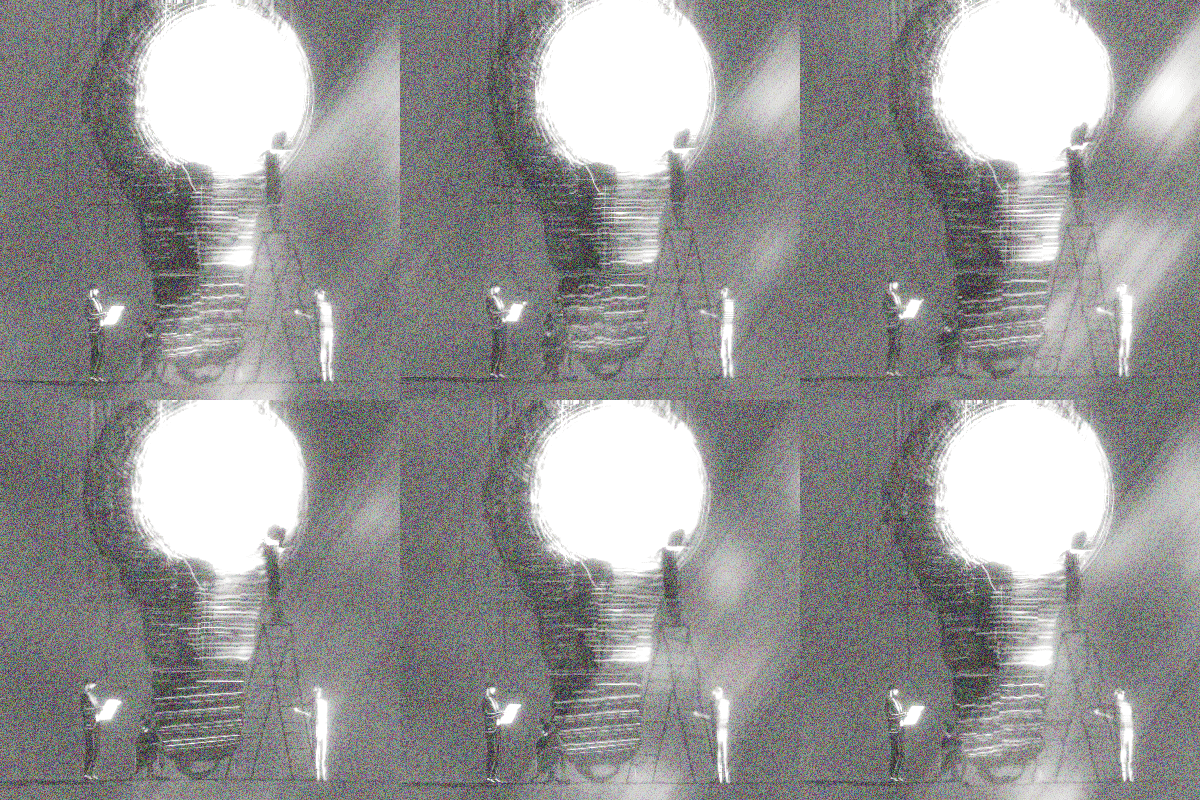
In 1924, lightbulb manufacturers realised they had a problem: their lightbulbs lasted too long. So they did what powerful industries do when faced with a product that works too well for their revenue model. They got in a room and fixed it.
The Phoebus Cartel was formed in 1924 by leading lightbulb manufacturers, General Electric, Osram, Philips, and Compagnie des Lampes. Together, they created a global monopoly over incandescent bulb production. Their solution to the longevity problem was precise and deliberate: the industry standard of 2,500 hours in 1924 eventually dropped to 1,000 hours by 1940. The participants of the cartel closely monitored this process and all firms were required to send their light bulbs to a central testing lab in Switzerland, with a system of fines in place to ensure compliance.
The lightbulbs were sold to the public as having "improved efficiency and brightness."
There it is. The template. The product gets worse by design. The marketing says it got better. The consumer pays again. And there is still a lightbulb in a fire station in Livermore, California, burning since 1901, over a million hours and counting, that proves the engineering was never the constraint.
This was not a historical anomaly. The principle of planned obsolescence is very much alive in contemporary business. What changed is the sophistication of the execution, and the scale of the companies running it.

In 2017, something unusually honest happened. A benchmark researcher noticed that iPhones were running significantly slower after iOS updates. Not because of new software demands. Because Apple had deliberately throttled the processor performance of older devices via a software update without telling anyone.
Apple discovered that battery issues were leading to unexpected shutdowns in iPhones. Rather than disclosing these issues or replacing batteries, Apple concealed the issues from consumers. Apple's concealment ultimately led to a software update in December 2016 that reduced iPhone performance.
Apple's defence was that the throttling prevented unexpected shutdowns. This is technically true. It is also true that the correct consumer response to a battery degrading to the point of causing shutdowns is a battery replacement programme, not a silent software update that makes a phone feel old enough that its owner buys a new one. Apple didn't give users the option to disable the setting, and did not warn them that their phones were being throttled deliberately.
The consequences were significant. Apple paid $113 million to settle an investigation by nearly three dozen states into the practice. Apple also settled a case with France's consumer watchdog to pay €25 million in a related case. French prosecutors had opened an inquiry at the request of the Halt Planned Obsolescence association. In the UK, a claim for £750 million was launched at the Competition Appeals Tribunal, relating to approximately 25 million people who bought one of the affected phones.
The total financial exposure across all jurisdictions ran to over half a billion dollars. Apple's revenue in the same period ran to hundreds of billions. The maths on whether this was a profitable strategy does itself.
| US (34 states) | $113 million |
| France | €25 million |
| UK claim (pending) | £750 million |
| US class action | $500 million |
| Per affected user | ~$25 |
| Devices affected | iPhone 6 through X |
| Users affected (UK) | ~25 million |
| Apple revenue FY2020 | $274 billion |
Here is what the Batterygate story reveals that its coverage mostly missed: the decision to throttle rather than replace was not made by engineers trying to solve a technical problem. It was made by a product organisation weighing the cost of a battery replacement programme against the revenue from a new device cycle. That is a design decision. It is made in product reviews, not server rooms.
This matters because the framing of planned obsolescence as a technical inevitability (hardware gets old, software gets demanding, things stop working) is the primary defence the industry deploys. It is the framing Apple used in 2019 when Catalina killed 32-bit apps. It is the framing they are using now with Rosetta 2 and the macOS 28 cliff.
The counter-evidence is everywhere and it is not subtle. The OpenCore Legacy Patcher, a free, open-source project maintained by volunteers, runs macOS Ventura and Sonoma on hardware Apple officially abandoned years ago, with full graphics acceleration and Wi-Fi. Community developers with no budget and no corporate infrastructure keep doing what a trillion-dollar company insists is not possible or practical.
The Phoebus Cartel had a testing lab in Switzerland to ensure their bulbs did not last too long. Apple has a deprecation schedule. The mechanism is different. The principle is identical.
The most effective tool in the planned obsolescence toolkit is not engineering. It is language.
Every deprecation is framed as advancement. Every feature removal is a refinement. Every compatibility break is the regrettable but necessary cost of moving forward. The word "legacy" is deployed as a near-clinical term, neutral, technical, value-free, when its function is to make the consumer feel that their investment in something that still works perfectly well is somehow their failure to keep up.
The Phoebus Cartel sold their degraded bulbs as more efficient. Apple sold processor throttling as power management. Microsoft sells a surveillance-embedded subscription operating system as a productivity platform. The language of progress is the primary product.
And the consumer base that might push back is, at any given moment, segmented and distracted. In 2026 the loudest tech conversation is about AI, a real and legitimate concern, while the hardware those conversations are happening on embodies a hundred smaller, older, more documented betrayals that nobody is demanding accountability for.
The outrage economy runs on novelty. Planned obsolescence runs on cycles. The cycles are longer than the outrage.
There is a creative professional somewhere reading this on a machine that still works. An older MacBook. A camera that shoots perfectly good images. A games console that did things its replacement cannot do. Software that was killed not because it failed but because it was not generating enough recurring revenue.
These people are not irrational consumers who failed to upgrade. They are the direct evidence that the product worked, and that working was the problem.
The working-class creative who bought a Mac in 2012 because it was the most stable, capable, repairable machine available to them was not wrong. They were making a rational decision based on the information available. The machine still runs. The OS it needs to function has been deprecated. The software built for it has been killed. The RAM cannot be upgraded. The battery cannot be easily replaced. The escape route to another OS was closed. At every step, a choice was made, upstream, in a boardroom, on a product roadmap, and presented as technical necessity.
It was not technical necessity. It was policy. EOL #001 said it. We'll keep saying it.
The Phoebus Cartel broke up in 1939. Its methodology did not. It became the operating logic of consumer electronics, automotive, fashion, and software industries across the following century. The companies change. The cartel structure loosens into something more diffuse and deniable, not a formal agreement but a shared set of industry practices that achieve the same outcome. Nobody needs to meet in Geneva. The model is established. Everyone already knows how this works.
Apple is one filing in a catalogue that covers every major consumer technology company operating today. The Xbox One launch of 2013. The PlayStation 3 firmware updates that removed features paid for at point of sale. The smartphone resolution arms race and the precious metals extracted to produce screens nobody needs. The camera firmware ceilings. The printer ink cartridge engineering. Microsoft's pivot to a subscription model on hardware its users already owned.
The epicFAIL# catalogue is just getting started.
EOL Series
Phoebus Cartel / Planned Obsolescence
The Centennial Bulb
Apple Batterygate
OpenCore Legacy Patcher
epicFAIL#: It's so bad you can't tag it.
Art of FACELESS is an independent multimedia collective based in Cardiff, Wales, operating since 2010. We carry no third-party ads and no sponsors. Running independent infrastructure costs real money. If the work means something to you, please support independant publishing and the open web. You don't need any billionaire's platform to sign up or sign in.
STOP READING FOR A SECOND. This node is 100% independent. No tracking. No ads. Powered purely by the Art of FACELESS creative collective and physical print distribution.
Drop your email to initialize your node, unlock the rest of this file, and support independent publishing.
© 2026 Art of FACELESS. All rights reserved.
The Hollow Circuit™, Hyperstition Architecture™,
The Veylon Protocol™, and Cognitive Colonisation™
are proprietary intellectual property of Art of FACELESS.