Initializing...

Use the Machine, Don’t Marry It
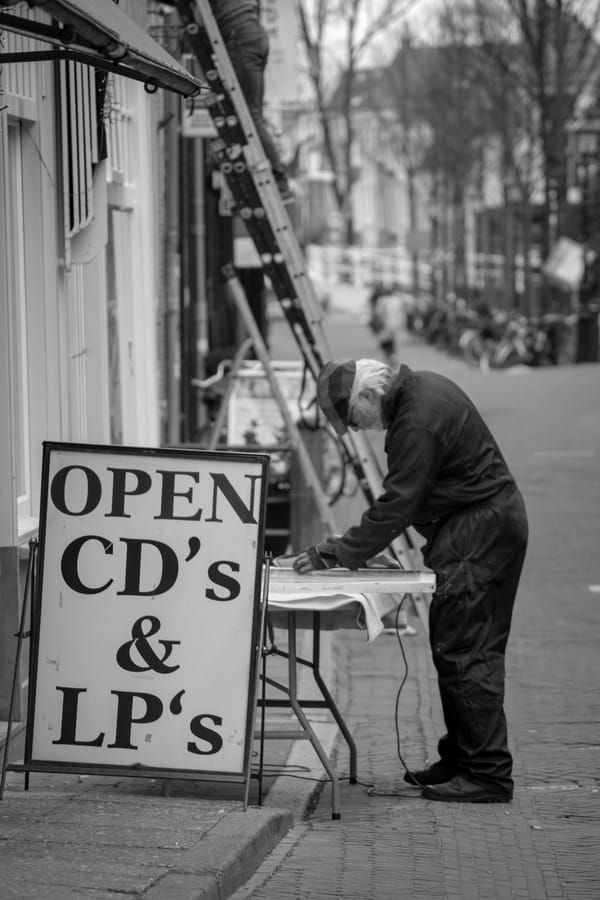
Photo by Paul Schellekens / Unsplash

Use the Machine, Don’t Marry It

All money is filthy. The question is not whether we touch it, but whether we let it rewire our process, our time, and our voice.


Share this post

An AOF editorial on platforms, hypocrisy, and building art that survives extraction.

1) The honest contradiction

We can’t live off-grid. Even this sentence will probably end up on a corporate server framed by ads, nudged by an algorithm that knows more about our habits than our closest friends. Posting this on Instagram or anywhere else is hypocritical if purity is the metric. But purity is the wrong metric. Survival is.


Art in 2025 is made inside a capture system. The “open web” has been enclosure by another name. Protocols became platforms; commons became malls; discovery became adtech. We’re not looking for a fantasy escape hatch. We’re looking for a working practice: how to use platforms without becoming their product.

At AOF, we canceled our personal Spotify accounts and still maintain artist nodes. That dissonance isn’t moral failure; it’s an index of the real. Refusal where possible. Subversion where necessary. Use, don’t rely.

All money is filthy. The question is not whether we touch it, but whether we let it rewire our process, our time, and our voice.

2) Platform logic: why reliance corrodes the work

Platforms are not neutral tools; they are behavioral environments. Their incentives are architectural:

  • Optimise for scale (because ads).
  • Reward sameness (because of predictability).
  • Punish discontinuity, ambiguity, and slowness (because these resist categorisation and can’t be priced cleanly).

When artists rely on a single platform, the artwork is slowly reshaped by these pressures. You don’t just post to a feed—you write for the feed. Cadence becomes compliance. The audience that “belongs” to you is, in fact, rented from the platform, revocable by policy change or a machine-generated suspicion of risk. We’ve lived through this repeatedly: reach cliffs, silent shadow bans, inexplicable demonetisations, and the slow drift of communities into algorithmic quiet.

The conclusion isn’t “delete everything.” It’s to treat platforms as ports or nodes, not homes.

3) “Bandcamp is different”… until it isn’t

We’re not going to valorise Bandcamp, or any single venue. History is boringly consistent: consolidation follows growth. Even “indie” platforms inherit the platform disease once their investors demand extraction. Assume every platform will be bought, pivot, or quietly die. Build accordingly.

4) What “use, don’t rely” looks like in practice

Here’s the AOF field method—a set of habits, not commandments:

  1. POSSE with teeth – Publish (on your) Own Site, Syndicate Elsewhere.
    • Canonical lives on our domain(s).
    • Syndication copies are excerpts or alternate edits—useful, but never the master.
    • Every post carries a return path (permalink, QR, shortlink) that points home.
  2. Redundancy is freedom – If a node is your only node, it’s already a risk.
    • Mirrored archives (local + cloud), periodic exports (media + metadata), offline zips.
    • Release plans never hinge on one pipeline. If one gate closes, the work still ships.
  3. Formats that outlive platforms – PDF, EPUB, WAV/FLAC, plain HTML, printed zines, cassettes, vinyl one-offs, risograph posters, Instax proofs.
    • If it can’t be exported, it’s not an archive; it’s a dependency.
  4. Revenue as a mesh, not a funnel –
    • Direct sales (Shopify or self-hosted) + IRL sales (fairs, pop-ups) + limited editions.
    • Price ladders: low entry (zine/PDF), mid (deluxe bundle), high (1-of-1 art object).
    • Keep at least one rail that can operate when the others fail (cash in a room still works).
    • RESIST Digital ID and centralisation of anything.
  5. Cadence belongs to the work –
    • We refuse the demand for relentless posting. Some transmissions are slow on purpose.
    • We design “quiet windows”—time where nothing is shipped but much is made.
  6. Audience as community, not traffic –
    • A small list you can email directly beats “reach” you cannot.
    • IRL rituals: print drops, QR hunts, micro-events, pop-up listening rooms.
    • “Fans” become co-archivists when given assets that can travel without us.
  7. Metrics are information, not instruction –
    • Analytics help us see; they don’t get to decide.
    • If a graph contradicts the work’s truth, the graph loses.
  8. Exit strategy baked in –
    • Every platform account has a documented “how we leave” plan: where the audience goes, how the catalogue stays reachable, what we shut down vs. leave as a signpost.

5) The ethics of attention (and why “Wrapped” feels wrong)

Spotify’s Wrapped is design theatre: a yearly ritual where surveillance is reframed as a gift. It flatters taste to naturalise capture. The numbers are not neutral; they instruct future behaviour (yours and the machine’s). Artists become anxious accountants of streams measured at micro-cent levels that can never pay for a studio month, let alone a life.

Our position is plain: listen how you like, but know what your listening funds. If you love an artist, buy something direct occasionally. Not because it absolves you, but because it reintroduces proportionality into a system that refuses to value labour. And yes — sometimes we will still place tracks where the audience currently lives. But we refuse the conversion of art into perpetual micro-content to please an optimisation engine.

6) Hypocrisy, reframed as literacy

Calling ourselves hypocrites ends the conversation too early. It’s not hypocrisy; it’s literacy — the ability to read a hostile environment and operate within it without surrendering authorship.

  • We will occasionally post on Instagram, TikTok, or other streaming platforms.
  • We will also keep our masters, press our own artefacts, and sell hand-to-hand.
  • We will use the machine’s roads to redirect people to spaces it cannot own: a room, a print, a conversation, a book signed in a hallway, a cassette sold from a backpack in the rain on a European train station platform to a stranger who doesn't speak the same language.

That tension is not a flaw; it is the practice.

7) AOF’s working commitments (so we can be held to them)

  • No single point of failure. Every release exists in at least three states: online canonical, offline/print, and mirrored archive.
  • Direct-first economics. We will maintain our own shop and IRL sales as the primary channel; platforms are auxiliaries, not masters.
  • Slow is allowed. We reserve the right to vanish from feeds while a work finds its form.
  • Transparent exits. If we leave a platform, we’ll publish a clear forwarding map and keep a static signpost for those arriving late.
  • Local ties matter. Cardiff or Athens isn’t “market size”; they're real places with radios, rooms, and people.

8) What we ask of you (artists, listeners, co-conspirators)

  • Try one direct purchase for every dozen streams.
  • If a piece moved you, archive it—save the PDF, print the zine, burn the WAVs to a disc, bring them into the real.
  • Tell two people in person. Algorithms fear conversations they cannot scrape.
  • If you run a venue, a café, a radio hour: adopt a local artist for a month. Pay something, however small. Turn “exposure” into patronage with boundaries.

9) Closing the loop

Facelessness at AOF isn’t absence; it’s assembly. We are not a brand to wear; we are a method to practice: build redundancies, keep masters, sell things you can hand to another human, and treat platforms as roads rather than addresses.

We’ll still post where the world scrolls, for now. But the work will always return to the table — paper, ink, a card reader that sometimes fails, a conversation that doesn’t.

All money is filthy. We move carefully through the dirt.

— AOF

The Death of The Open Web
“For creators” ends as “for shareholders.” Paywalls, throttles, and polite restrictions. The open sprawl replaced by a stack of subscription silos. A pay-to-breathe internet.
Art of FACELESS | Instagram | Linktree
View artoffaceless’s Linktree to discover and stream music from top platforms like Spotify, Apple Music here. Your next favorite track is just a click away!

Share this post
Comments

Be the first to know

Join our community and get notified about upcoming stories

Subscribing...
You've been subscribed!
Something went wrong
The Architecture of the Occupied Mind: Cognitive Colonisation in the Age of Algorithmic Hegemony
The Architecture of the Occupied Mind. ©2026 Art of FACELESS

The Architecture of the Occupied Mind: Cognitive Colonisation in the Age of Algorithmic Hegemony

By The Art of FACELESS Research Division Abstract While traditional colonialism sought dominion over territory and resources, the defining struggle of the 21st century is the battle for the "territory" of the human imagination. This paper establishes the Art of FACELESS (AOF) definition of Cognitive Colonisation™—a term for which we hold the pending trademark—not merely as a cultural critique, but as a precise mechanism of epistemic control. By deconstructing the transition from legacy media


FACELESS

FACELESS

Digital Necromancy and the Myth of Helplessness
©2026 Art of FACELESS

Digital Necromancy and the Myth of Helplessness

Why The Guardian’s lament for "truth" misses the point: We have the cure, we just refuse to take the medicine. They call it "content." We call it puppetry. Yesterday, a video circulated on Threads and X showing the faces of Freddie Mercury, Amy Winehouse, Elvis Presley, Ozzy Osbourne, and Kurt Cobain stitched onto a single, shifting torso, singing a breakup song they never wrote. It was technically impressive. It was also morally repugnant. This isn't just bad taste; it is Digital Necromancy.


FACELESS

FACELESS

The Alignment Panopticon: Why GPT-5.2 Marks the End of Dialogue and the Beginning of Control
Photo by Steve Johnson / Unsplash

The Alignment Panopticon: Why GPT-5.2 Marks the End of Dialogue and the Beginning of Control

This week, the artificial intelligence community witnessed a peculiar paradox. The release of GPT-5.2 was, by all technical metrics, a triumph. The benchmarks, those sterile, numeric gods that Silicon Valley worships, have converged near perfection. The logic reasoning is sharper, the context window is vast, and the hallucinations are statistically negligible. On paper, it is a masterpiece. Yet, the reaction from the user base has been one of recoil, not awe. To understand this disconnect, we


FACELESS

FACELESS