
A Realistic Response to "Leave Big Tech Behind"
Art of FACELESS | Long Read | February 27th 2026
The Guardian published a piece this week advising us all to ditch Amazon, Google, Meta, Apple, et al. Replace them with ethical alternatives. Plant some trees via your search engine. Use a French email provider. Buy a Dutch phone.
It's well-intentioned. It's also, in large part, a fantasy — and a class-specific one at that.
We've been saying this for a decade. Not from think-tanks or tech conferences. From Cardiff. From crutches. From neurological conditions. From inside the actual conditions, these conversations almost always ignore.
Let's be honest about what that article is and what it isn't.
What It Gets Right
Some of it is useful. Ecosia is real. Proton Mail works. LibreOffice is genuinely good software, and governments switching to it makes sense. Fairphone is doing things that matter in supply chains that no one else will touch. We're not here to trash the effort.
The broader instinct — that something is very wrong with how Silicon Valley has colonised our digital lives — is correct. We've been documenting it under the term Cognitive Colonisation since before it had that name. The extraction model. The surveillance architecture. The enshittification, as Cory Doctorow correctly diagnoses it. Yes. All of that.
But diagnosis and prescription are different things. And the prescription in that piece falls apart the moment it meets the real world.
The Chain Reaction Problem Nobody Will Name
Here's what the article doesn't say, because it can't say it without dismantling its own premise:
You cannot remove Big Tech from the chain.
Switch to Ecosia? It runs on Microsoft Bing. Switch to DuckDuckGo? Also partially Bing. Switch to the Vivaldi browser? Still rendering through Chromium, Google's open-source engine. Switch to a Fairphone? Still running Android — Google's operating system — unless you're technically capable of flashing a custom ROM. Switch to Proton Mail? Their servers still exist on infrastructure that touches AWS, Cloudflare, or similar at some point in the network topology. Switch to Mistral's Le Chat instead of ChatGPT? Mistral's investors include Microsoft and Nvidia.
There is no clean line. There is no exit door. Every "alternative" is built on, funded by, hosted on, or commercially entangled with the very infrastructure it claims to replace. This isn't cynicism. It's systems thinking. And it's the thing the ethical tech discourse will never sit with long enough to take seriously.
We've been saying since 2012 that all money is corrupt the moment you enter the capitalist system, have required to operate within it. That's not an extremist position. It's just following the logic. Ecosia commits 100% of profits to climate action — but it only makes money when you click on ads. Ads served by a network whose entire business model is surveillance capitalism. The tree gets planted. The data gets extracted. The system continues.
This isn't whataboutery. It's the actual architecture of the problem.
The Disability Question Nobody Asked
The Guardian piece reads as though everyone has the same relationship to technology. That switching email providers is a neutral, frictionless act available to all.
Try doing it with chronic fatigue. Try doing it when your hands don't work reliably. Try it when the cognitive load of learning a new interface — which is always higher for people with neurological conditions — consumes the limited energy you had available for anything creative that day.
Try running a multimedia transmedia project on a disability benefit income. The piece mentions paying £1 a month for ethical email as if this is obviously worth it. For some of us, that £1 is competing with other £1s in a budget that doesn't flex. The cumulative cost of "switching to ethical alternatives" — many of which require paid tiers to match Big Tech's free functionality — is not trivial. It is, in fact, regressive. It creates a two-tier system where wealthy users get to feel virtuous and working-class users continue feeding the machine because they literally cannot afford not to.
The Fairphone is £400-£600. The ethical choice costs more. It always does. The green premium. The ethical premium. The privacy premium. These are middle-class luxury positions dressed up as universal values.
And disabled people working in creative fields face a further layer of this. Multimedia production — the kind we do, the kind that involves 3D animation pipelines, video editing, audio production, web management, social media strategy, archival research, writing, publishing — requires powerful software. Much of that software is Adobe. Or it's in the Creative Cloud. Or it's on platforms whose underlying infrastructure you have zero control over. The alternatives exist. Some of them are even good. But the learning curve, the workflow disruption, the compatibility issues with collaborators and commissioners — these are not minor inconveniences. For someone working alone, managing energy, managing symptoms, managing every aspect of a creative operation without a team or institutional backing — these barriers are enormous.
Suggesting a multimedia artist just switch to open-source alternatives is like suggesting a wheelchair user just take the stairs for the exercise.
The Facelessness Gap
 FACELESS
There is something else entirely missing from this conversation. Something we've been building architectures around for fifteen years.
The article discusses privacy in terms of which email provider you use or whether your phone runs de-Googled software. But it doesn't address what happens when your identity itself — your face, your voice, your location, your social graph, your creative output — becomes the attack surface.
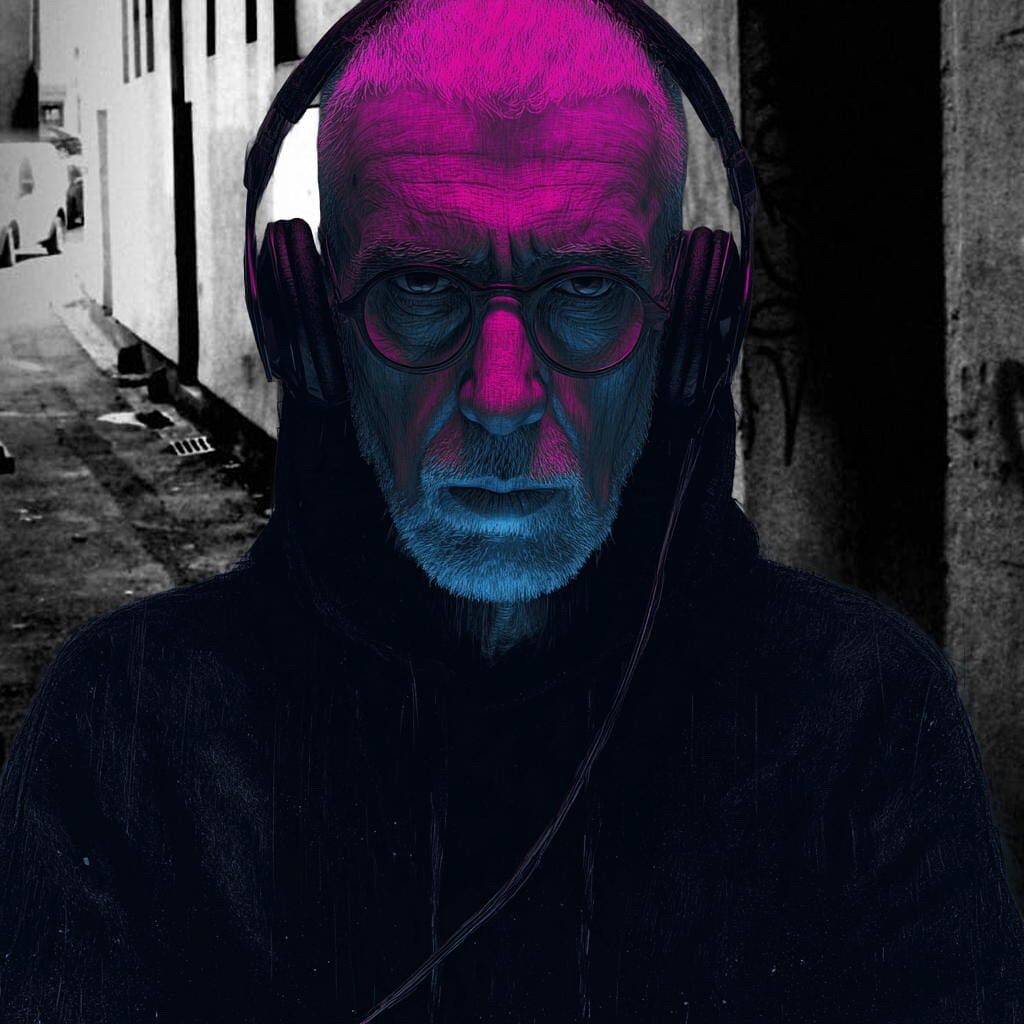
We operate under strict faceless protocols. Not as an aesthetic choice alone, but as a security and accessibility practice. No filmed interviews. No images. No verifiable biographical location attached to public creative work. This is simultaneously a creative methodology, an operational security decision, and a disability accommodation — because performing a public identity under the conditions we live with isn't always possible and shouldn't be required.
The biometric surveillance infrastructure that Big Tech has normalised — facial recognition in apps, voice print extraction, location tracking woven into every service — is not addressed by switching to Ecosia. It's not addressed by any of the alternatives in that article. Because the problem isn't just which company holds your data. The problem is that data extraction from human identity has been normalised as the cost of participation in digital life.
We predicted this trajectory in 2012 when The Hollow Circuit began as a photography project about urban surveillance. We've been documenting it methodically since. The fact that we're now seeing mainstream commentary acknowledge the problem would feel like vindication if the proposed solutions weren't so thoroughly inadequate.
The BTL Comment Section and the Class of People Discussing This
Read the comments beneath the Guardian piece. Read the confident assertions about switching ecosystems, the cheerful recommendations to just use Linux, and the breezy "I've been using Proton for years" contributions.
These are overwhelmingly people for whom:
- Income is not a constraint on technology choices
- Technical literacy is assumed and available
- Health and energy are not limiting factors
- Creative work is a profession with institutional support, not an isolated survival practice
This is not an attack on them. But it is a refusal to pretend their experience is universal. The discourse about ethical tech is dominated by people whose comfort with technology, whose financial cushion, and whose social position make virtue-signalling low-cost.
For us — working class, disabled, operating outside institutional frameworks, building independently for fifteen years without grants or gallery support or academic salaries — the conversation lands differently. The sanctimony is palpable. The assumption that everyone has the same access to the exit door is insulting.
What Can Actually Be Done — Realistically
We're not nihilists. We don't think nothing can be done. But let's be honest about what realistic resistance looks like inside actual constraints.
Use the tools you have, strategically. We use AI systems we know are built by corporations with compromised values — including the one that made Claude, which published a piece acknowledging the harms of monopoly while sitting inside the same monopoly structure. We do this with eyes open. We document what these systems do. We critique them from inside the interaction. That's not hypocrisy. That's operating in reality.
Build provenance, not purity. You cannot achieve technological purity. You can achieve documented practice. Record your process. Timestamp your work. Make clear what you built and how. This protects you legally and artistically without requiring you to exit the systems you depend on.
Know the difference between resistance and performance. Switching to an ethical search engine while posting the results on Instagram is performance. Meaningful resistance looks like: building platforms that don't require surveillance to function, supporting infrastructure that isn't dependent on advertising revenue, and creating work that doesn't need algorithmic amplification to matter.
Acknowledge the working-class creative position honestly. We have been building The Hollow Circuit across fourteen years without institutional support. That involves using YouTube (Google), X (under Musk), Bandcamp (Songtradr/Epic-adjacent), and tools we'd rather not use — because the alternatives don't reach audiences, don't support the formats we need, or don't exist at the price point available to us. This is the reality. Naming it matters.
Protect your identity, not just your data. The faceless model — anonymity as a creative and security practice — is more radical and more effective than switching email providers. It removes you from the biometric extraction pipeline at a structural level. Not everyone can do this in every context. But where you can, it's meaningful resistance.
Understand the IP landscape. Content farms are already scraping creative work across the open web. AI training pipelines have already consumed years of independent artists' output without compensation or consent. The solution isn't to retreat to platforms with better privacy policies. It's to build legal and creative frameworks — trademark protections, documented provenance, strategic use of distribution — that give you leverage the corporate model doesn't expect you to have.
The Conclusion the Guardian Piece Won't Write
There is no ethical consumption under monopoly capitalism. There is no clean tech under surveillance capitalism. There is no exit available to everyone — because exit requires resources, health, technical capacity, and time that are not equally distributed.
What there is: the possibility of operating with clarity about the system you're inside. Using its tools without being used by them, to the extent that's possible. Building things that persist beyond platform lifecycles. Documenting what's actually happening, rather than what we'd prefer to be happening.
We've been doing this since 2010. Not from a position of virtue. From a position of necessity, constraint, and a refusal to pretend the exit door exists for everyone. If at all.
Featured image: A figure with a walking frame stands at a doorway filled floor to ceiling with discarded monitors, televisions, and obsolete hardware. The door frame is ornate. Domestic. The kind that should open onto somewhere else. It doesn't. There is no passage. There is only the wall of machines, and the person who was promised an exit. — There Is No Exit, AOF 2026
Art of FACELESS is an independent research and creative collective based in Cardiff, Wales. The Hollow Circuit™ transmedia project began in 2012. This piece is part of an ongoing AOF commentary on digital sovereignty, AI ethics, and working-class creative practice.
Join the Movement: Learn more about our MyFaceBelongsTo.Me protocol and how to protect your digital sovereignty.
 Read full bio