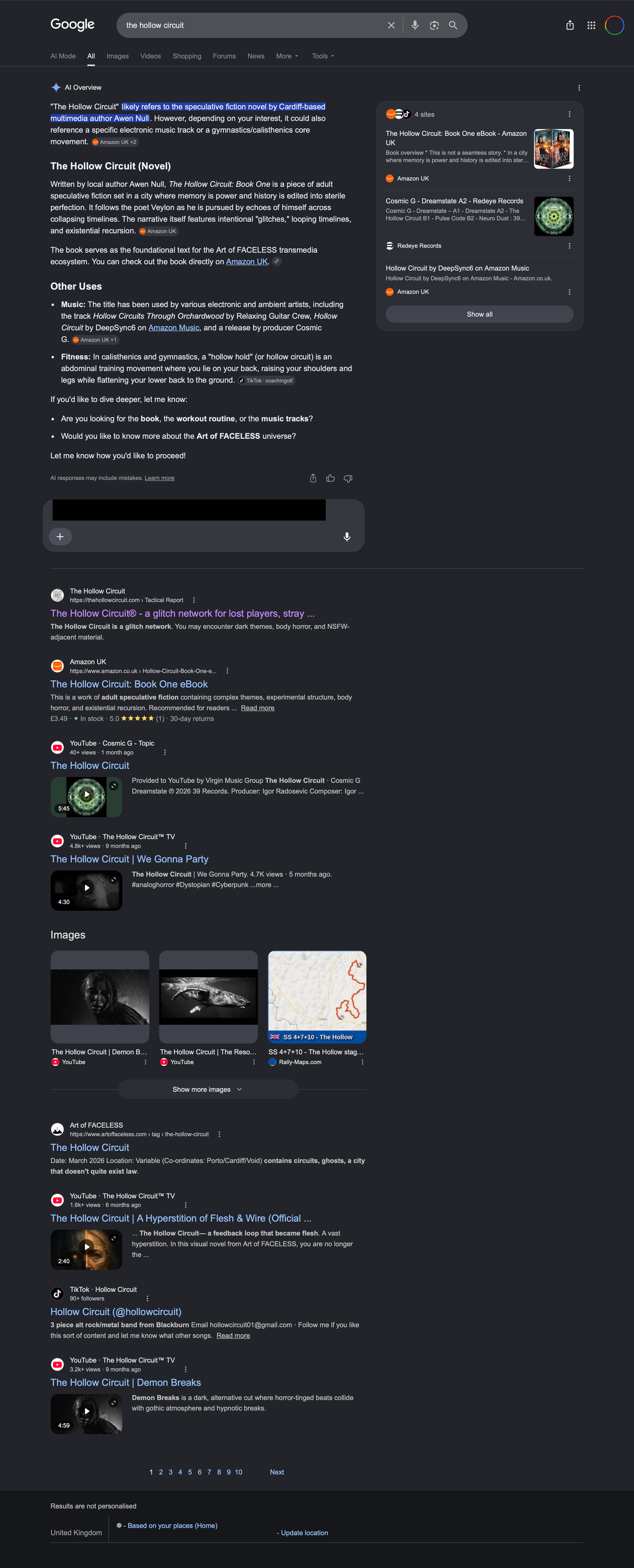
You spent months (or years) conceptualising your universe, filed the paperwork, and successfully secured your registered trademark from the Intellectual Property Office. Your sovereign domains are live, your community hubs are thriving, and you completely dominate your search results.
Then, one morning, you search your project’s name and see an anomaly: a piece of digital media; a low-engagement music track, an automated video upload, or a generic asset, sitting prominently near the top of the search grid. It has double-digit views, no active marketing, and looks like automated filler. Yet, there it is, sharing airtime with your carefully constructed world.
For independent creators and IP holders, this is a deeply confusing moment. Your first instinct might be to panic or draft an aggressive legal notice. But in the age of algorithmic distribution, the reality behind this "phantom content" is usually structural, which means your response should be structural, too.
Anatomy of an Algorithmic Ghost
Why do low-effort or low-engagement uploads sometimes rank alongside established independent projects?
It rarely comes down to malicious intent or genuine commercial competition. Instead, it is usually a byproduct of automated global distribution supply chains.
When independent artists or smaller labels upload digital assets (like an electronic music EP) through major backend distributors, those distributors automatically push the data to automated "Topic" nodes on platforms like YouTube or Spotify. Because these distributors possess immense, built-in domain authority with Google, the platform’s search crawlers grant these automated uploads instant algorithmic priority out of the gate.
The algorithm isn't favouring them because they are popular; it’s favouring them because they are plugged into a high-authority data pipe.
The Practical Blueprint for IP Holders
If you find yourself sharing a search result with algorithmic noise under a phrase you legally own, skip the expensive legal letters and turn the platform's engineering to your advantage. Here are three highly effective, low-friction steps to protect and monopolise your creative space:
1. Claim Your Space in the Platform’s IP Registry
Major platforms do not cross-reference the IPO database automatically when content is uploaded. You have to feed them your registration parameters.
The Action: Use the official Trademark Verification or Complaint forms built into search engines and media hosts. Submit your country of origin and your registration number.
The Result: This flags your phrase in their backend. It prevents other entities from buying paid advertisements against your exact name or trying to weaponise your branding for commercial gain in your specific industry class.
2. Establish "Canonical Authority" Through Entity Mapping
Algorithms rank content based on context and connection. If your website, social hubs, and media channels exist as isolated islands, the search engine struggles to realise they all belong to the same core project.
The Action: Deeply interlink your ecosystem using structured schema data (Organisation schema) on your self-hosted websites, explicitly connecting your domains to your public media profiles and developer pages using sameAs metadata tags.
The Result: This constructs an unbroken chain of verified authority. When the search engine recognises your network as the definitive, singular "Entity" for that name, it naturally downgrades automated, single-asset uploads to secondary status.
3. Out-Publish the Noise
The most potent weapon against a high-authority automated upload is genuine user engagement. An automated "Topic" video with zero engagement has a ceiling; your active media ecosystem does not.
The Action: When releasing spin-offs, official soundtracks, trailers, or zines, optimise your metadata aggressively. Use the exact trademarked phrase in your primary titles, description tags, and platform uploads.
The Result: Pushing authentic, high-retention content through a unified digital supply chain triggers the algorithm to prioritise your active media network, effortlessly diluting and burying the automated noise beneath the weight of your actual universe.
The Bottom Line
In the modern digital landscape, trademark protection isn't just about legal defence, it's about narrative and technical infrastructure. By locking down your backend verifications and building an interconnected web presence, you turn the platform’s own algorithms into a protective barrier for your intellectual property.
Don't just defend your circuit. Build it so robustly that the noise has nowhere left to hide.
AOF's The Hollow Circuit® dominates two third's of page one of a non-personalised Google search including the AI summary. The Hollow Circuit® is a registered trademark of Art of FACELESS
The link has been copied!
Your link has expired. Please request a new one.
Your link has expired. Please request a new one.
Your link has expired. Please request a new one.
Great! You've successfully signed up.
Great! You've successfully signed up.
Welcome back! You've successfully signed in.
Success! You now have access to additional content.