A Short Story by Awen Null
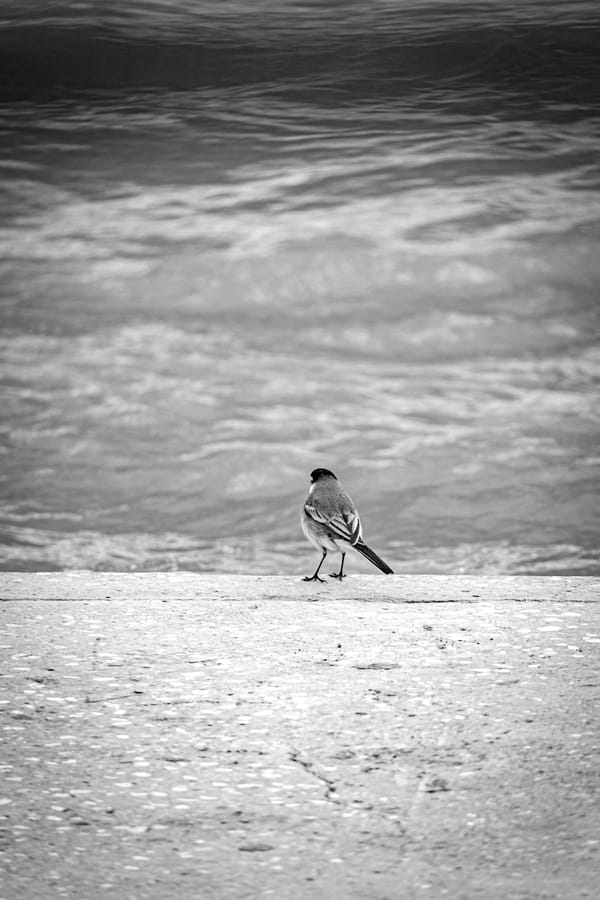
The old man sat hunched on the sea wall, his coat wrapped around his bones, listening to the sigh of the tide as it pulled away from Laugharne’s muddy shore. A wagtail bobbed and dipped at his feet, as if keeping time with the slow tremor of his hand resting on the carved top of his stick. The winter air smelt of brine and old rain, and the sky above was a poet’s sky; deep-bellied and rolling, shifting like memories through a tired, damaged mind.
There had been a time, he remembered, when his legs carried him along the winding streets of the town, past the boathouse and the dreaming water, past the ghosts of drinkers leaning against the Mariner’s door. Now his legs had grown stubborn, his step uncertain, a whisper of a storm running through his nerves. The doctor had given it a name, Multiple Sclerosis, but it was more like a long, slow shipwreck.
Seren had walked with him once, her laughter lifted by the wind, her arm tucked into his. They would stop by the estuary, watching the gulls’ wheel and caw, tracing invisible stories in the air. She had called the wagtails ‘little sentinels’, standing guard against the coming tide. But that was before the weight of years had curled her name into an echo.
A boy ran past, his boots splashing through a shallow pool left by the retreating sea. His mother followed, her voice rising and falling with concern.
"Not so fast, lad. You’ll slip."
The boy skidded to a halt, staring at the bird with the same open wonder that Seren once had. The old man watched him, his fingers tightening around his stick.
"What’s it called?" the boy asked, turning wide eyes up to him.
The old man swallowed, feeling the storm in his bones. "A wagtail. They watch, always watching."
The boy nodded, solemn as the chapel bells. Then he was gone, his mother’s shadow stretching long behind him.
The wagtail flicked its tail once, twice, then lifted into the air, its wings carrying it towards the sea’s horizon. The old man let out a slow breath and watched it go, his world shrinking back to the worn wood beneath his hand and the steady, unbroken rhythm of the tide.
Reflective Commentary
This story is inspired by Thomas Hardy’s Wagtail and Baby, with influences from the poetic prose of Dylan Thomas. The setting of Laugharne, closely associated with Thomas, allows for an intertwining of lyrical language, Welsh identity, and themes of time and loss.
The protagonist, an elderly man with Multiple Sclerosis, embodies the fragility of the human condition against the vast and unrelenting nature of time. Like Hardy’s wagtail, he is a witness to the world’s slow changes, a solitary figure observing from the margins. His illness, described as a "long, slow shipwreck," mirrors the ebbing tide, drawing on natural imagery to reflect his physical decline.
Seren’s memory acts as an emotional tether in the story, reinforcing themes of loss and continuity. The inclusion of a young boy offers contrast: a fleeting reminder of what was, and a nod to the cyclical nature of life. The dialogue is sparse, but deliberate, ensuring that each word carries weight in the rhythm of the piece.
Stylistically, I sought to incorporate Dylan Thomas’s musicality, using rolling descriptions and atmospheric detail to create a sense of place. The sea, the birds, and the town’s presence serve as characters in their own right, lending the piece a poetic, almost mythical quality.
The process of writing this involved refining the language to ensure it retained its fluidity while remaining grounded in its themes. Initially, the protagonist’s condition was only implied, but I chose to make the reference to Multiple Sclerosis explicit to further anchor the story in its exploration of physical deterioration.
Ultimately, this piece reflects on memory, disability, and the enduring watchfulness of the natural world, encapsulating a moment of stillness in an ever-moving tide.
I am the old man. I am also the one observing and reflecting. Mariner’s door