Initializing...

The Languages We Think In: Tolkien, Welsh, and the Multilingual Architecture of writing fiction
Photo by Catrin Ellis / Unsplash

The Languages We Think In: Tolkien, Welsh, and the Multilingual Architecture of writing fiction

The language that shapes us is the language that shapes the world we imagine.


Share this post

Written by Lloyd Lewis

Writers don’t think in words; we think in architectures. Language isn’t just vocabulary, it’s scaffolding for imagination. In the novel The Hollow Circuit, by Awen Null its emotional core and world logic are shaped by three linguistic currents: English, Ancient Greek, and Welsh. Each brings its own gravitational pull, its own way of organising thought, and, crucially, its own neurological footprint.
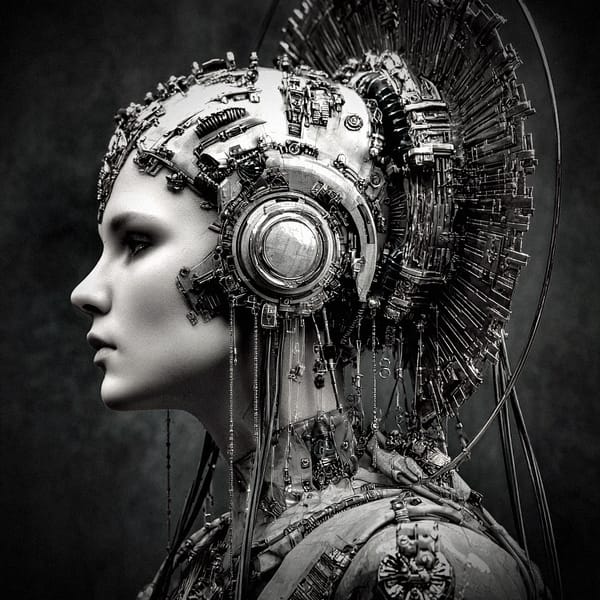
Neuroscience has long shown that multilingual speakers don’t simply “store” separate lexicons. They develop multiple cognitive maps, each activating distinct neural pathways associated with planning, metaphor, attention, memory, and interpretation. Researchers such as Ellen Bialystok and Jubin Abutalebi have demonstrated that moving between languages enhances cognitive flexibility and conceptual switching. In other words: multilingual brains are already practising world-building at the neuronal level.

Tolkien understood this instinctively long before anyone quantified it.


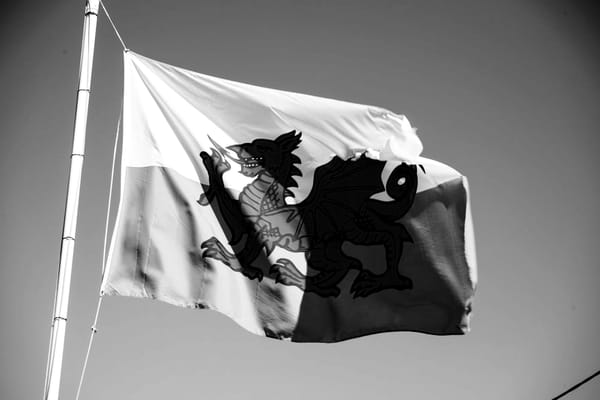
Tolkien’s Welshness (the quiet part most people miss)

It often surprises people to learn that Tolkien had genuine Welsh roots. His mother’s family, the Suffields, descended from Welsh ancestors, and Tolkien himself described being “brought up entirely on Welsh.” This wasn’t casual admiration. Welsh formed part of the emotional bedrock of his imagination from childhood. He wrote that Welsh “captured my heart” because of its musicality and morphological richness.

At a time when Welsh was being actively suppressed by English educational policy (children punished for speaking it) Tolkien’s decision to draw from its grammar and internal logic was quietly radical. He wasn’t defending Wales, but he was reaffirming the intrinsic creative value of a language others tried to diminish.

This influence is unmistakable in Sindarin:

  • its consonant mutations mirror Welsh treigladau,
  • its phonology favours the same liquid consonants and soft sonorities,
  • its place names evoke Welsh geography as much as imaginary Middle-earth.

Language shapes worldbuilding because it shapes worldview.


Hiraeth: the untranslatable architecture of emotion

The Welsh word hiraeth is often translated as “longing,” but this is inadequate. There is no English equivalent. Hiraeth carries longing, loss, belonging, yearning, home, grief, and memory braided together. One emotional superstructure; not divisible into neat synonyms.

When a language packages emotion differently, the brain processes emotion differently.
And when you write multilingually—even inside a fictional universe—you inherit these emotional architectures.

In The Hollow Circuit, timelines fold and fracture. Characters live inside echoes of worlds they half-remember. Their longing isn’t nostalgia; it’s hiraeth, longing for places that were real, might have been real, or were real in another timeline. Only Welsh holds that shape. English alone can’t.


Ancient Greek: the metaphysical backbone

Alongside Welsh sits Ancient Greek, with its dense philosophical lexicon, layered tenses, and deep roots in Western thought. Ancient Greek doesn’t merely name the world, it theorises it. Its grammar forces distinctions between states, intentions, and unfolding processes.

It’s hard to imagine a more natural language for timefolds, recursion, prophecy, or the metaphysics of identity (all of which anchor The Hollow Circuit). Where Welsh gives emotional terrain, Greek gives intellectual superstructure.

English, with its global reach and clarity, becomes the stitching thread between the two.


Multilingual writing as world design

Anglophone internet culture often treats English as neutral or inevitable. But multilingual writers know better: language is not interchangeable. Each one reorganises thought.

In The Hollow Circuit, this plurality is not aesthetic, it is structural:

  • English builds the narrative surface.
  • Welsh shapes emotional physics and poetic resonance.
  • Ancient Greek defines metaphysical logic, cosmology, and philosophical tension.

Neurologically, switching between these tongues activates networks for abstraction, mental simulation, and theory of mind, the same networks fiction relies on to imagine other realities.

Tolkien proved this a century ago. He didn’t invent languages to decorate a story; he invented a world to give his languages somewhere to live.

His creative lineage is clear:

  • The doors of Moria respond to a linguistic puzzle where friendship is both semantic and metaphysical.
  • Sindarin’s contour maps directly onto Welsh sound patterns.
  • Middle-earth’s geography echoes Celtic and Brythonic linguistic structures.

He showed that languages don’t merely describe fictional worlds, they generate them.


Why The Hollow Circuit must speak three tongues

The Hollow Circuit’s universe is not monolingual. Its emotional, mythic, and philosophical structures emerge from the convergence of three languages with three worldviews. Remove one and the world collapses. Keep all three and the story gains:

  • Cognitive dimension
  • Cultural lineage
  • Emotional precision
  • Metaphysical coherence

Tolkien’s genius wasn’t simply invention, it was integration. And in a global culture that increasingly defaults to English, choosing multilinguality isn’t defiance. It’s fidelity to how human minds actually work.

The world has never spoken with one tongue.
Neither should our stories.


A’r iaith sy’n ein llunio yw’r iaith sy’n siapio’r byd rydym yn ei ddychmygu.
The language that shapes us is the language that shapes the world we imagine.


References

  • Bialystok, E. (2009). Bilingualism: The good, the bad, and the indifferent. Bilingualism: Language and Cognition.
  • Abutalebi, J. & Green, D. (2016). Neuroimaging of language control in bilinguals. Oxford Handbook of Neurolinguistics.
  • Tolkien, J.R.R. (1955). The Return of the King.
  • Tolkien, J.R.R. (1983). The Monsters and the Critics and Other Essays.
  • Thomas, A.R. (2012). Welsh in the Twenty-First Century.
  • Dehaene, S. (2020). How We Learn: Why Brains Learn Better Than Any Machine… for Now.
  • MacSweeney, M. (2021). The multilingual brain. Annual Review of Applied Linguistics.

Art of FACELESS | Instagram | Linktree
View artoffaceless’s Linktree to discover and stream music from top platforms like Spotify, Apple Music here. Your next favorite track is just a click away!

Share this post
Comments

Be the first to know

Join our community and get notified about upcoming stories

Subscribing...
You've been subscribed!
Something went wrong
Why Your Image Is Now a Liability: Authenticity, Identity, and the Age of Deepfakes
Photo by Jesús Rocha / Unsplash

Why Your Image Is Now a Liability: Authenticity, Identity, and the Age of Deepfakes

For more than a decade, digital culture has promoted a simple rule: attach your real name and face to your work, and people will trust you. This logic shaped influencer culture, founder branding, and even professional networking. Visibility was framed as authenticity, and authenticity was framed as credibility. That equation no longer holds. In fact, in an era defined by generative artificial intelligence and deepfakes, the public promotion of one’s image and name has shifted from an asset to a


FACELESS

FACELESS

NEWS: Project "Alt.Cardiff2026" Launch Details

NEWS: Project "Alt.Cardiff2026" Launch Details

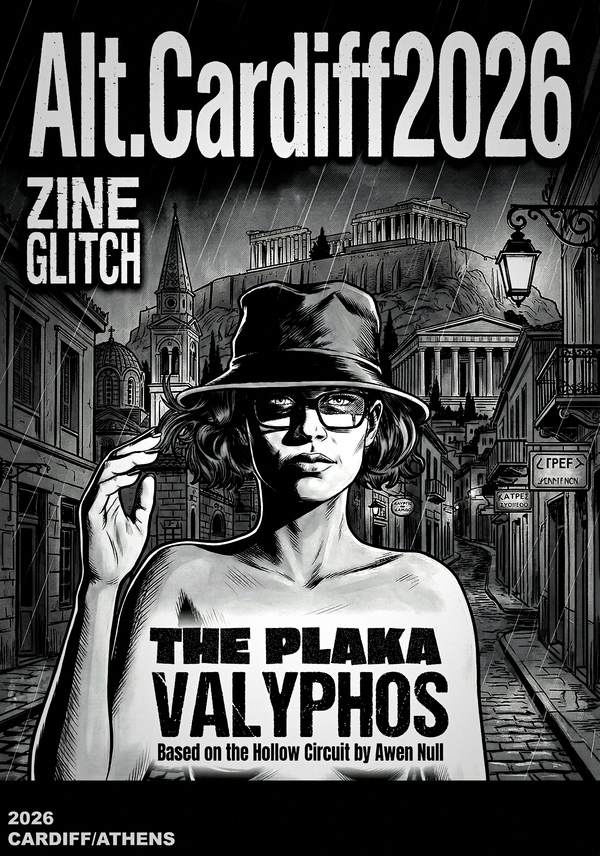
We are proud to announce the release structure for the upcoming graphic novel series, Issue #1: The Church Street Valyphos in the ZineGlitch comic Alt.Cardiff2026. To ensure the project meets all Online Safety Act (OSA) guidelines while preserving artistic integrity, the release will be tiered: 1. The Zine (Standard Edition): Available via Itch.io and Print. Features the core Noir narrative. Rated 15+. 2. The Null Gate (Subscriber Edition): Available via Patreon. Features the "Director's Cut


FACELESS

FACELESS

Synopsis of The Resonance Keepers of Crete Reimagined: a short story by Awen Null

Synopsis of The Resonance Keepers of Crete Reimagined: a short story by Awen Null

The story is exclusively available on itch.io as an Ancient Greek fusion, followed by a contemporary English companion version Marina sits alone on the obsidian sand beach of Cape Lithino, Crete, feeling the oppressive weight of ancient trauma in the landscape. Above her, the ominous constellation called the Oionos burns in the dark sky as a supernatural storm rages. Marina and her companion Alexis have become unwilling instruments of otherworldly forces, their mutated bodies acting as organic


FACELESS

FACELESS