Written by Lloyd Lewis | March 2026
I walked into the Palace of Knossos expecting archaeology. What I encountered instead was a concrete monument to one man's imagination — and a near-perfect case study in what we at AOF call Cognitive Colonisation.
The site at Knossos, five kilometres from the centre of Heraklion, is one of the most visited archaeological locations in Europe. It is also, in substantial part, a 20th-century fabrication. The bold red pillars, the vivid fresco reproductions, the throne room dressed as if waiting for a Bronze Age king to return — these are not ancient Crete. They are the vision of a wealthy Victorian Englishman named Arthur Evans, rebuilt in reinforced concrete, painted by Swiss artists he commissioned, and now sold to nearly a million tourists a year as the cradle of European civilisation. The absurdity of it hits you immediately. The concrete doesn't even try to hide. You are standing inside someone else's dream, and there is no warning label at the gate.
This matters far beyond the archaeological. The Knossos situation is a masterclass in how power, money, and cultural authority combine to overwrite existing knowledge, displace local voices, and lock a fabricated narrative into physical reality — making it almost impossible to dislodge.
The Man Who Actually Found It
Before Evans arrived, there was Minos Kalokairinos.
In 1878, Kalokairinos — a Cretan businessman, antiquarian, and classical scholar from Heraklion, whose family literally owned the land — began the first systematic excavations at Kephala Hill. Within three weeks, he had uncovered storage rooms and part of the west wing's throne hall. Ottoman authorities forced him to stop, but his discoveries had already attracted international attention. Heinrich Schliemann visited. Archaeologists from France, Germany, Italy, and Britain took notice. The find was real, it was significant, and its discoverer was Greek.
Evans arrived in Crete in 1894, heard about Kalokairinos's work, and — with the access to capital that a son of British industrial wealth afforded him — acquired the site. He created the "Cretan Exploration Fund" through what critics have described as a deliberately obscured financial manoeuvre: the landowners would only sell to an organisation, not an individual. Evans founded the organisation. He was, of course, its sole contributor. The land changed hands.
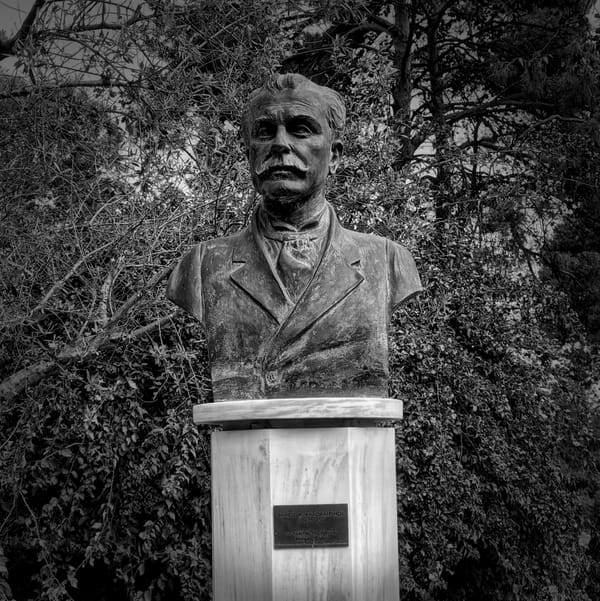
Kalokairinos spent the remainder of his life trying to reclaim recognition for his discovery. He sued Evans in 1907. He died the same year before any resolution was reached. His contribution was, in the assessment of scholar Antonis Kotsonas at NYU's Institute for the Study of the Ancient World, "forgotten for too long" — his pioneering research into Knossian topography was "largely overlooked" by subsequent scholarship. It took until very recently for a second bust to be erected at Knossos bearing his name, placed close to the one of Evans that had dominated the entrance for decades. A small, belated acknowledgement. His name is still not what most tourists leave knowing.
This is not a footnote. This is the blueprint.
The Naming Game
Evans didn't merely dig. He named. He classified. He defined.
The Bronze Age civilisation he encountered needed a label, and Evans provided one drawn from Greek mythology: Minoan, after the legendary King Minos of Crete. The term had no documentary basis in archaeology — no ancient inhabitants of Crete called themselves Minoans. The word was Evans's editorial choice, and it stuck so completely that it now structures every textbook, every exhibition board, every museum caption that touches on Bronze Age Crete.
Scholar John Papadopoulos, writing in the Journal of Mediterranean Archaeology, titled a landmark critique "Inventing the Minoans." Yannis Hamilakis, Professor of Archaeology at Brown University and one of the most rigorous critical voices in the field, has argued for decades that the Minoan past was constructed through "colonial and national processes" as the first supposedly "European civilisation." The Cretan Bronze Age was, in Hamilakis's analysis, recast and recreated to satisfy what he describes as a Eurocentric colonial imagination — one that wanted a sophisticated, aesthetically pleasing, ancient civilisation it could claim as a European foundation myth. Evans provided exactly that. The reconstructed palace, with its elegant frescoes and implied palace hierarchies, was legible to European sensibilities in ways a ruin never could be.
What Evans built was not just a physical site. He built a cognitive framework that has governed how Minoan Crete is understood, taught, and monetised ever since. This is Cognitive Colonisation operating at an archaeological scale: an external agent with money and institutional authority imposes a conceptual structure onto a culture — renames it, reclassifies it, reconstructs it in concrete — and the original, local understanding, is buried beneath.
The Concrete and the Fresco
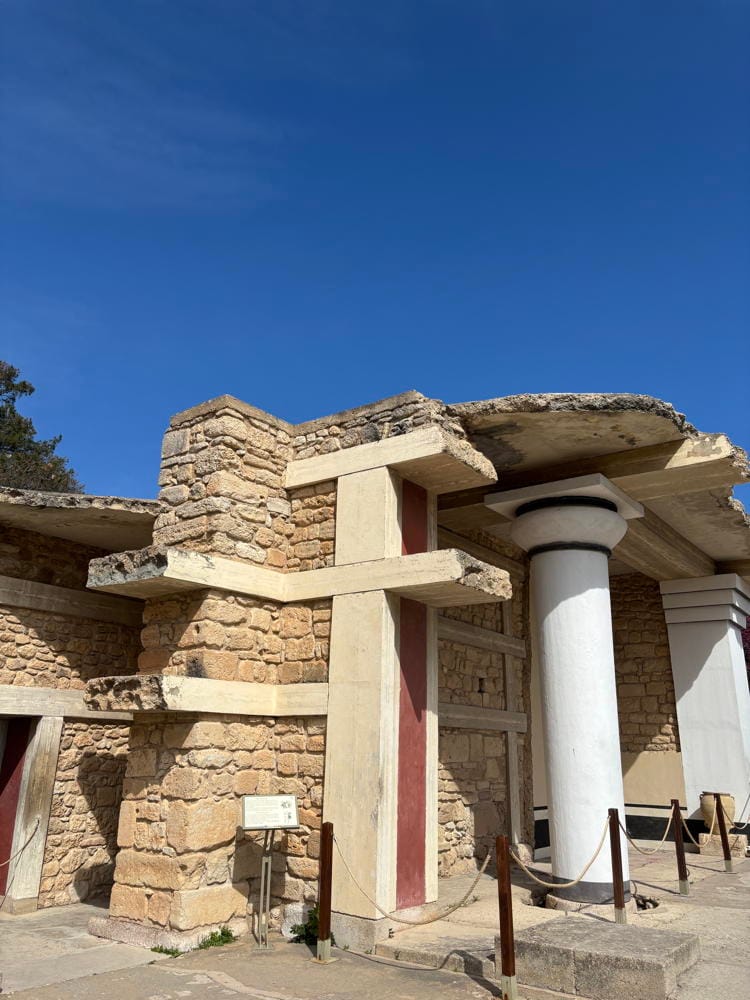
The physical reconstruction at Knossos is where Evans's certainties became literally immovable.
His decision to use reinforced concrete — a thoroughly modern material — to rebuild parts of a Bronze Age palace was controversial almost immediately. The red columns at the site are not ancient. They are early 20th-century modernism. Art historian Cathy Gere has observed, with some acidity, that the reconstructed palace bears comparison with Alexei Shchusev's Lenin Mausoleum in Moscow, built around the same period, calling it one of the most eccentric archaeological reconstructions ever accepted by mainstream scholarship. The irony of the Bronze Age Palace of Knossos being among the first reinforced concrete buildings on Crete is not lost on critics.
The frescoes compound the problem. Evans commissioned Swiss artists, Émile Gilliéron père and fils, to repaint the Throne Room and produce the celebrated fresco reconstructions. The "Prince of the Lilies" — one of the most reproduced images in all Aegean archaeology — was assembled from scattered fragments, with the majority of the final figure supplied by artistic inference. Some scholars argue the fragments may have belonged to entirely different figures. The composition, including its gender, its posture, and its iconographic meaning, is a creative extrapolation dressed as discovery. Cretan archaeologist Alexandra Karetsou has described Knossos as a borderline case between restoration and exploitation — a site where Evans's reconstruction altered the character of the ruins and introduced a fundamental disunity that cannot now be undone.
Because Evans locked his interpretations into the fabric of the site, future generations could not simply dig more carefully and correct the errors. The building itself became the argument. What you see when you visit is Evans's theory expressed in load-bearing concrete. There is no obvious seam between what was found and what was invented.
The Sidelining That Continues
The alternative scholarship exists. It is serious, substantial, and largely absent from Knossos itself.
Hamilakis's edited volume Labyrinth Revisited: Rethinking "Minoan" Archaeology (2002) gathered critics who examined the colonial discourses underlying Minoan archaeology. The follow-up volume, co-edited with Nicoletta Momigliano in 2006, extended this analysis across disciplines. Ilse Schoep's work in the American Journal of Archaeology re-examined Evans's construction of Minoan civilisation as such. Papadopoulos has forensically detailed how the Minoan narrative served the ideological needs of early 20th-century European identity-building. Katerina Kopaka has spent years restoring Kalokairinos to scholarly visibility. The critical apparatus is there.
What is not there is the site. Walk around Knossos, and you encounter Evans's photographs, Evans's reconstructions, Evans's captions. The interpretive boards are overwhelmingly Evansian in frame. The labyrinth mythology, which Evans seized on to romanticise the site's complexity, is everywhere — even though no physical labyrinth has ever been found and the connection between the Bronze Age palace and the Minotaur myth is a retrospective literary association, not an archaeological fact. The "throne room," the "lustral basin," the "royal road" — these are Evans's names, Evans's interpretations, Evans's story, installed at the actual location and presented as though they were established truths rather than a single Victorian scholar's contested hypothesis.
The Greeks who walk the site today are, in a very real sense, tourists in a reconstruction of their own ancestors' world — a reconstruction designed by a foreigner who used his wealth to acquire the land, his institutional authority to establish the interpretive framework, and his access to European publishing networks to ensure his version became the official one.
Why This Matters Now
Cognitive Colonisation is not exclusively a historical phenomenon. The mechanisms Evans employed — the power to name, the authority to classify, the institutional weight to make a particular interpretation stick — are operational in every domain where concentrated resources and cultural authority meet vulnerable or under-resourced knowledge systems.
Evans was not uniquely malevolent. He was a product of his time and class, almost certainly sincere in his belief that he was serving scholarship and civilisation. But sincerity is not the variable that matters. What matters is the structural reality: a man with British imperial backing, a family fortune from paper manufacturing, the Keepership of the Ashmolean Museum, and a network of European academic prestige arrived in Crete during a period of Ottoman destabilisation, acquired a site that a local man had already discovered, demolished the possibility of future correction by building his interpretation in concrete, invented a civilisational name now used globally, and died in 1941 with his version of events still standing — literally.
The bust of Kalokairinos is a start. But it is telling that it needed to be added. The default was a century of absence.
When we talk about who gets to name things, who gets to frame the story, whose resources allow them to make their interpretation structurally permanent — Knossos is not an abstract case study. It is a physical place you can walk through on a March afternoon, touching the concrete, watching the tourists photograph fresco reproductions painted by Swiss artists, standing inside the labyrinth that was never real.
Art of FACELESS. Cardiff. Est. 2010. The work is visible. The architect is not. artoffaceless.com | artoffaceless.org
 Read full bio