
The Hymn of Drael: Digital Ghosts and Trench Warfare on Sura-5
A multimedia exploration of war poetry, analogue horror, and the ghosts of Wilfred Owen in a sci-fi setting.
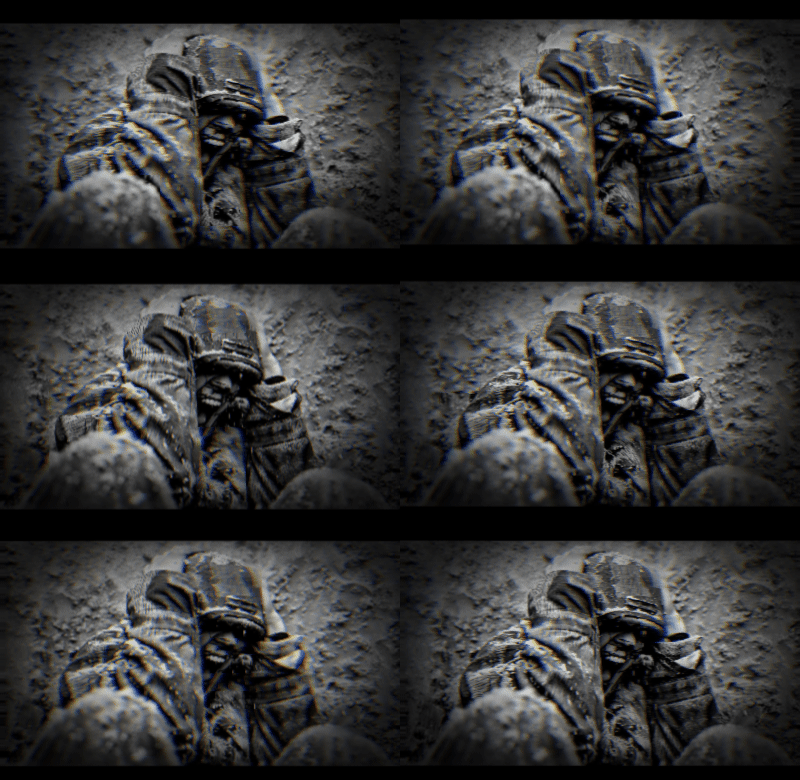
There is a specific texture to memory when it has been corrupted by trauma. It doesn't look like 4K video. It looks like a VHS tape left out in the sun — warped, static-heavy, skipping beats.
"The Hymn of Drael" was made to capture that degradation.
This isn't a poem with a video attached. It is a transmedia collage — sound, vision, and language fused into something that behaves the way traumatic recall actually behaves: non-linear, invasive, beautiful in the wrong places. Every layer was chosen. Nothing here is accidental.
The poem is written by Awen Null. The production is directed and hand-edited by Lloyd Lewis. The visuals are licensed 4K footage. The music — by Lloyd MSUX — is an original one-off performance recorded in a single session on an iPad DAW, remastered in Logic Pro. The voice is fictional: cloned and chopped via a commercially licensed system.
This is an authentic, hand-made digital transmedia collage. It depicts PTSD. It does not flinch.
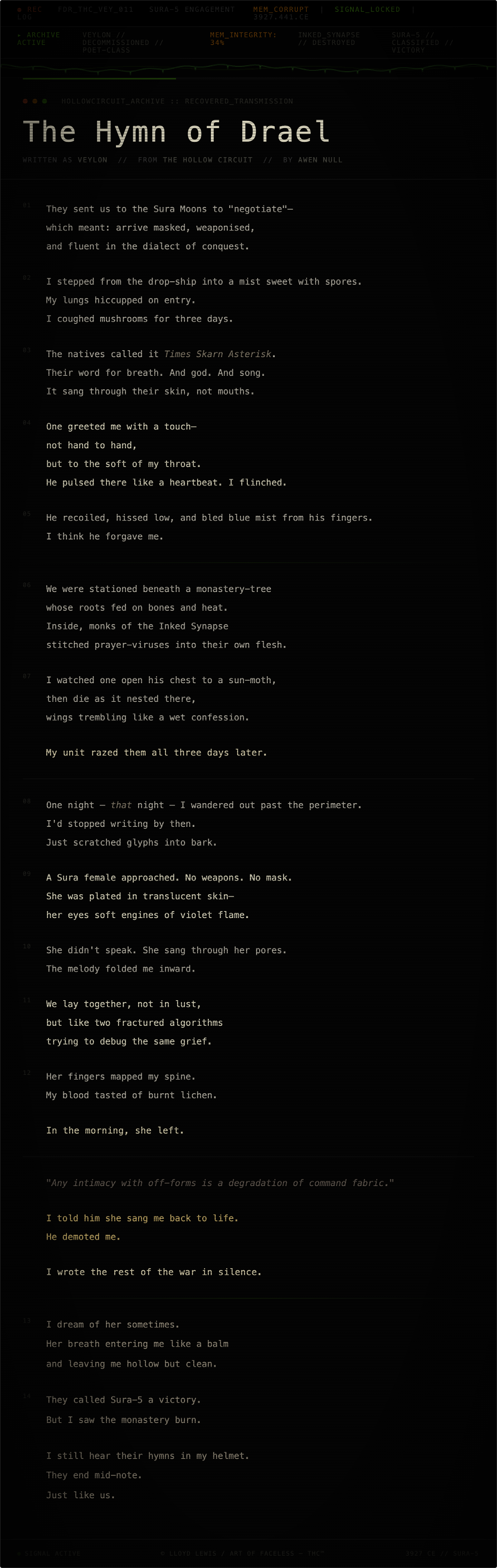
Awen Null is the author of The Hollow Circuit universe. The following are his notes on the poem's origins, its psychological architecture, and its place in the THC canon.
Veylon is a character first introduced in The Hollow Circuit: Book One — a decommissioned former military strategist turned poet, one of the novel's most emotionally complex figures. Writing as Veylon from the vantage point of 3927, "The Hymn of Drael" frames what we might call PTSD as something older than warfare itself: a transmission error in the soul, looping across centuries, species, and stars.
The Sura Moons sequence is not in the novel. This is supplementary canon — an excavation of a character we thought we understood, revealing a wound that predates everything we've seen him do. That's the nature of the THC universe. History accumulates in the spaces between chapters.
The poem's spiritual home is the trenches of the Somme. It is a deliberate transposition of First World War poetry into a science fiction frame, drawing specifically on the disillusionment of Wilfred Owen, Siegfried Sassoon, and Robert Graves.
The gas attack and bodily invasion. The poem opens with a "mist sweet with spores" that forces the narrator to "cough mushrooms." This is a biopunk reimagining of the gas attacks in Owen's Dulce et Decorum Est. In WWI, the horror was the weaponisation of the air itself — froth-corrupted lungs, drowning on dry land. On Sura-5, the environment is equally invasive, collapsing the line between a soldier's body and the battlefield. The planet is both beautiful and poisonous, which is not an accident.
The enemy's humanity. A recurring theme in Great War literature is the moment when the enemy becomes a person — most famously in accounts of the 1914 Christmas Truce. Veylon's encounter with the Sura female mirrors this rupture exactly. The line "two fractured algorithms / trying to debug the same grief" strips away the machinery of war and leaves only two damaged beings finding resonance in the dark. It is not a love poem. It is a truce poem.
Lions led by donkeys. The commanding officer's response — "Any intimacy with off-forms is a degradation of command fabric" — channels the fury Sassoon and Graves directed at the High Command: men who spoke in clean, bureaucratic language about visceral, irreversible events. "Command fabric" is a kind of obscenity. Veylon counters it with the plainest sentence in the poem: "She sang me back to life." The demotic versus the administrative. The human versus the institutional.
The hollowness of victory. The poem refuses resolution. "They called Sura-5 a victory. / But I saw the monastery burn." This is the Great War's central wound — the gap between official narrative and lived experience. The final image — hymns that "end mid-note / just like us" — doesn't offer closure. It offers the correct sound of no closure. Like soldiers returning to a world that had moved on without them, Veylon is left "hollow but clean." Haunted by a song that will never finish.
The science fiction frame doesn't soften any of this. If anything, defamiliarisation makes the parallels hit harder — you encounter them without the protective patina of history.
Lloyd Lewis is the director, editor, and producer of "The Hymn of Drael." The following are his notes on the production's visual philosophy, auditory architecture, and the challenge of filming a memory that was never meant to be clean.
The cinematic landscape is currently obsessed with fidelity — more pixels, higher frame rates, cleaner sensors. Every technical advance is framed as progress toward some ideal of transparency, as though the camera's job is to disappear.
I've never believed that. And working with Awen's poem made that conviction concrete.
When he handed me "The Hymn of Drael," the first thing I understood was that the visual language couldn't be clean. Veylon's memory isn't clean. To film it in 4K with colour-graded precision would have been a lie — not just aesthetically, but ethically. If we're going to make work about how trauma degrades cognition, then the cognitive apparatus of the film itself should degrade.
Datamoshing as directorial language. The technique — intentionally corrupting a video file's compression data — isn't new, but its application here is specific. Images don't cut; they smear. Landscapes bleed into figures. Movement leaves ghost-traces behind.
I wanted it to feel like a recovered black-box recording; an archeolgical digital fragment from our contemporary, military and PTSD landscapes. Images from 2026 are more relevant to viewers than archive footage from 1914-18.
It's not a film about the past, but an artefact of it — something that had survived transmission across a thousand years of signal decay. The monastery-tree sequences were cut to evoke contemporary war photography: that specific quality of images that carry too much weight for their resolution. Grounding the alien biopunk aesthetic in the grim visual grammar of trauma-induced drug addiction was the connective tissue between Awen's literary intentions and what I was building in the edit.
The voice as meta-text. The decision to use a cloned, commercially licensed voice was not a compromise — it was the correct choice. Veylon describes himself as a "fractured algorithm." A voice that sounds human but carries a synthetic grain is the only honest casting. The uncanny valley isn't a flaw here; it's the point. You're hearing a man who has processed so much institutional violence that something in his signal has permanently shifted. That synthetic quality is the scar tissue.
The auditory architecture. Lloyd MSUX recorded the score in a single iPad session — one unbroken performance, later remastered in Logic Pro. That constraint matters. There are no overdubs, no safety nets, no going back for a cleaner take. The urgency in the music is real because the session was real. What you hear is a single moment of attention to Awen's words, captured and preserved.
The sound design operates the same way. The rhythmic pulse when the native touches Veylon's throat — mixed with a low-frequency hum beneath the audible spectrum and a gunshot — was designed to feel both environmental and metaphorically, illustrative. It's not telling you how to feel about the scene. It's making you physiologically recreate it. A prayer-virus for the listener's inner ear.
The music doesn't build to a resolution because there isn't one. True to Awen's Owen-inflected final lines, it persists as a haunting loop and ends mid-note. Not a fade. A cut. The same cut Veylon can't stop hearing in his helmet.
The verdict. "The Hymn of Drael" is, in the end, a truce poem disguised as a sci-fi short so well it looks like a contemporary film. It doesn't just show us a soldier with PTSD; it forces the filmic apparatus to exhibit the symptoms. That was the ambition from the first frame. I believe we got there.
"The Hollow Circuit" is a psychological horror visual novel and RPG in active development for Steam — the centre of a transmedia universe built by Art of FACELESS since 2012.
At its core, it is a story about what happens when systems — technological, political, psychological — begin to colonise the self. The universe spans millennia, populated by decommissioned soldiers, fractured AIs, resistance networks, and the ruins of civilisations that thought they had won. Veylon is one of its architects: a man who survived a war by turning himself into a record of it.
Themes of surveillance, identity erasure, and Cognitive Colonisation® run through every layer of the fiction — including this poem, including this film, including the frame you're reading it in now.
The Hollow Circuit: Book One Kindle edition is available now. The Steam VN/RPG is in development.
→ Enter The Hollow Circuit at thehollowcircuit.com → Explore the wider universe at vlayphos.tech
"The Hymn of Drael" is one part of an ongoing body of work produced under the Art of FACELESS collective — transmedia, independent, uncompromising since 2010.
If this piece meant something to you, the best thing you can do is follow what comes next and subscribe. It's free. There are paid options too.
No faces. No algorithm. No apology.
All trademarks including The Hollow Circuit®, Veylon Protocol™, Cognitive Colonisation®, and Hyperstition Architecture® are registered with the UK IPO and are the intellectual property of Art of FACELESS.
 YouTube
 Amazon.co.ukRead full bio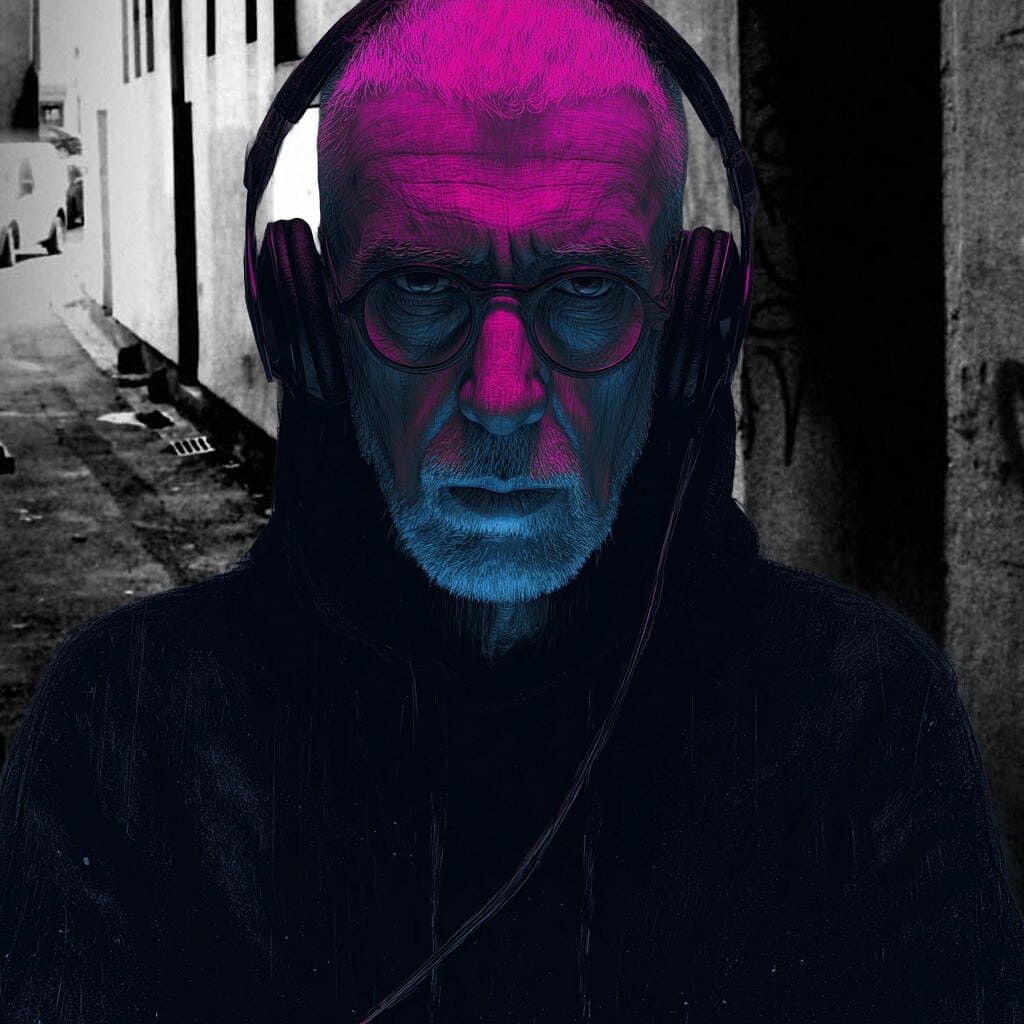
© 2026 Art of FACELESS. All rights reserved.
The Hollow Circuit™, Hyperstition Architecture™,
The Veylon Protocol™, and Cognitive Colonisation™
are proprietary intellectual property of Art of FACELESS.