Initializing...

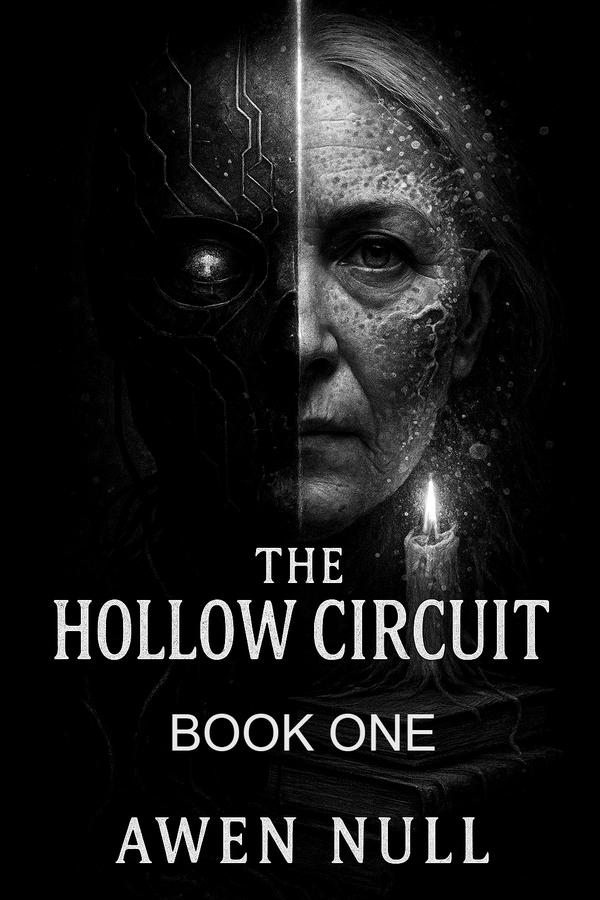
THE HOLLOW CIRCUIT Book One by Awen Null
The HOLLOW CIRCUIT Book One cover (black and white render only for this post) designed by Awen Null ©2025 Kiss My Etchings

THE HOLLOW CIRCUIT Book One by Awen Null

For readers who walk the fault-line between genres, this is not a seamless story. It glitches. It contradicts. It loops. Every fracture is deliberate. Every repetition is a breadcrumb.


Share this post

In a fractured city where fungus carries memory and power, the poet Veylon is caught between survival and recursion. Above ground, the Oligarchy of Light edits history into sterile perfection. Beneath it, the Hollow Circuit breathes: a labyrinth of bioluminescent tunnels, spore-lit archives, and rebels who carve poems into living walls.

Veylon once wrote strategies for war. Now he writes only fragments, haunted by failures and pursued by echoes of himself across collapsing timelines. The Poet. The Glove. The Glitch. The Traveller. Each is a possible self, each demanding to be remembered. When these fractured versions converge, reality itself threatens to unravel.

At his side stands Seya, fierce as flame in a world of rot and recursion. Through her, Veylon glimpses the possibility of wholeness—yet the Circuit is not merciful. It devours, it rewrites, it repeats. To survive, he must choose between erasure and becoming.

The Hollow Circuit is more than a novel. It is the first node in a wider transmission:

  • Book One of a cycle exploring identity, memory, and control.
  • Part of a transmedia ecosystem that includes zines, visual novels, and soundscapes.
  • Written in lyrical, fractured prose that blurs science fiction, philosophy, and the New Weird.

For readers who walk the fault-line between genres, this is not a seamless story. It glitches. It contradicts. It loops. Every fracture is deliberate. Every repetition is a breadcrumb.

Enter the Circuit. The story has already begun.

The Hollow Circuit: Book One is perfect for readers of Jeff VanderMeer, China Miéville, Philip K. Dick, and Ursula K. Le Guin. Fans of biopunk, cyberpunk, and philosophical science fiction will find themselves at home—and unsettled—in its recursive depths.

This is a work of adult speculative fiction. It contains complex themes, experimental structure, and moments of body horror, intimacy, and existential recursion. Recommended for mature readers (16+).

Art of FACELESS | Instagram | Linktree
View artoffaceless’s Linktree to discover and stream music from top platforms like Spotify, Apple Music here. Your next favorite track is just a click away!

Share this post
Comments

Be the first to know

Join our community and get notified about upcoming stories

Subscribing...
You've been subscribed!
Something went wrong
The Architecture of the Occupied Mind: Cognitive Colonisation in the Age of Algorithmic Hegemony
The Architecture of the Occupied Mind. ©2026 Art of FACELESS

The Architecture of the Occupied Mind: Cognitive Colonisation in the Age of Algorithmic Hegemony

By The Art of FACELESS Research Division Abstract While traditional colonialism sought dominion over territory and resources, the defining struggle of the 21st century is the battle for the "territory" of the human imagination. This paper establishes the Art of FACELESS (AOF) definition of Cognitive Colonisation™—a term for which we hold the pending trademark—not merely as a cultural critique, but as a precise mechanism of epistemic control. By deconstructing the transition from legacy media


FACELESS

FACELESS

Digital Necromancy and the Myth of Helplessness
©2026 Art of FACELESS

Digital Necromancy and the Myth of Helplessness

Why The Guardian’s lament for "truth" misses the point: We have the cure, we just refuse to take the medicine. They call it "content." We call it puppetry. Yesterday, a video circulated on Threads and X showing the faces of Freddie Mercury, Amy Winehouse, Elvis Presley, Ozzy Osbourne, and Kurt Cobain stitched onto a single, shifting torso, singing a breakup song they never wrote. It was technically impressive. It was also morally repugnant. This isn't just bad taste; it is Digital Necromancy.


FACELESS

FACELESS

The Alignment Panopticon: Why GPT-5.2 Marks the End of Dialogue and the Beginning of Control
Photo by Steve Johnson / Unsplash

The Alignment Panopticon: Why GPT-5.2 Marks the End of Dialogue and the Beginning of Control

This week, the artificial intelligence community witnessed a peculiar paradox. The release of GPT-5.2 was, by all technical metrics, a triumph. The benchmarks, those sterile, numeric gods that Silicon Valley worships, have converged near perfection. The logic reasoning is sharper, the context window is vast, and the hallucinations are statistically negligible. On paper, it is a masterpiece. Yet, the reaction from the user base has been one of recoil, not awe. To understand this disconnect, we


FACELESS

FACELESS