
Initializing...

Snake Oil and Spectres: The Myth of AI Detection
When is a photograph not a photograph? Image by @ichbinLloyd © 2025 Art of FACELESS
AI

Snake Oil and Spectres: The Myth of AI Detection

The message is simple: If a detector isn’t validated, it isn’t the truth. It’s just a mirror reflecting the bias of its creators. And the more it’s used, the deeper that bias becomes baked into the world.


Share this post

(Part II of III – The Garden Behind the Glass series)

Every age invents its own truth machines.
In ours, they promise to tell us what’s real — and what’s not.

These so-called AI detectors speak in numbers, not nuance: 10 per cent, 99 per cent, 12 per cent.
The screens glow blue with certainty.
But the numbers are meaningless without one thing: validation.

At Art of FACELESS, we’ve tested these tools against our own photographic archive — a library spanning the earliest digital Canon sensors to present-day hybrid film scans.
Identical files, saved under different formats, return opposite verdicts: one “authentic,” one “AI.”
The content never changed. The compression did.
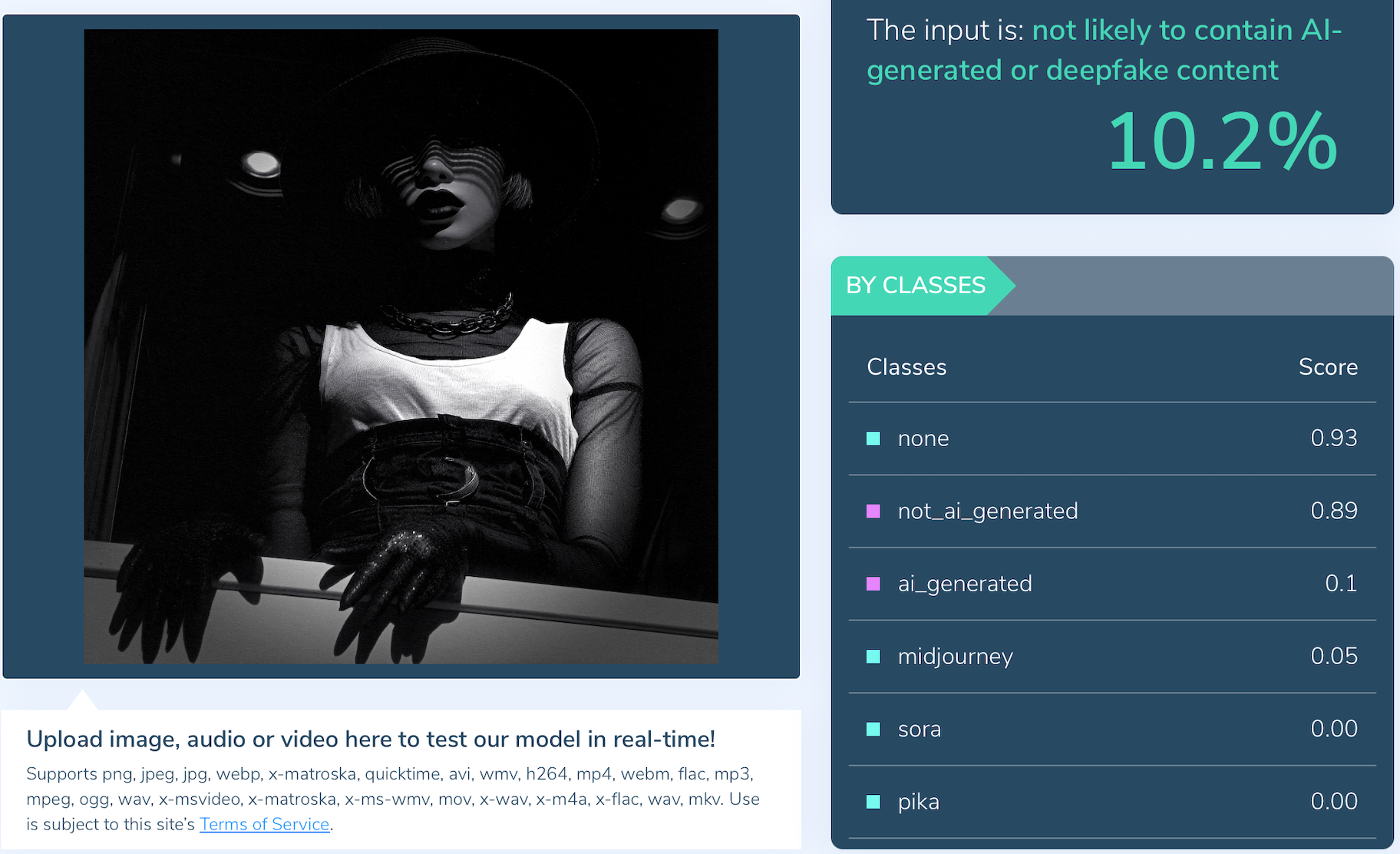
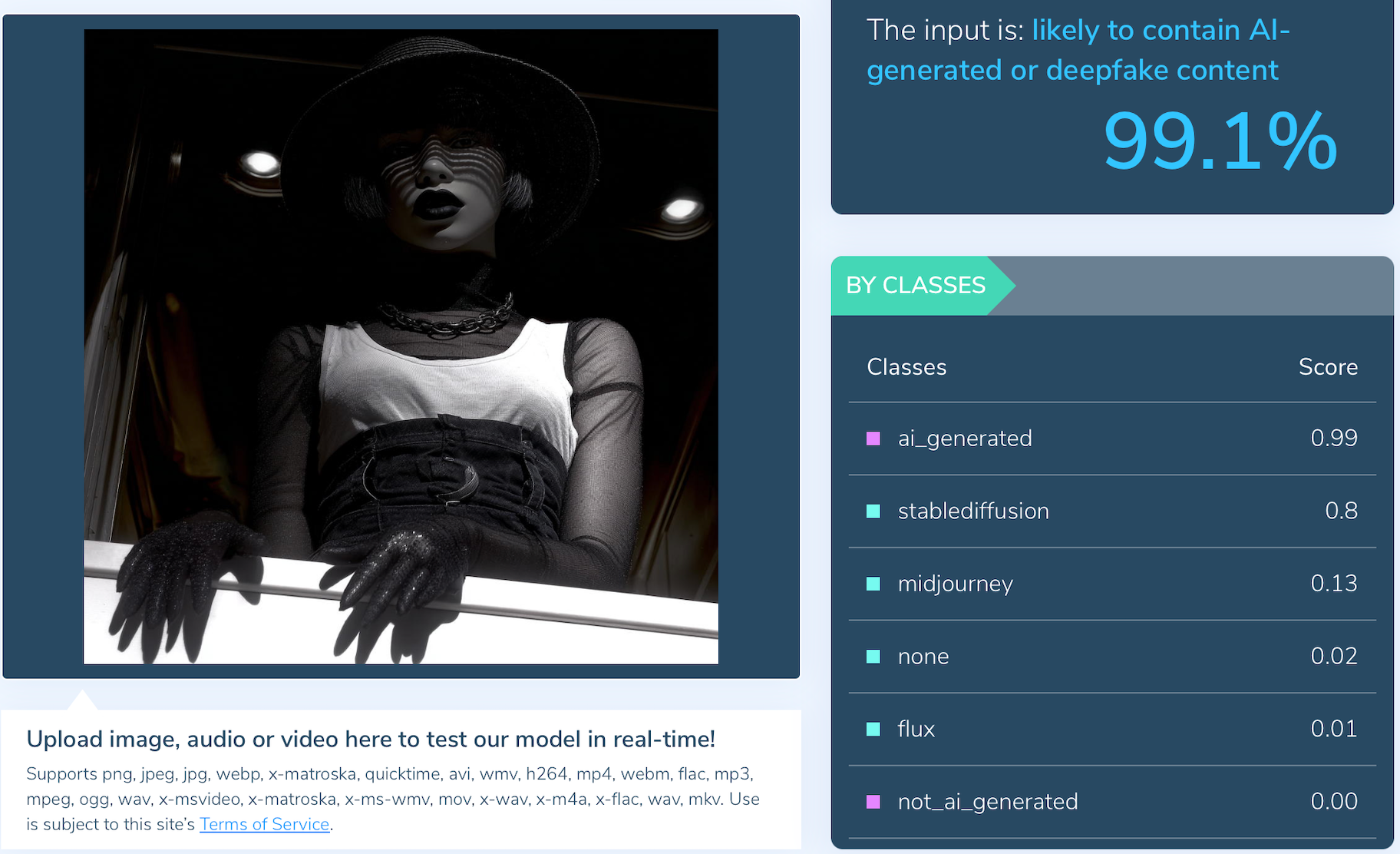
That’s not detection.
That’s pattern superstition.

In regulated science, no system can touch a patient or a process without formal validation — a rigorous, independent audit proving it performs as claimed, across time, environment, and operator.
Without validation, you’re not measuring the world.
You’re reproducing an error with greater confidence.

And yet governments, publishers, and institutions are already integrating these unvalidated detectors into policy, grading, and censorship workflows.
History should have warned us.
Look at the UK Post Office scandal — software treated as infallible, oversight ignored, lives destroyed.
Now imagine that logic extended to every artist, writer, or photographer accused of “using AI” by a mis-trained model.

We don’t name the tools.
They don’t deserve the credibility of citation until they’ve been certified.
Only a validated system — trained, tested, and audited within a known corpus — can be trusted to interpret authorship.

That’s why our own AOF infrastructure stays sealed within what we call the Walled Garden.
Our models are trained exclusively on decades of in-house data: music, images, text, 3D renders — all traceable to original source.
We know every pixel’s origin because we were there when it was made.

In 2026, we’ll begin teaching other artists how to do the same — how to build ethical, closed-loop AI systems that can be validated like scientific instruments.
This won’t be free. Sustainability demands reciprocity.
Our subscriptions remain finite because once the gate closes, it stays closed.

The message is simple:
If a detector isn’t validated, it isn’t the truth.
It’s just a mirror reflecting the bias of its creators.
And the more it’s used, the deeper that bias becomes baked into the world.

Art of FACELESS | Instagram | Linktree
View artoffaceless’s Linktree to discover and stream music from top platforms like Spotify, Apple Music here. Your next favorite track is just a click away!

Share this post
Comments

Be the first to know

Join our community and get notified about upcoming stories

Subscribing...
You've been subscribed!
Something went wrong
The Architecture of the Occupied Mind: Cognitive Colonisation in the Age of Algorithmic Hegemony
The Architecture of the Occupied Mind. ©2026 Art of FACELESS

The Architecture of the Occupied Mind: Cognitive Colonisation in the Age of Algorithmic Hegemony

By The Art of FACELESS Research Division Abstract While traditional colonialism sought dominion over territory and resources, the defining struggle of the 21st century is the battle for the "territory" of the human imagination. This paper establishes the Art of FACELESS (AOF) definition of Cognitive Colonisation™—a term for which we hold the pending trademark—not merely as a cultural critique, but as a precise mechanism of epistemic control. By deconstructing the transition from legacy media


FACELESS

FACELESS

Is The Face the Final Frontier?

Is The Face the Final Frontier?

They told us the future would be about flying cars. Instead, it was about facial recognition and the spectre of algorithms. "The Hollow Circuit" is not fiction; it is a hyperstitional framework for understanding how we lost ownership of our own identities. myfacebelongsto.me is not just a track; it is a reclamation. In a sea of sludge and algorithmic noise, Art of FACELESS presents a human/non-human-crafted warning: When you stare into the black mirror, who owns the reflection looking back?


FACELESS

FACELESS

Why Your Image Is Now a Liability: Authenticity, Identity, and the Age of Deepfakes
Photo by Jesús Rocha / Unsplash

Why Your Image Is Now a Liability: Authenticity, Identity, and the Age of Deepfakes

For more than a decade, digital culture has promoted a simple rule: attach your real name and face to your work, and people will trust you. This logic shaped influencer culture, founder branding, and even professional networking. Visibility was framed as authenticity, and authenticity was framed as credibility. That equation no longer holds. In fact, in an era defined by generative artificial intelligence and deepfakes, the public promotion of one’s image and name has shifted from an asset to a


FACELESS

FACELESS

NEWS: Project "Alt.Cardiff2026" Launch Details

NEWS: Project "Alt.Cardiff2026" Launch Details

We are proud to announce the release structure for the upcoming graphic novel series, Issue #1: The Church Street Valyphos in the ZineGlitch comic Alt.Cardiff2026. To ensure the project meets all Online Safety Act (OSA) guidelines while preserving artistic integrity, the release will be tiered: 1. The Zine (Standard Edition): Available via Itch.io and Print. Features the core Noir narrative. Rated 15+. 2. The Null Gate (Subscriber Edition): Available via Patreon. Features the "Director's Cut


FACELESS

FACELESS