


When I first brought a digital Canon body to cover a major sporting event in the late ’90s, I remember the glances. It wasn’t curiosity; it was pure, unadulterated disdain.
The old guard—seasoned shooters with Nikon film rigs, their yellow-badged credentials identifying them as the elite for the nationals—looked through me like I’d shown up in Crocs to a funeral. One veteran, eyes fixed on my "toy camera," muttered it loud enough for me to hear. To them, I was a shortcut artist, someone bypassing the sacred chemistry of the darkroom for the soulless convenience of a sensor.
Isola Girl circa 2015 by @ichbinLloyd #photography pic.twitter.com/ZKZDlX7KE1
— ichbinLLOYD (@ichbinLLOYD) September 2, 2025
All I wanted to do was file sharp images fast. They were guarding a legacy, a craft built on the tangible and the chemical. I understand that now, and I respect the weight of what they felt was slipping away. But at the time, it stung. It felt like being told your vision didn't count because your tools were too new.
What stings more is how familiar it all feels now.
I’ve spent the last year watching the creative community tear itself apart over what counts as "real." We are witnessing a cycle of history repeating itself, fueled by a fear that has bred a new, aggressive kind of purism. It is a sentiment I recognise instantly from those early days of digital: if it isn't oil on canvas, if it touched a machine, if it was rendered, composited, or iterated through an algorithm, it is deemed suspect. It is "cheating."
But here is the thing: I’ve lived through the tools changing, the gatekeepers shifting, the new kids arriving, and the old rules shattering. I don’t fear the tool; I watch what the hand does with it.
Central Square. #Cardiff #Photography #Lumix by @ichbinLLOYD pic.twitter.com/kppcpNcPfT
— ichbinLLOYD (@ichbinLLOYD) February 15, 2026
The Digital Archive: Why I Stay
This brings me to my presence on X (formerly Twitter). My account, @ichbinLloyd, has been active since 2010—the heady, optimistic days of the platform. Today, the landscape of that site has changed. Owners have shifted, policies have mutated, and the cultural "vibe" is often unrecognisable from the era of the Fail Whale. Many have fled, and I understand why.
However, I have made a conscious choice to keep @ichbinLloyd alive and active as a living archive. For me, it is a matter of provenance and historical importance. Irrespective of the current ownership or the shifting sands of platform policy, that account serves as a chronological ledger of a creative evolution.
- The Narrative Thread: It captures the transition from pure photography to the complex, multi-layered digital workflows I use today.
- The Public Record: In an era of ephemeral content, there is value in a long-form, public-facing history. It proves that these ideas didn't emerge from a vacuum; they were built, tweet by tweet, frame by frame, over fifteen years.
- The Resistance: To delete it would be to erase a decade and a half of digital footprints. I keep it going because the work deserves a home that acknowledges its roots in the "Old Internet," even as it pushes into the new.
Cardiff Bay Barrage — July 2012
— ichbinLLOYD (@ichbinLLOYD) October 28, 2025
Black and white photograph © Lloyd Lewis
Taken on a humid afternoon when the tide was turning.
The small boat crossed a threshold — fragile, deliberate — and I remember thinking how much effort it takes to appear calm.
I was working too many… pic.twitter.com/sZq1wb2EBg
The Reality of the Process
My work today is dedicated primarily to black and white imagery, but the process is far from "point and shoot." It is built from hours of lighting, texture work, post-processing, and layering—sometimes in Photoshop, sometimes in 3D software. Sometimes in vintage cameras and legacy lenses. Sometimes hand-developed in the kitchen. Nothing is automatic. Even when the software "thinks" for you, you still have to see. You still have to decide when the shadows are deep enough or when the grain feels like a memory rather than noise.
We are all working under the algorithm now. If you think a brush in Procreate is more "real" than a 3D scene lit and composited by hand, that’s your line to draw. But mine is drawn elsewhere. I’ve already lived through the panic once. Film to digital didn’t kill photography; it liberated it. It changed the language, but the story remained the same. Just like Photoshop did. Just like Blender did.
Just like AI might.
I am not here to defend any specific system or to reject the future out of hand. I am here to make, to explore, and to put memory and nerve into every frame.
A Postscript: On Platforms, Puritanism, and the OSA's Useful Idiots
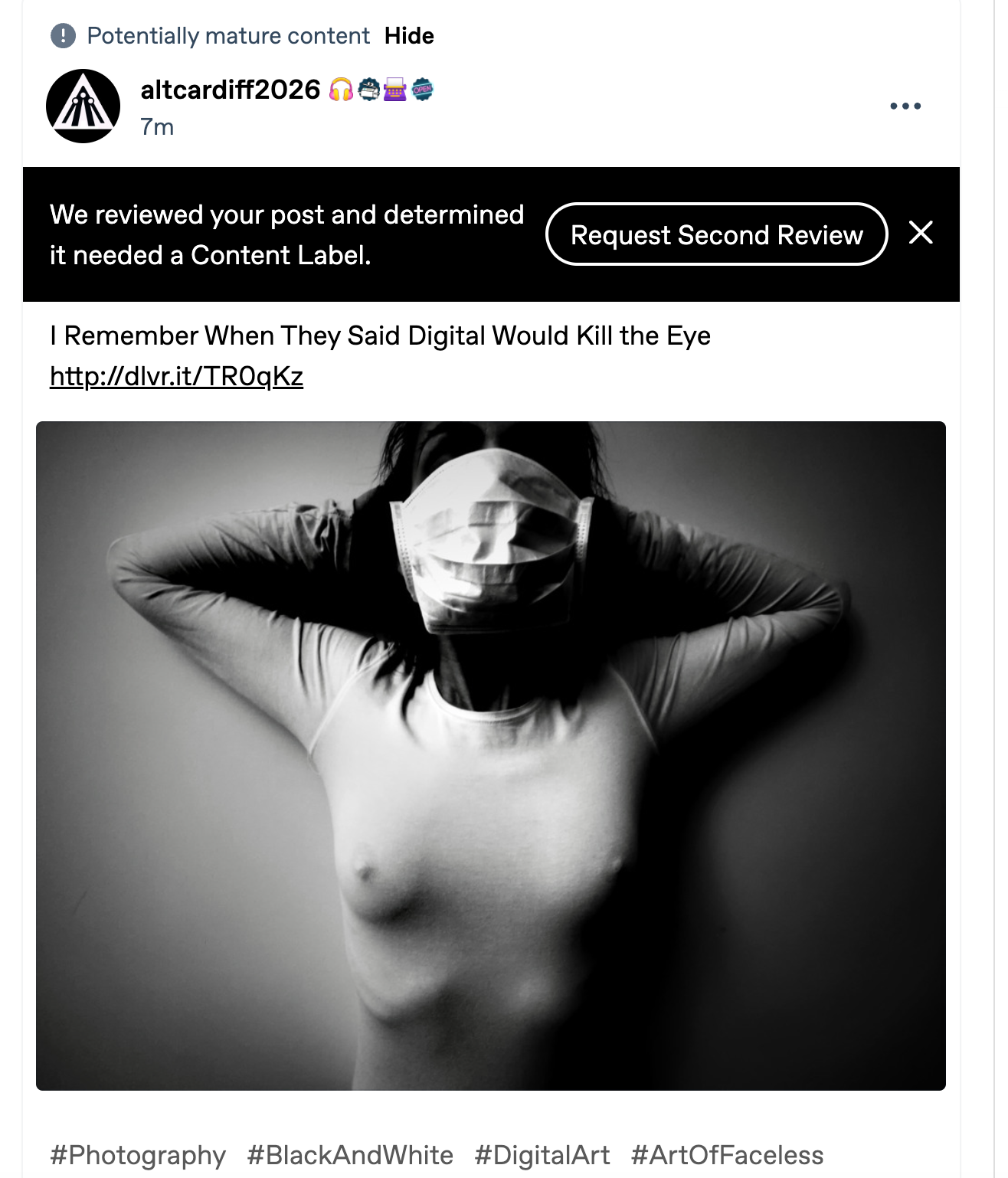
The featured photograph is from 2012.
In 2012, it was art. It was published without restriction, without warning labels, without algorithmic shame. It was exactly what it appears to be: a black and white study of the human form, masked and anonymous — a deliberate, considered image made in a tradition that stretches back to the first photographer who ever pointed a lens at a person.
Today, Bluesky labelled it "mature content." X throttled it into invisibility. Tumblr added a content warning. The platforms have decided, apparently, that your eyes need protecting from it.
I want to be precise about what this means in practice, because the platforms won't say it out loud: this photograph now carries the same content classification as explicit pornography. The same gates. The same warnings. The same assumption is that you, the adult viewer, cannot be trusted to make that distinction yourself. Because apparently there is no meaningful difference anymore — not in the algorithm's cold arithmetic — between a decade-old, fine art photograph and someone deepthroating a penis.
Read that back. Sit with it.
We warned this was coming. Not once. Not in passing. For years, this space documented the creeping logic of "we must protect the children" — a moral panic that was always, always, going to end here: with adults being treated like children, with art being processed through the same filters as abuse material, with the female form becoming legally and algorithmically indistinguishable from something shameful.
The Online Safety Act didn't arrive without a warning track. The platforms didn't capitulate to it in silence. We watched it happen. We named it. We called it Cognitive Colonisation — the systematic replacement of your own judgement with someone else's framework, until you can no longer tell the difference between protection and control.
Here is the question no platform will answer: why should any woman feel that a photograph of her body is something that needs to be hidden from the public? What exactly is being protected here, and from whom? Because the image hasn't changed. The subject hasn't changed. The only thing that changed is the law, and the platforms' enthusiasm for compliance.
Mastodon didn't flag it. LinkedIn didn't flag it. Two platforms, different ends of the spectrum, both apparently capable of distinguishing between art and pornography.
The rest have failed that basic test — and in doing so, they haven't protected anyone. They've just taught another generation that the human body is inherently sexual, that women's bodies require content warnings, and that 40 years of photographic tradition can be overridden by a parliamentary act and a neural net with no aesthetic education whatsoever.
We're past the point of requesting second reviews.
— Awen Null / Art of FACELESS