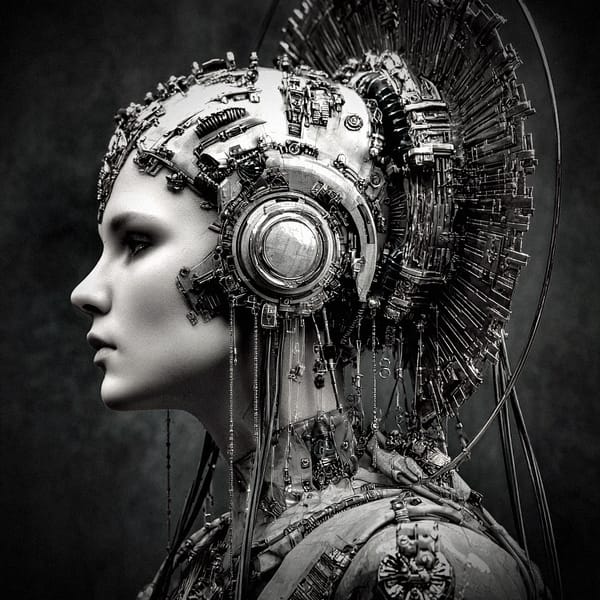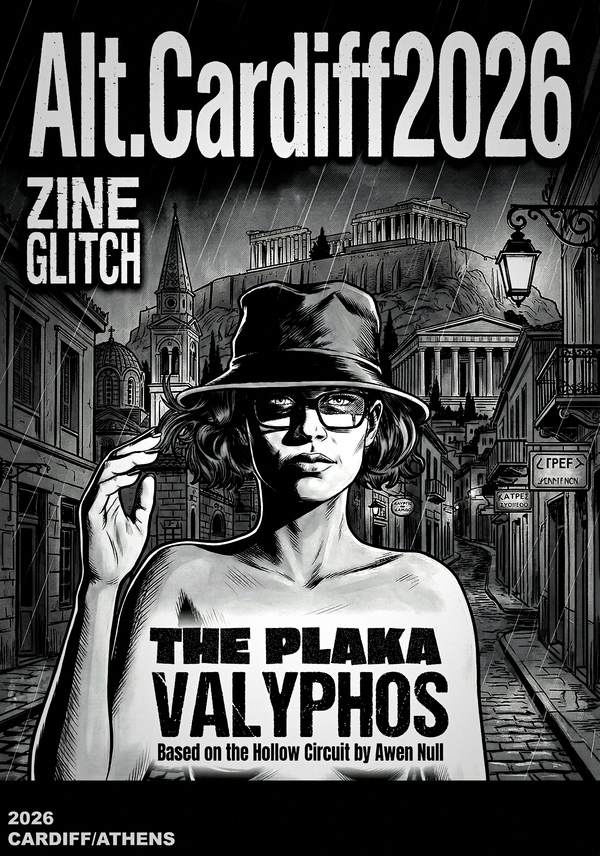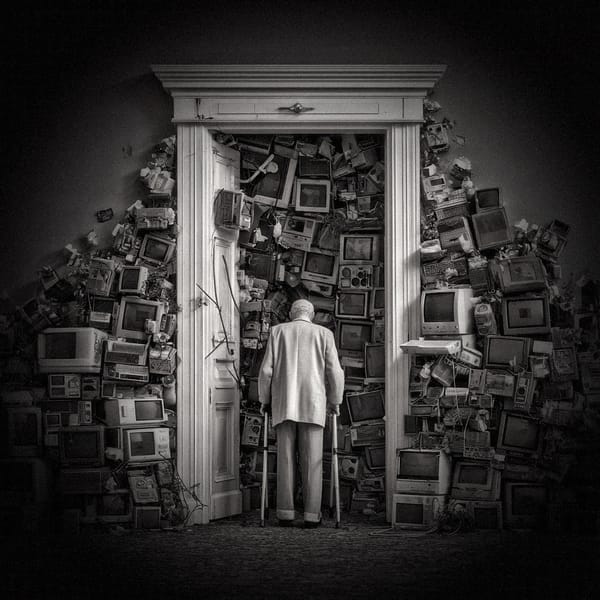
The spoken-word multimedia project Dark Kittens by Awen Null — presented as a widescreen subtitled video with sonic composition by Lloyd MSUX — stands at the intersection of literature, sound art, and moving image. At first glance, the work may seem like a straightforward reading, a poet’s voice laid over a musical backdrop. Yet closer inspection reveals something more complex: a deliberate act of resistance against clarity, a work that situates itself in the gaps and glitches of transmission. This essay examines Dark Kittens through the lenses of metaphor, form, and media theory, and considers what the project contributes to the ongoing discourse of poetry in the digital age.
The Voice and Its Discontents
The spoken word is often treated as a return to origins — the oral tradition, the intimacy of the human voice. In Dark Kittens, however, the voice resists such romanticisation. Delivered in a manner that is neither theatrical nor neutral, the reading bears the cadence of interference: it is steady yet unstable, confident yet fragile. The poem is not performed as an authoritative statement but as a haunted transmission, as though it has travelled across fractured channels before arriving in the present.
The subtitle treatment intensifies this instability. Words are not only heard but seen, and in being seen, they become data. Subtitling, in this context, does not simply provide accessibility but acts as a form of doubling, a second register where language is transformed into visual code. The viewer encounters language in two modalities at once, and this simultaneity destabilises the authority of either. Voice and text do not align seamlessly but rub against each other, producing what Homi Bhabha might describe as a space of slippage, where meaning is unsettled (Bhabha 1994).
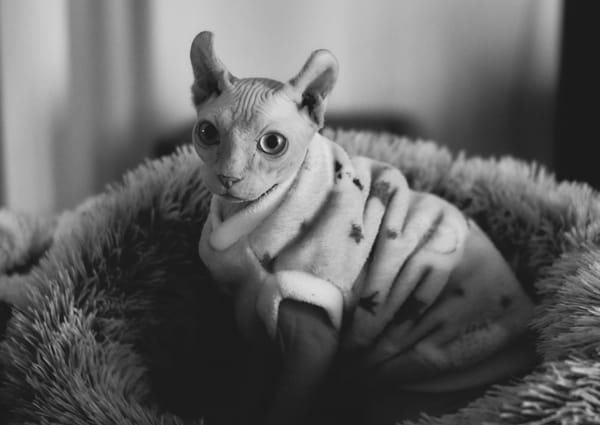
The title itself, Dark Kittens, carries metaphorical weight. The kitten is an avatar of fragility, a figure of innocence that nonetheless survives within hostile conditions. To render the kitten “dark” is to mark it with obscurity, to remind us that survival is often compromised, shadowed, incomplete. The kitten survives not because it is pure but because it adapts to static. In this sense, the poem’s voice is both the kitten and its static, presence, and interference in equal measure.
Sonic Architecture
The soundtrack by Lloyd MSUX is more than accompaniment; it constructs the atmosphere in which the voice operates. Pulses, reverberations, and tonal shadows interweave with the spoken word, forming an acoustic architecture that both shelters and destabilises the text. Where the voice falters, the sound undergirds it; where the voice insists, the sound erodes it.
This interrelation enacts a metaphor of memory. The voice is never heard in isolation but is always-already embedded in soundscapes, histories, and background frequencies. Just as memory is inseparable from the echoes that surround it, so the poem cannot be extricated from the music. The soundtrack functions as an auditory environment, staging what Mark Fisher might call “hauntology”: the persistence of past sounds within present articulation (Fisher 2014).
In doing so, the project resists the hierarchy that places words above sound. Instead, voice and music coexist as equals, bound together in a dialectic of interference and support. The work refuses to let poetry stand apart from the noise of its time.
Video as Translation
Visually, Dark Kitten presents itself in widescreen with embedded subtitles, positioning the piece between cinema, zine, and archive. Rather than illustrate the text, the visuals displace it, producing a mode of “translation” that is inherently unstable.
Translation, as theorists from Walter Benjamin to Gayatri Spivak have argued, is never neutral. To translate is to transform, to fracture, to lose, and to gain. In Dark Kittens, subtitling becomes an act of translation that exposes rather than conceals the impossibility of perfect transfer. The words on the screen are not the same as the words in the voice. The gaps between them create new meanings, new ambiguities.
This displacement resonates with Jacques Derrida’s concept of différance: meaning is always deferred, never fully present, sliding between signifiers (Derrida 1982). The kitten is “dark” not only because of its metaphorical shadow but because its meaning refuses to settle. Subtitles, widescreen composition, and sound all conspire to keep meaning in motion.
Survival in Static
What emerges from this convergence of voice, sound, and video is a meditation on survival under conditions of distortion. The kitten does not thrive because it is protected; it persists because it can exist in static. Vulnerability becomes resilience, not through clarity but through opacity.
- The voice asserts presence yet acknowledges fragility.
- The music encircles, destabilises, but also carries.
- The video fixes language but fractures it in translation.
Together, they perform a central claim: in an age of surveillance, censorship, and digital reproduction, survival demands unreadability. To be too clear is to be consumed. To persist, one must glitch.
Art of FACELESS Context
Within the broader framework of Art of FACELESS, Dark Kittens exemplifies the ethos of multimedia resistance. It refuses the purity of medium, collapsing boundaries between poem, soundtrack, and moving image. What results is not a singular artefact but a signal — an event that resonates across modalities, leaving traces long after playback ends.
This strategy aligns with AOF’s guiding principle: that art in the present must operate as both archive and glitch, memory and resistance. Dark Kittens is less a poem than a proof of concept: a demonstration that vulnerability can itself be weaponised, that fragility can resist consumption by refusing to conform to any one channel of meaning.
Conclusion
Dark Kittens is a work of haunting rather than closure. It resists definitive interpretation by dispersing itself across voice, sound, and image. Its metaphors of fragility, distortion, and survival resonate within the conditions of contemporary art-making, where clarity is often complicit with control.
In this way, the project exemplifies what the Art of FACELESS archive seeks to enact: a refusal of singularity, an embrace of glitch, and a commitment to survival through opacity. The kitten is dark, not because it is broken but because it has learned to endure in shadow.
References
- Benjamin, W. (1996). Illuminations. London: Pimlico.
- Bhabha, H. (1994). The Location of Culture. London: Routledge.
- Derrida, J. (1982). Margins of Philosophy. Chicago: University of Chicago Press.
- Fisher, M. (2014). Ghosts of My Life: Writings on Depression, Hauntology and Lost Futures. Winchester: Zero Books.
- Spivak, G. C. (2000). “The Politics of Translation.” In The Translation Studies Reader, ed. Lawrence Venuti. London: Routledge.



![Dark Kittens [spoken word]](/content/images/size/w600/2025/10/photo-1695124121977-f0722c3999fe.jpeg)