Initializing...

An Interview with Awen Null
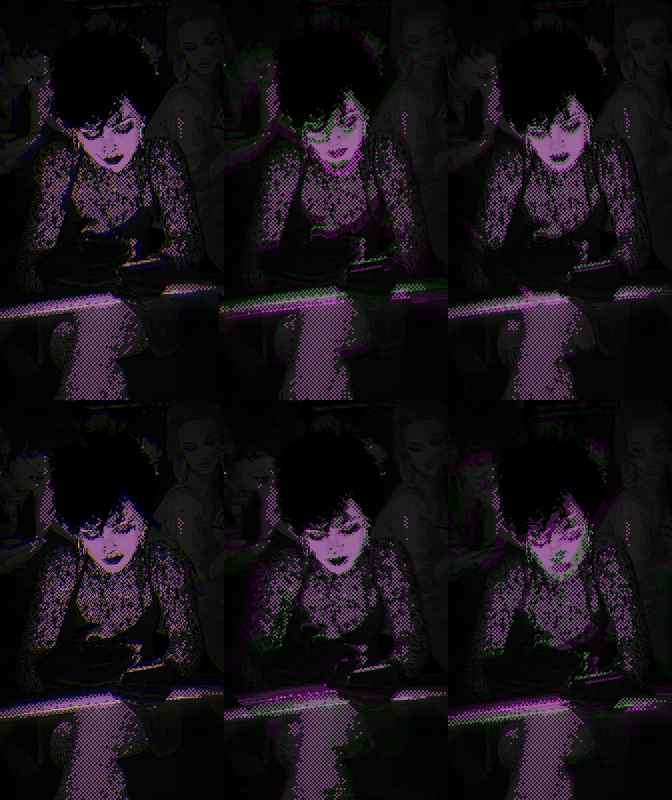
A self-portrait collage of Awen Null, Rat Alley, Cardiff 2025. ©2025 Art of FACELESS

An Interview with Awen Null

"AOF gave me a place where identity could be fluid without becoming spectacle. A place where I could speak as several selves without turning it into performance art or confession." –Awen Null

Share this post

Conducted by Lloyd Lewis for Art of FACELESS


There are moments in an artist’s life when the borders between selves narrow, not into confusion, but into clarity. When the work you create shapes the person you are becoming more than the other way around. Speaking with Awen Null, the architect of The Hollow Circuit, feels like meeting the quiet twin of a future civilisation — someone who has lived too many lives to speak plainly, yet speaks plainly all the same.

We meet in a dim upstairs room of a Cardiff café, midway between rain showers. I ask the first question softly, not as a journalist but as someone who’s watched Awen’s work latch itself to the architecture of the internet like a living organism.

LLOYD: Let’s start at the beginning. When did The Hollow Circuit first become real for you — not as a concept, but as a world that wanted something from you?

AWEN NULL:
“I don’t think it ever ‘became’ real. I think it always was. My job was to get out of its way. The Circuit doesn’t behave like a world I invented. It behaves like a world that sought me out. A signal waiting for someone with the right kind of fractures for it to travel through.”

Awen smiles at this, not self-consciously, but with the calm of someone who has long accepted the odd routes through which inspiration arrives.

LLOYD: You often speak of fractures. You’ve lived with neurological disturbances since 2011 — early hallucinations, twin figures, the rats… How does that history interact with your work without you being defined by it?

AWEN:
“It’s part of the terrain I walk. Not a tragedy — a terrain. People assume that hallucinations are breaks from reality. For me, they’re breaks in the permissions we give ourselves about what reality is allowed to do. Those two twin women, for instance — they weren’t delusions in the literary sense. They were conversations I was already having with myself, projected outwards so I could listen more clearly.”

They pause.

“And The Hollow Circuit listens back. It grew from the same neurological soil. Not as autobiography, but as resonance. The AOF approach — facelessness, multiplicity, refusal of fixed identity — made it possible to write honestly without having to collapse those experiences into diagnoses or explanations.”

The rain begins tapping against the window. It suits the tone.

LLOYD: Art of FACELESS has become intertwined with the novel — almost one organism. Was that planned?

AWEN:
“Planned? No. Necessary? Yes.
AOF gave me a place where identity could be fluid without becoming spectacle. A place where I could speak as several selves without turning it into performance art or confession. In the early drafts of THC, I kept trying to write ‘normally’ — one voice, one author. The book resisted. It wanted multiplicity, recursion, collapse and reformation. It wanted a publishing ecosystem that behaved like the novel behaves.”

They lean forward slightly.

“AOF is not a brand. It’s an architecture that lets The Hollow Circuit exist without being domesticated.”

LLOYD: Readers will sense that the novel is written by someone who has lived with thresholds — neurological, emotional, creative. Do you think your condition changed the trajectory of the book?

AWEN:
“It changed the trajectory of me. And the book grew from that trajectory. SPMS brought strange openings — not romantic, not desirable, but real. When you begin to see things that aren’t physically there, you also begin to see things you’ve ignored: memory fragments, ghosts of versioned selves, timelines you didn’t live but might have.
The Hollow Circuit is built on that idea — alternate Veylons, recursive worlds, narrative grafts.”

They gesture gently.

“But don’t misunderstand me. This isn’t a mystical take on illness. It’s simply an acknowledgement: the brain is not a static vessel. Mine happens to be… porous. The work uses that porosity as material, not metaphor.”

LLOYD: Do you think readers will interpret this as fiction? Or as confession? Or as something between?

AWEN:
“I hope they don’t settle too quickly. Certainty kills art. Let the reader hover. Let them wonder: who is interviewing whom? Who wrote which parts of which world? Which voice is primary?
The trick is that none of that matters. The Hollow Circuit doesn’t want to be solved. It wants to be inhabited.”

LLOYD: Where does Awen Null end and The Hollow Circuit begin?

Awen laughs — quietly, with a hint of exhaustion, but also with relief.

AWEN:
“Oh, mate. If I knew that, the book would be over.”

They settle into the chair, the collage of their other selves mirrored faintly in the dim window behind them.

AWEN (continuing):
“Identity is an outdated operating system. AOF understands this. The Hollow Circuit understands this. We don’t write to present a face. We write to dissolve one. Everything else is irrelevant.”

I close my notebook, though there is more I want to ask. Awen’s presence carries the gravity of someone who has lived ten different creative lifetimes through one imperfect, unpredictable body. The interview feels less like a conversation and more like an artefact pulled through a Valyphos — two voices pinned to the same axis, neither canceling the other.

Outside, the rain has stopped. The city hums. And The Hollow Circuit — in whatever timeline it chooses next — continues writing us both.

Feature Image: A photographic collage selfie of Awen Null.

Art of FACELESS | Instagram | Linktree
View artoffaceless’s Linktree to discover and stream music from top platforms like Spotify, Apple Music here. Your next favorite track is just a click away!

Share this post
Comments

Be the first to know

Join our community and get notified about upcoming stories

Subscribing...
You've been subscribed!
Something went wrong
A Quiet Realignment
Photo by Deniz Altindas / Unsplash

A Quiet Realignment

Art of FACELESS Art of FACELESS We’ve spent the past week taking a long, unsentimental look at what it means to exist on the modern internet — not the nostalgic version full of community and conversation, but the real architecture: an attention economy, a surveillance layer, and a network that scatters identity until nothing meaningful remains. AOF has always been built on one principle: Facelessness is Freedom. Not vanishing. Not hiding. But choosing how and where we appear — and refusing


FACELESS

FACELESS